Showing posts with label braiding. Show all posts

Thursday, December 11, 2025

Andean-style braiding progress since the last post

There's not much progress, honestly, but I am doing things at spare moments.

I finished the zigzag braid.  I like it and feel like I'm slowly getting better at the physical movements and am understanding more of the theory behind it.


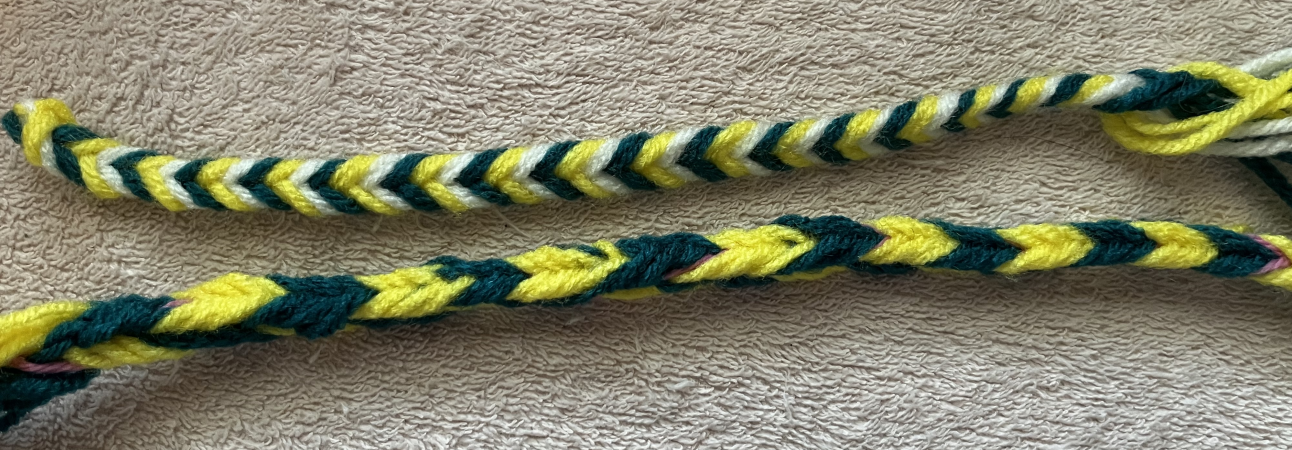
Then I started a new braid.  This braid has one side twisting clockwise and the other side twisting counterclockwise, to make a braid that is a straight square instead of a spiral.  This is a pretty common braid that can be made in several ways.

I wanted to try this braid to see if I could match the braiding pattern on a photo of a sling from the Silk Road area (in Asia) that I saw in an online museum archive.  I'm not quite there yet but I am getting to practice a couple of new things.

It's an intentional pattern design so I have to keep track of which strand goes where and when.  Also, the colors are aligned vertically rather than spiraling, which means alternating the twisting directions on the N/S versus the E/W sides.  And one side is all the same color, so I have to keep track of which thread is the lower vs the upper, the left set of threads vs the right, and so on.  One additional thing is that this is in a fairly thick cotton yarn; dunno if that adds anything to the complexity but it is different from doing it in a fairly thick acrylic yarn.


As with other braids I've tried, I started in the middle, braiding the square braid with 4 strands (3 white and 1 green).  Then I joined the ends together into a loop, and continued downwards with 8 strands.

My braid isn't perfect but it's getting better as I make various mistakes, realize what's going on, and then try to improve.

In addition to looking through Adele Cahlender's book on Andean Sling Braiding, and through Roderick Owen's books, I also used Jean Leader's explanations from this page on her website: https://www.fascinatingbraids.com/sling.html and in particular, her instructions on Sling Braids with Spirals and Stripes.

I'm not sure what's next.  I do want to make a few hemp slings and share them with my friends.

Everything else is on the to-do list, too.  But life is busy, and other things often take priority.  Although I do fun things when I have a chance, I don't always end up with something interesting to photograph or write about.

Wednesday, November 12, 2025

Yet another novice level post on Balearic-style slings and Andean-style braiding


Zigzags!  I've done a zig and a zag and have started the next reversal.  I'm trying to do about six repeats between reversals, though I'm not keeping track all that closely.  My consistency is improving, yay!  And I think my understanding is improving, too.  I guess I'll find out as I keep braiding, start the next braid, etc.


I've also made another sling using the same instructions and methods as last time.  Hmmm, the sling is a bit less than a meter long, so I do think I'll make the next one longer.  The first one is also a bit less than a meter long.  This second one has a slightly longer pouch but a slightly shorter finger loop.  The release cord is about an inch longer than the retention cord (when I fold everything in half around the middle of the pouch).  I had thought the two would look and feel a bit different from each other, but no, they don't!  So I guess I have a ways to go before I'm content with the consistency of the braiding.  Or maybe this is good enough and I'm too picky.

I might soak this one to see if that makes a difference in how it looks, whether it stretches out or evens up, etc.

Dunno what I'll make next.  Maybe do this one again, but maybe a bit longer and maybe with 5 strands instead of 6.  Or 10 instead of 6.  Or try a braided sling with a woven pouch.  I guess I'll see what inspiration strikes.

I'm also starting to feel like I want to start some tablet weaving projects.  I'm not sure how much longer it'll be until I can set up my little weaving area again.  The sling-braiding and the fist-braiding don't take up much room and can be done anywhere.  For various reasons, weaving takes up more space and needs a dedicated spot where I can walk away for a few hours or a few days and things can be resumed without too much trouble.

I believe that's it for me today.

Sunday, November 9, 2025

More sling chatter (and a new braid)

I showed my first sling to someone who knows how to use a sling.  This person confirmed that it looked and acted like a perfectly reasonable sling, yay.  This person usually makes slings by attaching paracord to a sling pouch made of duct tape.  I love that slings are so low-tech with so many ways to make them from whatever convenient items are in your local environment.

I've started another Andean in-the-fist braid.  I tried with 8 strands (4 strands folded in half) first.  It was difficult for me to see which was the lower and which was the upper strand.  So I cut another set of strands, and I'm doing another braid the same way I did the first.  It's going well.  I'll probably start zig-zagging soon, and then, depending on how much yarn is left when I get tired of that, will try some other variations.  At some point I will return to 8-strand braids!  Though it amuses me that the 16-strand braid is easier to learn on.

I've also tried a new-to-me braid.  I'm pretty sure I've done something very similar using a different technique.

It's from a youtube video on making a sling.  It's in Spanish, so they of course use the local terminology of Honda or Waraka.  Here's part 1, which shows the braid and the first half of the sling's construction: https://www.youtube.com/watch?v=KMJAAkhHcZE and here's part 2, which shows the woven split pouch and the rest of the sling's construction: https://www.youtube.com/watch?v=Kw1chCl6fXs&t=616s

The finger loop, made with 4 strands, is the standard 4-stranded cord made all around the world.  I like this particular method, where diagonally opposite strands twist past each other, alternating the twist direction.

Then it's joined, and the new braid is a braiding technique I've not done before.  It's a 4-strand braid (each strand has two pieces of yarn).  I'm pretty sure I've done this braid structure on a marudai and also through fingerlooping.  But this is a freehand braid, and it's kind of cool-looking and fun to do.

Not that I'm perfect at it or anything.

The video demonstrates the sling construction using a fairly thick single-ply yarn.  Interesting.

I wonder if I should do a track plan and compare it to the other braids I believe this resembles?

The braid is slightly elastic, though more so in compression than in tension.


I only used enough yarn to play around with the braid rather than doing a full sling.

The split pouch is one of the styles I see in the books (and websites and videos) on Andean slings I have access to.  I'm looking forward to trying it when I decide to make that style of pouch on a sling.

I wonder what the braid would be like if I use more than 4 braiding elements?  Also, will I get faster with time, and how will that compare with other braiding techniques?  The braid in the video was secured at the top, while I was randomly holding onto it while braiding.  Maybe I'd be faster if it was hooked to something.

I have no idea whether this is a traditional technique or a more modern shortcut.

My stash of random acrylic is getting low.  I also use it for charity knitting and share it with another charity knitter/crocheter.  We're both fairly productive; there's not much left.  My second in-the-fist braid is using different colors because some of the skeins of yarn I used in the first braid are now with my friend, being turned into charity hats.


Thursday, November 6, 2025

A braid pic (first try at Andean-style braiding in the fist)

It's not quite done, but I'm making progress.


You can see how I'm finally getting the hang of things.  The braid is properly spiraling, yay!  And my tension is starting to become more consistent.

I'll work on this for a little while longer, but the strands are getting short.  They are not even in length -- I must not have adjusted the tension/evenness very well when I first started.

After this, I think I'll play around with 8 strand braids for a little while.  (The above braid is a 16 strand braid.)  There are some fun variations that seem very logical in their construction/development when I look at the charts in Cahlender and the Owen and Owen/Flynn and Tada books.  So I'll check them out.  Owen and Tada make charts for the marudai or square disk, but it's straightforward enough to generalize them back to in-the-fist braiding, I believe.  If I understand and can make the various 8-strand braids for realz, it'll be a good sign for when I return to the 16 strand braids and beyond.  It'll also help me to continue gaining the physical finger skills to make my braids more consistent and more efficient to braid.  And heck, I can always use a marudai or disk for any of these braids if I want to.

I've wandered into a bunch of fun videos in Spanish on slings and Andean-style braiding and cordage.  I don't know enough Spanish to follow all the details of what is being said.  But I recognize some of the words and I can certainly watch what's happening in the video part of things.  It's a nice complement to English-language sling-braiding videos.  And it's also a nice complement to the many videos I enjoy watching about other kinds of braiding and narrow wares, in whatever language they may be in.


Tuesday, November 4, 2025

Andean/Tibetan-style braiding in the fist and other sling-related baby steps

No pics yet, but I'm starting to learn how to do this, yay!

I started with 8 strands (of acrylic worsted weight yarn) folded in half, which is probably slightly more complicated than it needed to be, but it's giving me a lot of good info on what not to do and why.

My baby braid is very uneven.  Hopefully it'll be a lot better by the time I'm done.

I used 4 different colors -- one color each for lower N/S, upper N/S, lower E/W, and upper E/W.  That way, it's easier to keep track of each level and what it's doing.  I'm doing the same moves each time and am getting a square braid with vertical stripes.  I'm not fully sure why it's not spiraling like it seems to do in a lot of Youtube videos, but it looks about right compared to my in-print resources and according to what my brain thinks is happening.  Or maybe not.  I guess this is one of the things that will become obvious eventually.

One I finish mangling this braid, I'll retreat to 4 strands folded in half (2 threads per side instead of 4) and try again.

I do understand the underlying theory of having upper and lower threads, with the lower threads being the ones that move.  I understand the idea of crossing the strands clockwise or counterclockwise, and I also understand rotating 90 degrees to do each side in turn.  I'm sure there's a lot I don't understand yet, and probably am not even aware of not understanding.  But that's what this kind of learning is all about, right?

I'm getting comfortable with holding the braid in my fist along with the threads that are not to be bothered during the current braiding step.

I liked the starting method, which I saw somewhere I can't remember but is probably universally known and I just didn't know it.  Lay down the lower N/S threads, then the lower E/W threads, then the upper N/S threads, and finally the upper E/W threads.  I used a piece of thread to hold the cross in place for the first few moves.  One starts with braiding the lower N/W threads and goes from there.  The threads will not be locked into place for a round or two so it's possible to adjust where the middle is.

I will probably show a pic of my baby braid when it's done, baby missteps and all.

One of the goals, obviously, is to be able to make Andean and Tibetan style braided slings, in addition to making cool braids in general.

The braided sling I wrote about in the previous post is keeping me entertained.  I need something heavier to toss around -- cat toys don't have sufficiently predictable aerodynamic properties.  But not too heavy, since my accuracy is still garbage and I don't want to break anything with a poorly-aimed projectile.  What I really need is to find someone who is already a decent slinger to give me some good feedback.

My next bast-fiber sling might be with a 5-strand pigtail/herringbone braid.  I'll probably do the same basic design.  I do need to double-check how to split or join the braids at the pouch since I think it's slightly more complicated than doing it with a 3-strand braid.  After that, I might start experimenting with different ways to add a sling pouch.  Eventually, of course, I'll start tapering the various parts -- heavier near the pouch, perhaps more slender by the end of the release cord.  Not all historic slings do that but some do.

So many fun things to learn and play with!  (Netting!  Sprang!  More fingerloop braiding!  More tablet-weaving!  More inkle-weaving!  Kumihimo/marudai fun!  Etc.  So much etc.)


Sunday, November 2, 2025

A simple braided sling

My weaving area is still unavailable.  But I guess the sling-braiding itch got too hard to ignore.  Thus, a sling!


It's made from 6 strands of 48 lb hemp, in a simple 3-strand braid with a split pouch.  I followed the Dan Bollinger tutorial on slinging.org, here: https://slinging.org/20.html

His instructions are for a 1m sling.  He recommends starting with strands that are 2.8 times the length of the desired finished length.  So, for the 1m sling (39"), cut 6 strands at 110" each (280cm).  Braid the central finger loop for about 4", then join.  Braid about 14", split for the pouch.  Each side of the pouch is about 4" long, then rejoin and braid another 18".  Do an overhand knot (or some kind of sturdy knot) to finish, then trim the ends.

Hemp is hard on my poor fingers!

My braiding is not as consistent as I would prefer.  I'll have to see how well the sling works...  I'm also wondering if I should try waxing or oiling it, and what effect that might have.

This is similar to the Balearic style in that it has a simple pouch made from splitting the cordage for braiding and then rejoining.  A lot of slings use a leather pouch, or they sew a bit of leather or something to these split braids.  Or they weave a pouch that is incorporated into the braiding at each end.  Most of the tutorials I saw for Balearic slings had the release cord tapering at the far end, sometimes ending in a tassel made from much thinner material.  Many tutorials also did 5-strand pigtail braids rather than 3-strand.  And some were made from grass that was twisted into cordage as the braiding proceeded.  That made it easier to increase or decrease the size of the braids.  Some had thicker braids near and in the pouch area, for example, in addition to narrowing the release braid.

I still plan to do slings made from animal fiber (or maybe just acrylic yarn at first, and then animal fiber) and the fancier square braids, with various styles of woven/braided/sewn/etc. pouches.

But these quick bast-fiber braided slings are cute, too.

And yes, even with the delightfully amateurish construction, I am exceedingly pleased with myself.  I'll get better with more experience and with the feedback from actual real-life use.


Saturday, October 11, 2025

The demo/teaching thing


I did the demo/teaching thing referred to in the last post.  Most people took their braids, but a few were left behind, or were ones I did as part of teaching and demoing.

I mostly taught people the 5-strand unorthodox fingerloop braid, A-fell.  (though it was kind of slentre-like in that it was easiest to go through the middle finger loop on the way to the ring finger loop by holding my hands mostly palm-downwards rather than palms-facing)

For a few young children, I did twisted-loop cords with them.  One slightly older child learned the 7-strand fill-the-gap disk braid.  (I had a pile of disks with me for just that purpose)

A few people already had done fingerloop braiding, so we had fun with 5-loop orthodox braids (square, flat, and split/double), 7-loop orthodox braids (square and flat), 7-loop unorthodox braids, and the 7-loop pigtail braid done as a V-fell braid (load up 4 fingers on one hand and 4 on the other, and the empty little finger grabs the index finger loop of the other hand).  We also did a 4-loop loop-exchange braid, and I tried playing around a bit with various unorthodox 7-loop braids though none turned out so well that I needed to write them down.

As you can see from the above photos, people had fun choosing different colors to see what would happen.  With the unorthodox braids, sometimes the back side (the one that looks interwoven) is more interesting than the front side (the one that looks like Vs).

I also got to spin a bit, on both wheels and spindles.  Someone had some raffia and shared it around so we could all make some cordage (twist one side and fold it over/under the other side).  And as always I had my knitting with me and got a fair amount of knitting done.

It was fun, both the teaching and the hanging out with other people who enjoy playing with fiber.

My weaving area is still unavailable, so I haven't done much else in the way of narrow wares this month, at least not so far.  All the stuff mentioned in my last post is still on my want-to-do list.  We'll see what happens.

One of my feline weaving assistants has passed away.  She was old and it was sudden.  I'll miss her.  Yes, even her deeply non-helpful weaving assistance.


Monday, September 29, 2025

Thoughts for an upcoming demo/teaching thing (braiding)

My tablet-weaving area is still unavailable, thus no tablet-weaving or other narrow wares this past month.  I did do some real weaving on a rigid heddle loom.  I'm sure my experience with band weaving (tablet, inkle, heddle, etc.) helped as I did my first beginner-ish project.  If/when I do more weaving, I can add some narrow wares to use as handles and trim and what-not.

I've been asked to be part of a demo this weekend.  Specifically, I've been asked to demo/teach braiding, and in particular, fingerloop braiding.  I'll be in the family crafts area, so I'll be doing quick one-on-one teaching to people of all ages, plus or minus a bit of whatever I want to demo when I don't have customers to teach.

Hmmm.

This calls for the standard, most common/famous fingerloop braid, right?  The 5-loop unorthodox A-fell braid!  It's pretty easy to learn, not much to wrap your brain around.  The hardest part is the finger dexterity as you walk the loops.

Put loops on the index, middle, and ring finger of one hand, and the middle and ring finger of the other.  Use the empty index finger to go through the middle-finger loop on the other hand and pick up the ring finger loop.  Walk the loops down on that hand, and repeat with the other index finger.  Etc.  It doesn't matter if the loops are taken reversed or non-reversed.  Well, with the usual caveats about bicolor loops, I suppose, or the other subtle differences in the braid's structure or appearance.  But the braid looks roughly the same either way and it doesn't do anything weird like fall apart or become two braids.

For people for whom that is too complicated, we can do the 3-loop variation.

What I like about the above braid (in addition to its near-universal prevalence) is that it is relatively bomb-proof, i.e., you'll end up with SOME kind of braid, and also that it generalizes very easily.  With your index finger of one hand, go through the loop next to the loop on the smallest finger on the other hand and pick it up, then walk the loops and repeat with the other hand.  That works whether it's 3, 4, 5, 6, 7, etc. loops.

I might bring discs with me to teach the 7-strand fill-the-gap braid, too.  Or even the 8-strand kongo-gumi braid.

I should have some random demo braids on display, as well.  Plus maybe make sure I remember how to do several other kinds of braids if I get bored, either for demo or to teach.  Other variations on a 5-loop braid, of course.  Maybe one of the loop-transfer braids (the 4-loop, probably), since that's fairly easy to teach.

Should I pre-cut yarn in addition to having some for others to cut their own lengths with?  Should I do this in the context of making a project such as a small bracelet?  Or not, and suggest using the braid as a bookmark or keyring attachment or small tie, etc.?

I should probably also re-read a bit on the history of cordage so I can spout a few facts and what-not at people.

I might want to bring a hand-out, taped down, that people can take pics of if they want info on links to good websites and other resources for learning.

Should I bring silly things such as a sprang project?  Plus my knitting, of course.  The inkle loom is probably too fragile to be out in public (i.e. too easy for people to break or steal).

I want to practice some in-hand Andean-style braiding at some point (in addition to everything else I want to do), so that's another potential project for me to bring to entertain myself with.  Hmmm...  is that a possible method that could have been used by people doing the common 4-strand sennit/braid?  Or does it not generalize as easily?  Is the braid easier to make going up from the hand, or down from a tie-on point?

-------------------

I also wanted to mention that Noemi Speiser has passed away.  She was 99, I believe -- a good, long, productive life. Her contributions to our knowledge of historic braiding and braiding techniques are immense.  I've learned a lot from her publications and from the people she educated and inspired, and I have plenty more to learn as I continue to explore the world of braiding and other narrow wares, both woven and not.

https://trauer.nzz.ch/traueranzeige/noemi-speiser


Friday, August 29, 2025

Some idle thoughts

No tablet weaving is currently happening, alas.  My tablet weaving space is not currently available.  I've been doing other things but not tablet weaving.

I am thinking about a Next Project, though.  I'm thinking it's going to be the practice band for the tie-down technique, #50 in Tablet Woven Treasures.  Not because I specifically want practice, but because I rather like the motif.  Mervi Pasanen posted a pic of it done in different colors and that sent me looking...

Here's an instagram pic of it:  https://www.instagram.com/p/DMUzit3t7Kj

I do not plan on doing tubular selvedges at this point though it's possible I could change my mind.  I might do the wrapped/braided tassels, though.

I'm also considering some other potential tablet weaving projects.  Nothing I can remember offhand, but I do remember that they're all less fiddly techniques.  Eh, we'll see what happens once the tablet-weaving area is available again.

Speaking of Finnish Iron Age bands, Applesies and Fox Noses has been reprinted, yay!  It's available through a couple of different sources.

------------------------

I was going to be teaching some fingerloop braiding this weekend, but a conflict came up so that won't be happening.

I did do some impromptu teaching/demos a few weeks ago.  I showed/taught the 2-loop loop-exchange braid, the 4-loop loop exchange braid (in two colors, for a spiral), and then the 4-loop sinnet (the Skjoldehamn 4-loop braid), also in a two-color spiral.

Although I haven't done much other braiding recently, I was having fun going through some online museum archives and spotting the braids, whether or not I could get enough resolution to see what was going on or not.

One of them is the International Dunhuang Programme.  Here are a couple of links to braids in the collection, including a couple of slings!

https://idp.bl.uk/collection/D244E5464D954BE2855CEDF81EF4077D/
https://idp.bl.uk/collection/EE55C581E46942499DD8DAB5455B588A/
https://idp.bl.uk/collection/1B110B210B104CBC9AAE6E407CE0A7A2/
https://idp.bl.uk/collection/B7289C7590C441ABAA857511168C12A9/

https://idp.bl.uk/collection/48FF9807471C4CD896A5796DB6694AA9/ is a cute little purse that does have some cordage.  I can't quite tell from the photo if it's a twisted cord or a small braid, though my first impression is twisted cord.

The collection has some cool shoes and sandals, too, made from cordage and weaving/interlacing techniques.  There are a bunch of "strings" in the collection as well, most of which appear to be simple bast-fiber cordage.

Ack, there was some other site I'd been wandering through recently with either bands or braids or both, but it's slipped my mind for the moment.  What a reminder to me to keep good notes, perhaps even in this here blog!

-------------------------

For some reason, I recently watched a few Youtube videos on World War I archaeology, which included a project where the bones of unknown soldiers were recovered.  What was interesting to me (in addition to everything else in the videos) is how badly preserved any textiles are.  It's only been a century (less than a century when some of the digs happened) and not much is left, and what is left is usually fragmentary and filthy.  That gives me a bit of perspective on the much older sites where textiles or textile fragments have been preserved, both the ones where anything left is in bad shape and ones where the preservation is excellent (such as the Dunhuang textiles in the above paragraph).  It also gives me a bit of perspective on the effectiveness of Our Microscopic Friends and how efficiently and effectively they go about their recycling work, and ditto for natural chemical processes.

Leather tended to be better preserved than cloth, or rather, boots often at least partially survived their long decades underground.  Some metal was preserved with a lot being very corroded.  No soft body tissues seemed to be present but bones were still in pretty good shape, some showing terrible injuries that no doubt contributed to the deaths of the people whose bones they were.


----------------------

I don't remember if there was anything else I wanted to write down.  I can always add to this post later.  Or write another.


Saturday, May 17, 2025

Musings on the trousers from Turfan (Tarim Basin)

I can't remember exactly how this started.  But I started watching this video with a friend, about the world's oldest known trousers.  https://www.youtube.com/watch?v=Pl7siWwzibs&t=71s&ab_channel=DeutschesArch%C3%A4ologischesInstitut

I already knew a bit about this, mostly because there was a fair amount of info that came out several years ago.  But I love the topic so it's always great to watch and read and learn more.

These are the trousers from the body of a man who was buried in Turfan, in the Tarim Basin, roughly 3000-ish years ago (13th to 10th century BCE).  The pants are carefully designed, woven, and constructed, and appear to have been created to be comfortable for someone who rode a horse.  Horse-related artifacts are found in the graves in this area, so it's not an unreasonable hypothesis.

I am fascinated by this part of the world, and the textiles are one of the things I'm fascinated by.

The pants are indeed very interesting.  They show that the artisans of the time were very skilled in a multitude of techniques.

Most of the cloth is woven in twill, similar to modern blue jeans.  The people here were weavers of wool plaid twill, which is also found among the weavers of Hallstatt and other Celtic weavers.  Which of course is interesting and the subject of much excitement and speculation from those who get excited and speculative about these sorts of things.  These pants have areas with stripes and tapestry-woven-like color patterns.

There are decorative bands near the ankles and knees (or lower legs).  They almost look like tablet weaving from a distance, but a closer view shows that they are not.  The video says that they are made from a twined technique that is similar to the New Zealand technique of taniko.  This is also the same twining technique used for the Native American Columbia Plateau baskets!  Not that this is a terribly revolutionary technique, but it is still very cool.  In other words, this is not evidence that these groups were all in contact with each other, but rather, that this technique has been independently re-invented many times.

It is always interesting how people take the same ideas and use them in different applications.  Even the Columbia Plateau baskets show some of this, with the original baskets made from strips of plant leaves and stems, and modern basket weavers often using commercially spun and manufactured cords and yarn.  But here are the exact same techniques used for weaving baskets and also for weaving cloth.

I have no idea why the creators of the Turfan man's pants decided to twine decorative patterns at various points along the warp.  Each piece of the pants is thought to have been woven as one piece, so it's not like the decorative band was sewn to the twill; it was made as part of the fabric creation process.  I don't know why there are several areas with ornamental embellishments -- do they have a utilitarian purpose?  Some other purpose (such as to mark the owner or weaver in some way, or to honor deities or avert the evil eye)?  Mostly ornamental because why not?

Here's another paper about the pants, linked from Carol James' blog: https://www.spranglady.com/uploads/7/7/0/8/77084287/17_2014_beck_et_al._qi_348_224-235.pdf


The photos are pretty decent, though not quite as detailed as I would like.  The paper also gives schematics should I wish to make my own version of these pants.  Assuming they were designed to be worn in real life, and aren't just some kind of funerary clothes or something someone had lying around or something.

Why Carol James?  Because there are sprang artifacts, and she is often the expert who is brought in to assist with that.  Yes, of course I want to make copies of those artifacts.  Which I suppose means that I'll need to learn sprang.  And an aside, though a lot of people already know this -- some of the oldest nalbinding artifacts yet discovered have been found in this region, though probably not in this particular grave.

Anyway.

The seams are covered with braids, and there's a drawstring at the waist.  Narrow wares!  And thus a proper topic for this blog.

The braids are the very common 4-strand braid that I was nattering on about a few months ago.  Some use two colors and some only one, I believe, though it's possible the apparent one-colored braid used two dark colors that look similar in the technical paper's photographs and/or that have degraded over the years.  The pic below is a two-color braid.


The drawstring is a standard twisted cord.  I think the drawstrings have been loosely knotted together with a slip knot but I'm not 100% sure yet.  The ends of the drawstrings aren't well preserved, but it kind of looks like one of the better preserved ends was dipped in something to keep it from unraveling.  Or maybe there used to be a knot or something and it's now gone, and the ends are kind of goopy from their slow deterioration over the millennia.


An aside -- there's also a paper linked from Carol James' site that talks about the dyes: https://www.spranglady.com/uploads/7/7/0/8/77084287/16_2014_kramell_et_al._qi_348_214-223-2.pdf

This paper analyzed the dyes and found chemicals consistent with madder for the red and indigo for the blue.  They concluded that the madder was probably local and the indigo was likely to have been imported since the local area was great for growing madder but more marginal for growing indigo-bearing plants.  Dunno, though -- the area had a ton of international trade, but also, it might well have been possible to grow both madder and, say, Japanese indigo locally.  The authors found evidence of red, blue, and brown dyes, but no yellow, interestingly enough.  I don't know how carefully they looked for it, or if the dye chemicals would have degraded, or if these graves didn't contain yellow textiles, or if the locals had something against yellow and green (green being an overdye of indigo/yellow or vice versa).  There was evidence that mordants were used for the dyeing, and the authors felt that these too could be acquired locally.

But back to the drawstrings!  Or actually, time to talk about the spinning.  Everything seems to be made from singles.  Many of the singles were spun S and some were spun Z, though it is possible that some of the photos are reversed.  For the drawstring, the braids, and the sewing thread, the artisans used several strands of this single-ply yarn rather than plying them.

The resolution of the photos is not quite good enough for me to see the weaving.  Are both warp and weft single-ply yarns?  Is there a consistent direction for warp or weft, i.e. are the both spun the same direction, different directions, or random?  And so on.

The paper on the dyes gives some spinning and plying info from various textiles they analyzed -- some S-singles, some Z-singles, and some sZ and some zS 2-ply yarns. So, it's not fully consistent.  And that implies that there were a lot of spinners around to acquire yarn from, probably.  In general, a spinner tends to have a preferred spinning direction, so the presence of S and Z singles implies more than one spinner.  Unless maybe there were rules or superstitions about which way to spin and thus it might vary, maybe.  I'm also interested in seeing how consistent the yarn thicknesses tend to be.

I haven't even touched on the clothing construction in any serious way since I mostly wanted to write about the braids and drawstrings and the twined decorative panels with a little about the spinning of the threads/yarns that made up the braids and drawstrings.

So all of the above is kind of stupid and unjointed.  But I still wanted to get my thoughts down while I remembered them.  I've probably forgotten some already, not that this is any great loss to humanity.  I need to re-read some of the old Silk Road stuff I have, and maybe go see what new things have been published since I last read about these topics.  I might add more references to this post, or, if I am so inspired, write another stupid and unjointed post.

And maybe I need to make some of these pants, or at least the braids.  Reminder to myself -- find out more about the braids and tassels briefly mentioned in the paper about dyes.  And think a bit more seriously about learning sprang, though maybe I want to explore more new-to-me techniques in braiding and tablet-weaving first.


Sunday, March 30, 2025

Fingerloop braiding in public

Yesterday I did another little fingerlooping class.  This was a freeform drop-in thing.


I taught some braids, yay!  The ones in the photo are a 4-loop Makusua braid, done as a Z-spiral.  The other is a medley of A-fell 5-loop braids (unorthodox, split, round/square, flat, and pigtail/plait).

The people I taught had not done much fingerloop braiding, though one said it reminded her of something she did in elementary school, so maybe she had learned how to fingerloop braid when she was younger.

The braid they found easiest was the last one -- the 5-loop pigtail/plait, where the loops do not go through each other.  Basic directions -- put 3 loops on one hand, fingers abc, and 2 loops on the other, fingers bc.  The a finger (aka index finger) picks up the c finger (aka ring finger) on the other hand.  Walk loops and repeat.  Generalize to other numbers of strands as desired, and ditto for using the littler finger as the traveling finger rather than the bigger finger.

So, hmm, in the future, if/when I teach new braiders, maybe I should start them off with plaiting.  Or don't be too ambitious, and just teach one braid instead of a bunch!  I do get carried away with enthusiasm and wanting to show people cool stuff.  But with plaiting, people can get used to moving loops around and transferring them from finger to finger.  Then one can add the idea of pulling one loop through another loop, then pulling one loop through two or more other loops, and after that, reversed vs unreversed taking of the loops.

The event had various things going on.  I saw some lovely tablet-weaving, some spinning, some knitting and crocheting, lucet-ing, inkle weaving, sewing/embroidering, nalbinding, a bit of macrame, and so on.  I'm not sure if anyone was braiding besides me, though I did see some finished braids (done by several different methods) and also a marudai (though it was was bare, no braid on it).

--------------------

Currently I'm finishing up a knitted doily so I haven't set up a new band yet.  But I'm thinking about it.  So many possibilities!  The things that appeal today are tablet-woven cords, two-hole, 3/1 twill, and "something new" whether it's double-cloth or brocade or pebble weave or some other technique I've not yet officially explored.  But my ideas change often so who knows what I'll actually do?

It's kind of amazing to look back and see the techniques I've played with in the past several years.  For many, I've only done a little taste, but at least I've tried and experienced some of what's involved.  I hope I get to continue my tablet-weaving self-education for a good long time.

And ditto for braiding, of course!


Monday, March 10, 2025

Plans and reminders

I taught some fingerloop braiding last weekend, and as a result of that, will be doing it again at a different venue in a few weeks.  It'll be a mix of fingerloop braiding and the 7-strand Fill the Gap disk braid.  Hmm, what braids do I want to have available to teach?  I'll want to have a few things in mind that will be suitable for the skill levels and experience of the people I'll be working with.  Heck, maybe some of them will be able to show me new things, too.

The teaching I did last weekend (and will be doing at the end of the month) was informal, a kind of choose-your-own-adventure, drop-in, make-and-take, demo kind of thing.  I was braiding more of the little chevron 5-loop D-shaped fingerloop braids (https://loopbraider.com/2017/08/30/uo5-11-triangle-patt/, the single-color variation of the bicolor chevrons) and people wandered over to join me.  The friend with whom I was doing those 6-loop unorthodox Sion braids came over, too.  So... we showed someone how to braid those.

Someone else had never braided before, so I started them off with a basic 3-loop orthodox fingerloop braid, done V-fell, with its three common variations (split/doubled, square, and flat).  After that, I showed them the 4-loop braid that is the same as the Skjoldehamn hood ties, from the class I taught about a month ago, using the method of the Wayuu people.  The person I showed said it looked a lot like the braids used on Karaite prayer shawls.  And wow, it actually is the same braid (though I think Karaites typically use freehand braiding techniques rather than fingerloop braiding).  So that was kind of cool.  As far as I know, other strains of Judaism use different cord structures for the fringes/braids/knots.  Plus there's a cool discussion to be found about what blue dye is or was originally used and what is now permissible -- indigo (woad or another indigo), murex purple, something else entirely, etc.

I'm pretty sure I demonstrated/taught a few more braids but I can't remember who or what.  And I forgot to take pics of the braids I made before giving them away.

I'll probably do the same kind of drop-in braiding thing rather than a formal class for the next go-round.  The disk braiding will also be pretty straightforward.  A friend gave me some foam disks to share, so I'll have those available.  I need to make more cardboard disks to hand out since I'm low on those.  My friend also gave me some foam disks with more than 8 slots, should I someday want to teach some of the other braids that can be done on a disk.  I probably won't do that this time.

--------------

The other thing I'm doing that is narrow-wares-related is planning my next tablet-woven band, yay.  It'll be for a friend, who has asked for something longer than I usually do.  So I'll have to rig up something to measure out the warp, and hopefully keep it under control as I get going.  I expect that the cats will be their usual non-helpful weaving assistants.

I think I'll be doing a two-hole band that is very similar to the Antinoe E28288 band I did (and loved making) last year.  It's actually one of the Siksälä bands, one of the remaining fragments of Matus CC : 14.  And to claim that's my inspiration is a bit of a lie -- I saw a pic on Aisling's instagram page and thought it would work well for my purposes.  She said that she got the pattern on etsy and that it's a Siksälä pattern.  I looked at Aisling's pic and charted it out myself and then tracked down the historical reference to double-check my charting.


This is from the Siksälä II pdf publication, p. 203 --  Siksälä Kalme II Matuste ja leidude kataloog, by Heiki Valk, Jaana Ratas, and Silvia Laul, 2014.  There's all kinds of cool stuff in the pdf that is of interest to the narrow minded.

The colors of the original may or may not be discernible, and may or may not match the colors in Aisling's version, but I'm choosing colors to match my friend's preference so it doesn't matter.  My color arrangement is very much influenced by Aisling's.

These little 2-hole X-O patterns are pretty common -- various versions of this motif are also in Eva Sandermann Olsen's section on Latvian-style 2-hole tablet weaving, and in the Celaines book, and in general, are pretty easy to come up with just by fiddling around.  I'm not even sure which etsy pattern Aisling is referring to, though I think it might be the yellow and green one offered by Hrafna Norse Crafts.


(The above pic is the example from Olsen's wonderful free Tablet Weaving pdf.)

Anyway, I love two-hole patterns, I think this will look good in my friend's chosen colors and for the intended application, and it is a straightforward pattern that won't require excessive concentration to weave.

I also want to do a few more 2-hole brick-type patterns.  There are some colorful ones in the Celaines book that appeal to me in addition to various Karisto/Pasanen and general social media (as in, I don't remember their names) 2-hole patterns.  I saw someone else last weekend who was making tablet-woven cords (from one of the patterns in Tablet Woven Treasures) and now I too want to make more tablet-woven cords.  And everything else -- there are so many fun things I want to make, and not enough time/energy to do it all at once.  I like to savor what I'm doing and that means it takes a while to get to everything I want to do.  There are things I may never get to, alas.  But I am enjoying both the process and the finished creations, and I always have a long list of things I'd like to make and do.

Hopefully I'll have some more interesting pics next time I post.  Mostly I wanted to get my thoughts and ideas down, to help me plan and also to help me remember.


Friday, February 28, 2025

This Year's Final February Fingerloop Braid Post

At least I think it's the final fingerloop braid post of February 2025.


Ingrid Crickmore says that this pattern looks very striking as a square braid.  She's correct!  Find it here: https://loopbraider.com/2015/10/18/flat-6/.  It's braid "6FL-5. Piole + W".

I used my usual Aunt Lydia's #10 crochet cotton on this one, to make a finer braid than the braid made from rug warp.  I followed Crickmore's colors and patterns.  La and Lb had dark red loops and Lc had a black loop.  Ra and Rb had white loops and Rc had a black loop.

I did this as a V-fell braid and started braiding with my right hand.  The braiding sequence is: little finger on the right hand goes through all the loops on the left hand and picks up the left index finger loop by hooking over the top (reversing it).  Walk the left hand loops.  Left ring finger goes through all the loops on the right hand and picks up the right index finger loop by hooking over the top (reversing it).  Walk the right hand loops.  And repeat.

It reminds me of a king snake, with the black between the red and the white.  The colors don't show up amazingly well in my photo.  It's really very nice and dramatic and colorful.

I made two braids with this pattern, to give as a gift.  I didn't measure the braids but they're the usual 14-20" long or so.  I tried to arrange the braids so that both sides can be seen in my pic.  That is one small critique of Crickmore's site -- she usually (but not always) only shows the top side of the braid, i.e., whichever side has the coolest looking color pattern.

The finer the thread, the longer it takes to make the braid.  Of course.  I only dropped one loop per braid, and each time it was very easy to pick up and continue braiding without an obvious blip in the braid.

I'm not sure which braids I'll do next.  I do like these cute color-patterned braids.  But it's also fun to learn new braiding structures and techniques, and to continue practicing the braids that I don't do that smoothly yet.

Tuesday, February 25, 2025

A quick little post

I may add more to this post later.


This is the same triangle braid I did a few days ago -- 5 loops, V-fell, unorthodox (ring finger on one hand goes through middle finger loop of other hand and picks up the index finger loop of the other hand, hooking over the top).  I used 3 loops of light purple and 2 loops of dark purple.  I made two braids, to be given as a gift.  The finished braids are each about 20" long (not including the knot and fringe, of course).  I'll tighten the knots and trim the fringe before they're given away.

The braiding seems a little loose, which is interesting.  Is it the cotton rug warp?  Is it how I'm tensioning the braid?  Is it always like this and I usually don't notice?

The pic shows both the top and bottom sides of the braids.

I'm probably going to do a few more braids for giving away, with a variety of braiding structures and color patterns.  If I get more done today I'll add them to this post.  Otherwise there will be a new post later this week.  Crickmore's website is full of great inspiration.

------------------

I did finally warp up and start an Icelandic missed hole tablet woven band, yay!!!  I started by doing all the early exercises that Wollny includes in the first part of the chapter.

Background pattern, yup.  This is basically the Sulawesi background done in 3-hole.

Then a few patterns that are simple diagonals-type patterns where the holes are there but don't form the tabby-ish pattern.

Then we start with waffling, first with the holes, then with the color thread (which means floats), and with each of the background threads (before and after the holes, and yes, also floats).  Motifs are filled with different textures in the center -- various floats and double-face and background pattern, etc.

There's also a little tacking stitch, to pop up a thread from a different hole to tack down some of the long floats, or just to do it because it's ornamental.

Wollny recommends doing it by turning two tablets one-eighth turn, to bring up a lower thread and drop the higher thread.  I found this kind of messy when looking for the shed.

If it's only one tack, it's relatively straightforward to lift the lower threads and drop the higher threads for that one row.  For several tacks, it gets annoying.

These actually are very similar to the Finnish half-turns, and in the end, that's what I found to be the easiest.  Do another turn on the two tablets involved in each tack (either up or down), throw the weft, then bring them back to their original orientation before going on to the next move.

So that was all fun -- seeing how Wollny approaches this technique and some of the variations and constraints she considers when designing her own.

Now that I've done the sampler patterns, I'll choose random stuff from Wollny's charts for a while, and quite probably for the rest of the band.  If I get bored or run out of patterns I like before I run out of warp, I'll switch to 3-thread Sulawesi motifs or play around with diagonals charts or twill charts or other techniques that look good with 3 threads.

I like how this technique looks, and I like how it's both related to float work and combined with float work.  And now I've done a bit of float work, too.  Well, floats that are deliberate.

The waffling technique is often used in conjunction with brocading, but I won't be doing that for this band.

It's interesting to me how this feels different from 2-thread, at least the way it's presented in this book and possibly in archaeological/historical examples.  They each have a characteristic texture, which is a lot of it, I think.  Also, the tablets are relatively stable without much effort, unlike 2-hole tablets.

I'm using 12 pattern tablets along with two 4-threaded edge tablets per side, for 16 tablets total.  As usual, the motifs are a bit elongated, though I'm trying not to tighten up too much on the weft when I throw it while still trying to keep it firmly packed down into the shed both before and after I turn the cards.


Sunday, February 23, 2025

Colorful Oseberg tablet woven band (and a little bit about the Sion 269 purse braids)


 Hmm, I guess my "next band" wasn't in the Icelandic Missed Hole technique.  I saw a Sally Pointer pic of a colorful Oseberg-pattern band and decided that I needed one, too.  Luckily Oseberg is easy to chart up, especially with the fairly clear photo that was posted.  This version is symmetric and has 11 tablets.

Hers is probably in wool.  Mine is the usual big-box store cotton.  She used black, light green, yellow, and a pinkish red.  I don't have enough black cotton left, so I changed it out for purple.  And the reds I have are a little too bright, or something.  I switched to orange.  What the heck, let's make sure we cover all the secondary colors, right?

The backside is not quite the same as the front side.  I have a small length of the reverse side along the bottom of the above pic, and you can see the blip of orange between the parallelograms, while of course the orange is in the middle of the parallelograms on the front side.

You may not be able to make out the colors in the above pic, so here's a close-up.  The colors are still a little washed out compared to the actual band.


The weaving went as quickly as one might imagine.  I like it a lot.  It's very cheerful and colorful!  It's destined for a gift.  It's the usual 66"-ish long and about 1/2" wide (12mm/167cm).

You can see how the twist of the thread ply interacts with the twist of the tablet-weaving.

Maybe I should make a few more of these in various bright colors, just for fun.  Or in between other, more complicated projects.

---------------

Yesterday I nerded out about the Sion 269 purse braids with a friend.  Now someone else knows how to make them!  The friend might be a little more concerned about the reversed vs unreversed version than is necessary, but it's still a cool little detail that not everyone would have noticed let alone cared about.  And it does say something about the group of purses -- even with apparently the same yarn, different knitters and different braiders were probably involved, given these small differences in braiding technique and also the differences in knitted gauge.  I'm not sure the yarn is the same -- it's hard to compare the exact color shades and thus the dyelots from one photo to the next.

My friend randomly arranged the loop colors in a pleasing order and instantly re-created one of the color sequences of the actual purse braid.  Boutrup/Speiser speculated that the braids were made by the same person or at the same time since a lot of these 6-loop unorthodox braids have the same or similar color sequences, and that seemed statistically unlikely if multiple people were making braids.  It might just be something about how the human mind works instead.

I've changed my mind a bit on how the appearance of the 6-loop A-fell unorthodox Sion 269 purse braid changes based on whether the loops are taken reversed or unreversed.  There really is little or no consistent difference, and my current theory says it's as much or more about how we do the moves and tighten the braid as it is about the exact path the loops take.  So, unless one is doing bi-color loops, the braids come out looking pretty much the same either way.  At least with the acrylic yarn I use for experiments.

I should do some Slentre style braiding experiments.  Those Skjoldehamn wide braids (and the Hedeby apron braid) -- how easy are they using the Slentre technique?  They're easy enough to do freehand, especially for long braids.  But I have a small speculation that might need a bit of experimental data; perhaps the Slentre fingerloop braiding method, first recorded in the Faroe Islands, is the last stronghold of a much wider braiding tradition?  Testing this idea with some of the archaeologic braids could be interesting.  Probably not, but you never know.  Many can probably be done with other fingerloop methods, with loops used to hold the tension even if loops are treated as single elements, as with the pigtail braids.


Tuesday, February 18, 2025

Fingerloop Braid of the Day (5-loop triangle fingerloop braid)

Today's quick braid.  The top photo is the front side and the bottom is the back side.  Or whatever they're called -- twill vs hopsack or whatever.


I'm thinking that V-fell finger dexterity is something I should work on, to be able to do those 9-loop braids more smoothly.  My thumbs seem to be working OK but my ring and pinky fingers are moving more awkwardly.  Dunno if it's the way I'm holding my hand when there are loops on the thumbs, or if it's my ring and pinky fingers in general.  So I looked at Ingrid Crickmore's site for inspiration.

This tutorial, and in particular, the little 5 loop braid in the first photo, grabbed my attention as something quick and easy to do.  Mostly, it was because I also want to play around more with color patterns and designs and stuff, and because I'm still thinking about unorthodox braids, reversed and unreversed loops, and the like.  The tutorial is here:  https://loopbraider.com/2017/08/07/uo-triangle-5-7-9tut/ and because I felt like it, I watched the video for it here: https://www.youtube.com/watch?v=3M8MrVx9rCA&ab_channel=IngridCrickmore

Crickmore calls this a Triangle Fingerloop Braid of 5 loops.  And so it is.

This is an unorthodox braid, done V-fell.  The ring finger on one hand skips the ring finger loop on the other hand, goes through the middle finger loop on the other hand, and picks up the index finger loop from over the top (reversing it).  Walk the loops, repeat on the other hand, etc.  With this braid, the loop nearest the traveling finger is skipped over and the loop closest to the about-to-be-picked-up loop is gone through.

Let's see if I can write it out...

Loops on left hand, on a, b, and c fingers.  Loops on right hand, on a and b fingers.

Rc skips over Lc, goes through Lb, and takes La reversed (hook over the top of the loop).  Walk the loops on the left hand.  Lc skips over Rc, goes through Rb and takes Ra reversed (hook over the top of the loop).  Walk the loops on the right hand.  Repeat.  Tighten the braid as necessary.

The yellow doesn't have enough contrast with the white, but that's OK.  The braid was indeed quick and easy to do, of course.  It helped that I was careful to have all the loops the same length.  My fingers seem to be reasonably dexterous.

I showed both sides of the braid since Crickmore often only shows the top side and I wanted to see what the other side looked like.

There's another page on the site that diagrams out the color patterns for the braids in the triangle fingerloop braid tutorial page, and it's here: https://loopbraider.com/2017/08/30/uo5-11-triangle-patt/.  The braid I did is the top one, which she calls Bicolor Chevrons.  I might have done this exact braid before, or if not, something similar from her diagrammed-out choices.  But I wanted something nice and easy, so I could go back to basics and work on my fundamentals, and this was a fine choice.

I know that if I take the loops unreversed, the colors on the V will be mirror images...  I might do that at some point just to see if/how it changes the braid's shape.  I can also take an occasional loop or two unreversed semi-randomly (or deliberately) to change around the pattern every now and then.

Dunno if I'll crank out a few more 5-loop triangle unorthodox braids, or if I'll move on to 7-loop braids next, and whether they'll be triangle braids or what Crickmore calls D-shaped or some other unorthodox or even orthodox braid(s).


Monday, February 17, 2025

Today's fingerloop braid twiddles


Neither is from Sion purse 269.  Whew!

The top braid is a 6-loop pigtail-style braid.  It's the fingerlooped version of the Skjoldehamn 6-element braid.  Fingerlooping is fast and efficient, but so is freehand braiding.  I do notice that my braid has a bit of a spiral to it.  I wonder why?  I did this A-fell, on the theory that A-fell was the more common braiding style in Europe.  Maybe I should try it Slentre style.

The bottom braid is a 9-loop square braid.  I'm still pretty clumsy at it -- transferring loops from my pinky finger to my ring finger is not yet smooth, especially if I don't want to drop the loops on my other fingers or my thumb.  It didn't help that not all of the loops were exactly the same length.  But I'm slowly getting better.  I did this V-fell, of course.  On my left hand were 4 yellow loops and 1 pink loop.  On my right hand were 4 teal loops.  The pink yarn is slightly thinner than the others, apparently, since it's nearly invisible in the braid and the photo.

I want to improve at the 9-loop braid since there are lots of fun things to do with 9 loops.  Also, I should start doing fun braids again in addition to trying to figure out actual historic braids.  (Not that I figure out much, since I'm sure the braids are pretty obvious to most experts, which I assuredly am not.)


Saturday, February 15, 2025

Today's Sion purse 269 6-loop unorthodox fingerloop braid exploration (so far)


The above pics show the fronts and backs of the braids.

Both are unorthodox 6-loop fingerloop braids, A-fell technique, index finger goes through middle finger loop before grabbing the little-finger loop on the other hand.

Both are done with 6 different colors, using 2 strands for each color.  For each strand, I did one long loop, hooked it around my tie-off point, and put a finger into both loop ends.  If that makes sense.

The top one (both pics) was done with the loops reversed, hooked from the bottom of the loops.  The bottom one (both pics) was done with loops unreversed.

Conclusions:

The loops-reversed braid is a little wider and flatter than the loops-unreversed braid.  The loops-unreversed braid is narrower and more domed.

The loops-unreversed braid is less nicely interlaced on the flat side of the braid than the loops-reversed braid, but it's still possible that's something about how I braided and tensioned things.

In the loops-unreversed braid, I can see little peek-throughs of the previous-color strand.  That corresponds to what I see in the Sion purse photos I've been talking about, and is consistent with my initial conclusions about how the drawstring braids and purse strap braids were done.  I can see them in the loops-reversed braid but they're not as obvious.

Now that I've worked with these braids for a while and know what to look for, I can sort of see the flat/interlaced sides of the braids in the Kornbluth photos in addition to the sides with the Vs.

I think that I'm done with this braid for the moment, at least in the context of trying to understand the braids on Sion purse 269.  But I've said that before, so who knows?

---------------

I'm pretty sure my next tablet weaving project is going to be in the Icelandic missed-hole/3-hole technique.  I'm curious about what Wollny calls "waffling" -- areas where the tablets turn forwards and backwards to keep the missing-hole tablet position on the top (or bottom) of the band, so that there are floats on one side and a tabby-looking area on the other.  She has a fair number of charts in Tablets at Work, so I can do a sampler and check out some of the different characteristics of this technique.


Friday, February 14, 2025

Unorthodox braids with an even number of loops, part the next (4 loops!)

I'm gonna be doing more experiments with the Sion A-fell unorthodox 6-loop braid, but for grins I quickly tried the 4-loop version.

Ooh....  It's fun and educational!

I cut 2 loops and folded them in half, which is why this braid is 2 colors.  I started with one color on the middle finger and the other color on the ring finger.

The 4-loop A-fell unorthodox braid:  the index finger goes through the middle finger loop and picks up the ring finger loop on the other hand.  I started with my right hand, but it's probably very similar or the same if one starts with the left hand.


This makes a triangular braid which spirals slightly as it grows, though of course some of that could be me or the yarn I'm using.

First I took loops reversed, hooking from the bottom of the loop.  I really like this one!  It forms 3 Vs, one per side (the bottom is slightly looser but it's really not noticeable unless you look for it).  The colors are nested V V V V, alternating colors, rather than being a spiral.

Then I took the loops unreversed.  The braid is a little tighter.  The shape is a very high domed D with a shallow groove in the bottom.  The top looks like a round braid and the bottom looks like a square braid, and like above, there are three sides to the braid if you count the top D as two of the sides.  There is one V on each side of the D and the other two sides are lined up as / or \, so it looks like a V on one side of the braid is connected to an A on the other side, in a longish ellipse.  If that makes sense.  The top of the braid looks like A V, with the inner part of the A connecting to the inner part of the V of the next-down level of the braid. The bottom is a slanted line(s) that goes across the groove, which connects the outer edge of the V with the outer edge of the A on the previous-up level of the braid.  It too is a very nice braid.

Then I took the loops reversed, hooking from the top of the loop.  This is very similar to hooking from the bottom.  I think (but I'm not 100% sure) that hooking from the top is not quite as crisp, and my guess would be because hooking one way slightly twists the plies of the yarn, while hooking from the other direction slightly untwists them.

This is a pretty fabulous braid and I will keep it in my repertoire.  I will eventually see what happens with loops of different colors, bi-color loops, etc., and also compare it to a 4-loop orthodox braid (this is an orthodox braid on one side but not the other).  But wow, this is a very quick braid to make and gives a lot of bang for the buck.

If I get to 6-loop braids today, I might add on to this post rather than make a new post.  Or I might make a new post anyway.

Dunno if I want to draw out the Noemi Speiser style track diagrams for these braids.  Eh, probably not.  Or at least not yet.


Monday, February 10, 2025

STILL nattering on about the 6-loop fingerloop braids of Sion Purse 269

In my last post on this subject, I added the following a little while later:

------------------

Edited to add (because it's not worth another post)...

I think the circled area is one strand in this photo of the drawstring.  There's that one light-colored ply in the yellow strand which makes it distinctive. (Yeah, I know it's two strands of yarn.  But I'm using "strand" in the sense of "one side of the fingerloop".)  Maybe, because I can't 100% conclude that the other strand of the braid is different -- maybe the entire loop has that lighter ply.  Or maybe it's just this one short stretch.


But, if this is the same strand of yarn, and if it is different from the other strand, then the two Vs are symmetric, and thus the loops were taken unreversed.

--------------------

The above photo is of the purse drawstring.  Now let's do the purse strap!


It took me a few minutes of looking, but I'm pretty sure I've circled the same strand.  It's blue, and one of the plies in one of the braiding elements is significantly thinner than the other, while the other blue strand has both plies pretty similar in both of the braiding elements.  And given the same caveats above, this braid took the loops reversed.

------------------------

So......

Did the braiders not care if the loops were reversed or unreversed?  The reversed seems slightly flatter to me, but I'd need to do more careful experiments, removing or duplicating other potential variables, to be sure.

If the braiders didn't care, then this may be evidence of two different braiders.  Although it's possible that a braider would switch back and forth, it is also possible that different braiders had their favorite or customary way to make this braid.

If the braiders cared, then they were interested in something about the difference between the two methods.

Maybe I'll make a few more braids and see if there are consistent differences between taking the loops reversed vs unreversed (and maybe also with reversing the loop in the other direction, i.e., hooking it from the top instead of the bottom).  Also, I should start working with doubled strands at some point, maybe in a finer yarn or thread.  If I'm feeling terribly ambitious, I can try some other unorthodox braid structures, too, such as going through two loops instead of one.  Though given how easy it is to do the unorthodox braid going through the middle-finger loop, I'm pretty sure that's what the braiders would have done if they were cranking this braid out in industrial-ish quantities.

------------------------

My current tablet-woven project is almost finished, yay!  I'm still having fun with it.  I'll throw in pics and ramble about it in another post when it's finished.  I'm already thinking about what I might want to do next.