Showing posts with label Crickmore. Show all posts

Tuesday, June 2, 2026

A few fingerlooped braids

I've done a bit of fingerloop braiding in the past few weeks.  Here are pics of them with a bit of blather about them.  I tried to pose the braids so that all sides could be seen for those braids where different sides had different appearances.  They're all about 12-13" long counting the knots and fringes.  For future reference -- lengths that are about 36" long (about 17" after folding in half and knotting) will give a braided area about 10-11" long, with enough extra at each end for knots and evenly-trimmed fringes.

One fun thing -- for the most part, when I dropped a loop (or more than one loop), I was able to recover fairly well without disrupting the braids' patterns.  Yay!!!


This is an 8-loop loop exchange braid, done in a spiral color pattern (all the green loops on one hand, all the purple loops on the other).  There's not much to say about this one except that yup, it's a loop exchange braid.  I like how it kind of looks like a twisted cord at first glance.  But it isn't.


This is a 7-loop D-shaped V-fell braid with loops taken unreversed, with 4 bicolor loops (purple/yellow) and 3 purple loops.  As you can see, the bottom is purple and a little chain or zigzag of yellow crawls along the top.


This is a 6-loop unorthodox A-fell braid (the same one as the Sion braid) with the loops taken reversed, with 3 loops of blue, then 1 loop red, 1 loop yellow, and 1 loop red.


Here's another 6-loop unorthodox A-fell braid with loops taken reversed, with four loops of blue, one loop of white, and one loop of green.

I initially tried it with a bicolor loop of green/yellow, and with the loops taken unreversed so they would mirror themselves around the center of the top (with the chevrons).  I didn't like it.  It looked looser than with reversed loops and needed careful tightening, and even then, the colors just weren't popping in a way that I liked.  However, for future reference, the bottom loop of the bicolor loop was the color closest to the center of the braid.


This one is a 7-loop orthodox square braid, V-fell, loops taken reversed (obviously).  It has 4 loops of white, then 1 loop black, 1 loop yellow, and 1 loop black.


And here's another 7-loop orthodox square braid, done as above.  With this one, there is one loop of red and 6 loops that are bicolor black/white, with the black as the top loop (in the initial starting position, 3 loops on each hand).

This one is kind of interesting because it almost looks the same as the white/black/yellow band, in that one side of the square has single-color chevrons and the other side has the trapezoids or harlequin pattern or half-chevrons or whatever you want to call it, with bicolor chevrons.  The way they differ can be seen by looking at the red loop in this braid vs the black loop in the other -- which side of the braid has a chevron vs a half-chevron.  I'm not sure it was worth the effort to set up bicolor loops for this particular color arrangement.

I tried another variation with the bicolor loops on one hand being black loop up and the ones on the other hand being white loop up, but that formed vertical stripes.  Duh.  I liked the half-chevron thing better.  It could be interesting for a future braid, though.

Anyway, much fun was had and the braids are mostly with their intended recipients.  These short braids are a very comfortable size to work with, not a lot of awkward stretching near the beginning while doing braid tightening.  They still take a while to do because big-box store #10 crochet cotton is thinner than worsted weight acrylic yarn.  But it takes less time than DMC Cebelia #30!  And braids done in these finer-than-worsted threads are attractive, in my opinion, with a good gauge/thickness/hand and with color patterns that are at a good scale to be visible but not showing unevenness or other silly stuff.

I used Ingrid Crickmore's site (loopbraider.com) for inspiration on color patterning possibilities, but these are all braids I know how to do without needing to reference all the wonderful fingerloop braid experts out there.  I've labeled this post with all of them anyway and might well have forgotten a few.  After all, that's how I learned how to do these braids, by reading all the sources and then practicing while trying to observe.

I'm not sure what I'll do next.  There's some tablet weaving on my agenda (commissions) over the next few weeks.  Dunno beyond that.

I taught my class last weekend (one-step disk braids, with the 9-strand move-the-extra braid as the example) and it went well enough.  I didn't have a lot of students so I can keep this in my repertoire for a while before I run out of victims.  Heck, by now, it's probably time to re-start teaching braids that were in heavy class rotation a few years ago, since there may well be a new set of people who weren't around then and who might be interested.

Monday, March 10, 2025

Plans and reminders

I taught some fingerloop braiding last weekend, and as a result of that, will be doing it again at a different venue in a few weeks.  It'll be a mix of fingerloop braiding and the 7-strand Fill the Gap disk braid.  Hmm, what braids do I want to have available to teach?  I'll want to have a few things in mind that will be suitable for the skill levels and experience of the people I'll be working with.  Heck, maybe some of them will be able to show me new things, too.

The teaching I did last weekend (and will be doing at the end of the month) was informal, a kind of choose-your-own-adventure, drop-in, make-and-take, demo kind of thing.  I was braiding more of the little chevron 5-loop D-shaped fingerloop braids (https://loopbraider.com/2017/08/30/uo5-11-triangle-patt/, the single-color variation of the bicolor chevrons) and people wandered over to join me.  The friend with whom I was doing those 6-loop unorthodox Sion braids came over, too.  So... we showed someone how to braid those.

Someone else had never braided before, so I started them off with a basic 3-loop orthodox fingerloop braid, done V-fell, with its three common variations (split/doubled, square, and flat).  After that, I showed them the 4-loop braid that is the same as the Skjoldehamn hood ties, from the class I taught about a month ago, using the method of the Wayuu people.  The person I showed said it looked a lot like the braids used on Karaite prayer shawls.  And wow, it actually is the same braid (though I think Karaites typically use freehand braiding techniques rather than fingerloop braiding).  So that was kind of cool.  As far as I know, other strains of Judaism use different cord structures for the fringes/braids/knots.  Plus there's a cool discussion to be found about what blue dye is or was originally used and what is now permissible -- indigo (woad or another indigo), murex purple, something else entirely, etc.

I'm pretty sure I demonstrated/taught a few more braids but I can't remember who or what.  And I forgot to take pics of the braids I made before giving them away.

I'll probably do the same kind of drop-in braiding thing rather than a formal class for the next go-round.  The disk braiding will also be pretty straightforward.  A friend gave me some foam disks to share, so I'll have those available.  I need to make more cardboard disks to hand out since I'm low on those.  My friend also gave me some foam disks with more than 8 slots, should I someday want to teach some of the other braids that can be done on a disk.  I probably won't do that this time.

--------------

The other thing I'm doing that is narrow-wares-related is planning my next tablet-woven band, yay.  It'll be for a friend, who has asked for something longer than I usually do.  So I'll have to rig up something to measure out the warp, and hopefully keep it under control as I get going.  I expect that the cats will be their usual non-helpful weaving assistants.

I think I'll be doing a two-hole band that is very similar to the Antinoe E28288 band I did (and loved making) last year.  It's actually one of the Siksälä bands, one of the remaining fragments of Matus CC : 14.  And to claim that's my inspiration is a bit of a lie -- I saw a pic on Aisling's instagram page and thought it would work well for my purposes.  She said that she got the pattern on etsy and that it's a Siksälä pattern.  I looked at Aisling's pic and charted it out myself and then tracked down the historical reference to double-check my charting.


This is from the Siksälä II pdf publication, p. 203 --  Siksälä Kalme II Matuste ja leidude kataloog, by Heiki Valk, Jaana Ratas, and Silvia Laul, 2014.  There's all kinds of cool stuff in the pdf that is of interest to the narrow minded.

The colors of the original may or may not be discernible, and may or may not match the colors in Aisling's version, but I'm choosing colors to match my friend's preference so it doesn't matter.  My color arrangement is very much influenced by Aisling's.

These little 2-hole X-O patterns are pretty common -- various versions of this motif are also in Eva Sandermann Olsen's section on Latvian-style 2-hole tablet weaving, and in the Celaines book, and in general, are pretty easy to come up with just by fiddling around.  I'm not even sure which etsy pattern Aisling is referring to, though I think it might be the yellow and green one offered by Hrafna Norse Crafts.


(The above pic is the example from Olsen's wonderful free Tablet Weaving pdf.)

Anyway, I love two-hole patterns, I think this will look good in my friend's chosen colors and for the intended application, and it is a straightforward pattern that won't require excessive concentration to weave.

I also want to do a few more 2-hole brick-type patterns.  There are some colorful ones in the Celaines book that appeal to me in addition to various Karisto/Pasanen and general social media (as in, I don't remember their names) 2-hole patterns.  I saw someone else last weekend who was making tablet-woven cords (from one of the patterns in Tablet Woven Treasures) and now I too want to make more tablet-woven cords.  And everything else -- there are so many fun things I want to make, and not enough time/energy to do it all at once.  I like to savor what I'm doing and that means it takes a while to get to everything I want to do.  There are things I may never get to, alas.  But I am enjoying both the process and the finished creations, and I always have a long list of things I'd like to make and do.

Hopefully I'll have some more interesting pics next time I post.  Mostly I wanted to get my thoughts and ideas down, to help me plan and also to help me remember.


Friday, February 28, 2025

This Year's Final February Fingerloop Braid Post

At least I think it's the final fingerloop braid post of February 2025.


Ingrid Crickmore says that this pattern looks very striking as a square braid.  She's correct!  Find it here: https://loopbraider.com/2015/10/18/flat-6/.  It's braid "6FL-5. Piole + W".

I used my usual Aunt Lydia's #10 crochet cotton on this one, to make a finer braid than the braid made from rug warp.  I followed Crickmore's colors and patterns.  La and Lb had dark red loops and Lc had a black loop.  Ra and Rb had white loops and Rc had a black loop.

I did this as a V-fell braid and started braiding with my right hand.  The braiding sequence is: little finger on the right hand goes through all the loops on the left hand and picks up the left index finger loop by hooking over the top (reversing it).  Walk the left hand loops.  Left ring finger goes through all the loops on the right hand and picks up the right index finger loop by hooking over the top (reversing it).  Walk the right hand loops.  And repeat.

It reminds me of a king snake, with the black between the red and the white.  The colors don't show up amazingly well in my photo.  It's really very nice and dramatic and colorful.

I made two braids with this pattern, to give as a gift.  I didn't measure the braids but they're the usual 14-20" long or so.  I tried to arrange the braids so that both sides can be seen in my pic.  That is one small critique of Crickmore's site -- she usually (but not always) only shows the top side of the braid, i.e., whichever side has the coolest looking color pattern.

The finer the thread, the longer it takes to make the braid.  Of course.  I only dropped one loop per braid, and each time it was very easy to pick up and continue braiding without an obvious blip in the braid.

I'm not sure which braids I'll do next.  I do like these cute color-patterned braids.  But it's also fun to learn new braiding structures and techniques, and to continue practicing the braids that I don't do that smoothly yet.

Tuesday, February 25, 2025

A quick little post

I may add more to this post later.


This is the same triangle braid I did a few days ago -- 5 loops, V-fell, unorthodox (ring finger on one hand goes through middle finger loop of other hand and picks up the index finger loop of the other hand, hooking over the top).  I used 3 loops of light purple and 2 loops of dark purple.  I made two braids, to be given as a gift.  The finished braids are each about 20" long (not including the knot and fringe, of course).  I'll tighten the knots and trim the fringe before they're given away.

The braiding seems a little loose, which is interesting.  Is it the cotton rug warp?  Is it how I'm tensioning the braid?  Is it always like this and I usually don't notice?

The pic shows both the top and bottom sides of the braids.

I'm probably going to do a few more braids for giving away, with a variety of braiding structures and color patterns.  If I get more done today I'll add them to this post.  Otherwise there will be a new post later this week.  Crickmore's website is full of great inspiration.

------------------

I did finally warp up and start an Icelandic missed hole tablet woven band, yay!!!  I started by doing all the early exercises that Wollny includes in the first part of the chapter.

Background pattern, yup.  This is basically the Sulawesi background done in 3-hole.

Then a few patterns that are simple diagonals-type patterns where the holes are there but don't form the tabby-ish pattern.

Then we start with waffling, first with the holes, then with the color thread (which means floats), and with each of the background threads (before and after the holes, and yes, also floats).  Motifs are filled with different textures in the center -- various floats and double-face and background pattern, etc.

There's also a little tacking stitch, to pop up a thread from a different hole to tack down some of the long floats, or just to do it because it's ornamental.

Wollny recommends doing it by turning two tablets one-eighth turn, to bring up a lower thread and drop the higher thread.  I found this kind of messy when looking for the shed.

If it's only one tack, it's relatively straightforward to lift the lower threads and drop the higher threads for that one row.  For several tacks, it gets annoying.

These actually are very similar to the Finnish half-turns, and in the end, that's what I found to be the easiest.  Do another turn on the two tablets involved in each tack (either up or down), throw the weft, then bring them back to their original orientation before going on to the next move.

So that was all fun -- seeing how Wollny approaches this technique and some of the variations and constraints she considers when designing her own.

Now that I've done the sampler patterns, I'll choose random stuff from Wollny's charts for a while, and quite probably for the rest of the band.  If I get bored or run out of patterns I like before I run out of warp, I'll switch to 3-thread Sulawesi motifs or play around with diagonals charts or twill charts or other techniques that look good with 3 threads.

I like how this technique looks, and I like how it's both related to float work and combined with float work.  And now I've done a bit of float work, too.  Well, floats that are deliberate.

The waffling technique is often used in conjunction with brocading, but I won't be doing that for this band.

It's interesting to me how this feels different from 2-thread, at least the way it's presented in this book and possibly in archaeological/historical examples.  They each have a characteristic texture, which is a lot of it, I think.  Also, the tablets are relatively stable without much effort, unlike 2-hole tablets.

I'm using 12 pattern tablets along with two 4-threaded edge tablets per side, for 16 tablets total.  As usual, the motifs are a bit elongated, though I'm trying not to tighten up too much on the weft when I throw it while still trying to keep it firmly packed down into the shed both before and after I turn the cards.


Tuesday, February 18, 2025

Fingerloop Braid of the Day (5-loop triangle fingerloop braid)

Today's quick braid.  The top photo is the front side and the bottom is the back side.  Or whatever they're called -- twill vs hopsack or whatever.


I'm thinking that V-fell finger dexterity is something I should work on, to be able to do those 9-loop braids more smoothly.  My thumbs seem to be working OK but my ring and pinky fingers are moving more awkwardly.  Dunno if it's the way I'm holding my hand when there are loops on the thumbs, or if it's my ring and pinky fingers in general.  So I looked at Ingrid Crickmore's site for inspiration.

This tutorial, and in particular, the little 5 loop braid in the first photo, grabbed my attention as something quick and easy to do.  Mostly, it was because I also want to play around more with color patterns and designs and stuff, and because I'm still thinking about unorthodox braids, reversed and unreversed loops, and the like.  The tutorial is here:  https://loopbraider.com/2017/08/07/uo-triangle-5-7-9tut/ and because I felt like it, I watched the video for it here: https://www.youtube.com/watch?v=3M8MrVx9rCA&ab_channel=IngridCrickmore

Crickmore calls this a Triangle Fingerloop Braid of 5 loops.  And so it is.

This is an unorthodox braid, done V-fell.  The ring finger on one hand skips the ring finger loop on the other hand, goes through the middle finger loop on the other hand, and picks up the index finger loop from over the top (reversing it).  Walk the loops, repeat on the other hand, etc.  With this braid, the loop nearest the traveling finger is skipped over and the loop closest to the about-to-be-picked-up loop is gone through.

Let's see if I can write it out...

Loops on left hand, on a, b, and c fingers.  Loops on right hand, on a and b fingers.

Rc skips over Lc, goes through Lb, and takes La reversed (hook over the top of the loop).  Walk the loops on the left hand.  Lc skips over Rc, goes through Rb and takes Ra reversed (hook over the top of the loop).  Walk the loops on the right hand.  Repeat.  Tighten the braid as necessary.

The yellow doesn't have enough contrast with the white, but that's OK.  The braid was indeed quick and easy to do, of course.  It helped that I was careful to have all the loops the same length.  My fingers seem to be reasonably dexterous.

I showed both sides of the braid since Crickmore often only shows the top side and I wanted to see what the other side looked like.

There's another page on the site that diagrams out the color patterns for the braids in the triangle fingerloop braid tutorial page, and it's here: https://loopbraider.com/2017/08/30/uo5-11-triangle-patt/.  The braid I did is the top one, which she calls Bicolor Chevrons.  I might have done this exact braid before, or if not, something similar from her diagrammed-out choices.  But I wanted something nice and easy, so I could go back to basics and work on my fundamentals, and this was a fine choice.

I know that if I take the loops unreversed, the colors on the V will be mirror images...  I might do that at some point just to see if/how it changes the braid's shape.  I can also take an occasional loop or two unreversed semi-randomly (or deliberately) to change around the pattern every now and then.

Dunno if I'll crank out a few more 5-loop triangle unorthodox braids, or if I'll move on to 7-loop braids next, and whether they'll be triangle braids or what Crickmore calls D-shaped or some other unorthodox or even orthodox braid(s).


Monday, February 17, 2025

Today's fingerloop braid twiddles


Neither is from Sion purse 269.  Whew!

The top braid is a 6-loop pigtail-style braid.  It's the fingerlooped version of the Skjoldehamn 6-element braid.  Fingerlooping is fast and efficient, but so is freehand braiding.  I do notice that my braid has a bit of a spiral to it.  I wonder why?  I did this A-fell, on the theory that A-fell was the more common braiding style in Europe.  Maybe I should try it Slentre style.

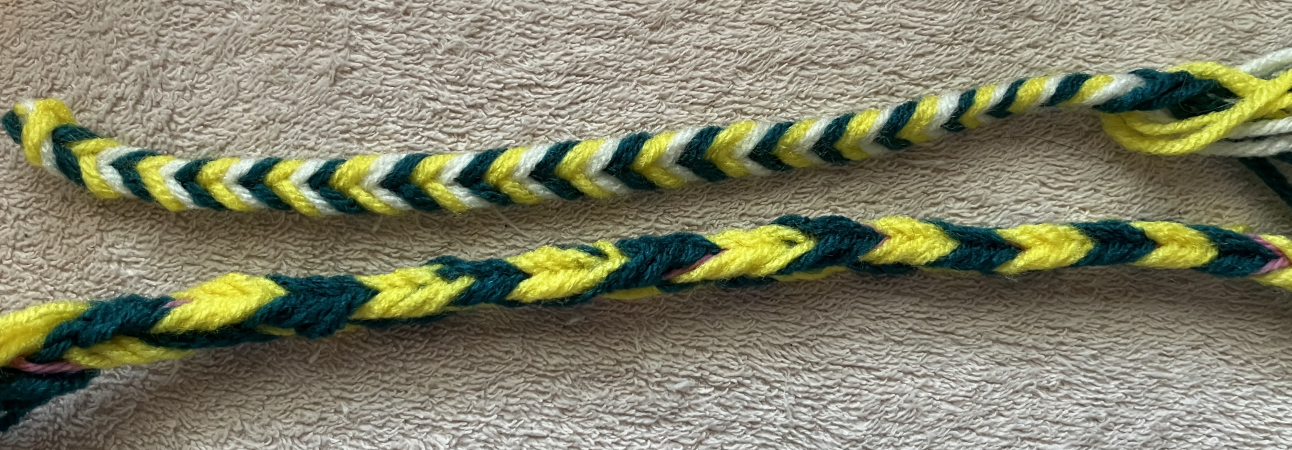
The bottom braid is a 9-loop square braid.  I'm still pretty clumsy at it -- transferring loops from my pinky finger to my ring finger is not yet smooth, especially if I don't want to drop the loops on my other fingers or my thumb.  It didn't help that not all of the loops were exactly the same length.  But I'm slowly getting better.  I did this V-fell, of course.  On my left hand were 4 yellow loops and 1 pink loop.  On my right hand were 4 teal loops.  The pink yarn is slightly thinner than the others, apparently, since it's nearly invisible in the braid and the photo.

I want to improve at the 9-loop braid since there are lots of fun things to do with 9 loops.  Also, I should start doing fun braids again in addition to trying to figure out actual historic braids.  (Not that I figure out much, since I'm sure the braids are pretty obvious to most experts, which I assuredly am not.)


Sunday, December 22, 2024

The Skjoldehamn hood braid (some experiments)

I'm still playing around with the braids that were used as ties on the Skjoldehamn outfit.  Today I tried a few things with the 4-element cords that are part of the hood.

Here is a small pic of the hood, screen-shotted from archive.org's copy of the thesis pdf.


And here is a small pic of the ties along with a diagram that traces the path of each element in the braid.


These are both from https://web.archive.org/web/20220225172743/https://kaupafar.com/wp-content/uploads/2022/02/Nye-tanker-om-Skjoldehamnfunnet.pdf with the cords being discussed on p.47-48.

Google translation from the Norwegian text gives the thesis description of these cords as such (somewhat edited): 

"The braid here measures 19 cm including one tassel of 2.5 cm, and is approx. 0.4 cm thick. It is braided from two pairs of S threads in olive green yarn and two pair of S threads in brown-red yarn. The colors wind in spirals (clockwise) down the braid...

"The green tassel is a highly felted/felted weave fabric (of unknown bond) enveloping the outermost part of it. The tassel is sewn on irregular stitches in green Z2S yarn. The round braids are sewn to the hood with both golden and dark grey-brown yarn in Z2S. Since the right side braid is not preserved in its entirety (only 6 cm is preserved) it is uncertain how long this originally was..."

Løvlid seems to think that the ties went under the chin. Other people think that they tied in the back, to adjust the way the hood fit at the back of the head and to keep the top of the hood from flopping forward onto the face.


My first braid (shown in the previous post and also the rightmost braid in the above photo) was done using the above diagram -- outermost thread goes under 2 elements and around 1, first the left than the right.

I did that again today.  (it's the second braid from the right, above)  It's nice but still slightly awkward (though less awkward than the first time).  Then I went poking around on the internet and my books.

It's possible to do this using a disk -- I think it's the very first braid in Rodrick Owens' 250 Braids book.

It's also possible to do this in the opposite way.  Instead of going under 2 elements then around and over, you can go over 2 and around and under.  It didn't seem to be all that much faster than the first method.

But I also found Laverne Waddington's description, which gave me yet another method for making this cord.

Her freehand method  (for 4 cords lined up as 1 2 3 4) is for 2 to cross over 3 and 4, 1 crosses over the cord that is now in the 2 position.   Then, 3 crosses over 2 and 1, with 4 then crossing over the cord that is now in the 3 position.  This is the middle braid in the above photo.  It's a little looser than the previous method, but a lot of that might be because it's the first time I tried it.  There's a nice rhythm to it.

She also showed a fingerlooping method, yay!  She learned it from Hilda in Potosi and Julia, (the post doesn't give further details beyond identifying them as her weaving teachers).  Since the cords on the Skjoldehamn hood are made with 2 strands per element, it is not at all impossible that they were made from fingerlooping.

Here is Waddington's tutorial on both the freehand and fingerloop methods: https://backstrapweaving.wordpress.com/tutorials/tutorial-4-strand-braid/

I first tried the method for spiral-4 braids from Ingrid Crickmore's website, which is a braid that is well known in historic (and modern) fingerloop sources.  Hmmm, close.  That's the second photo from the left.  I'm pretty sure I twisted the loops as I picked them up with the traveling finger.  The braid is pretty loose, which is partly due to using loops instead of single strands of yarn.  Crickmore says that this one needs careful tightening, so I'm sure a lot of it was just me braiding quickly without paying too much attention.

Here are Crickmore's descriptions of the spiral braids: https://loopbraider.com/2019/12/28/spirals-and-2-loops/ and https://loopbraider.com/wp-content/uploads/2019/12/part-2_4-loop_spiralbraid.pdf

Then I tried Waddington's method, which doesn't take any loops through any other loops.  That's it!  I tried a few variations, too, to compare.  This is shown in the leftmost braid.

The fingerloop method that seems to be equivalent to the Skjoldehamn braid is as follows.

Put loops on index fingers and ring fingers.  Have both of Color A on the left hand and both of Color B on the right hand.  (One can get different color patterns by making different choices, of course.)

Shift the loop on the right ring finger to the right middle finger.  Put the loop on the left index finger onto the right ring finger.  Use that left index finger to pick up the loop on the right middle finger.

Then do the other hand.  Shift the loop on the left ring finger to the left middle finger.  Put the loop on the right index finger onto the left ring finger, then use that right index finger to pick up the loop on the left middle finger.

Repeat.

I also tried putting the index finger loop onto the middle finger, then moving the ring finger loop to the other hand, then shifting the middle finger down.  This braid, while perfectly charming, does not give the same pattern.  You can see that in the middle of the braid pictured above.  I also did a little bit of the regular spiral loop (one loop through the other) without twisting the loop, just to double check.

When I was doing it according to the instructions from Hilda and Julia, the braid looks right and is reasonably well-tensioned.

(And now that I'm re-watching the video.....   They walk the loop from the index finger to the middle finger, place the other-hand ring finger loop on the index finger, then put the middle-finger loop on the other-hand ring finger. WELL!  Something new to try, and to see how it compares to what I've been doing.)

All of my braids were relatively short, with pretty much no obvious tension change from start to finish.  Dunno how much of that is because I've been doing this for a while, vs the shortness of the braids, vs the braid structure.

But it seems entirely reasonable that the Skjoldehamn hood ties were made using fingerlooping, with freehand braiding also being a reasonable choice.

A few questions -- the description says that the braids were done from two pairs of S threads.  Were these two single-ply yarns?  Or one plied yarn?  Or two 2-plied yarns?  The picture is fuzzy enough that I can't tell.

I wonder what color these were originally?  Brown-red and olive green could be red and yellow, orange and blue, etc.  Or brown-red and olive green, of course!

What I learned:

There are indeed several ways to do 4 loop fingerloop braids, depending on how one transfers loops from hand to hand.  I knew that about other fingerloop braids I've done, and also about other 4-loop fingerloop braids, but I don't know if I had explored ways to do this kind of braid where loops are only exchanged between two fingers rather than traveling around the entire hand.  I wonder how this will generalize to braids with more elements?  Maybe the Potosi method (on 6 strands) would work for the Hedeby braid?  Hmmm.

There are a lot of ways to make this simple 4-element braid (which I already knew -- this is a very ubiquitous world-wide braid, used in several different textile and textile-related crafts).

There are at least 3 ways to make the braid freehand, and probably several others I haven't explored yet.

Since it is possible, quick, and efficient to make this braid using fingerloop methods, it raises the odds of some or all of the other 2-strand multi-element braids on the outfit being fingerlooped, too.  Of course, they might all have been done freehand.  Or some of each.

Some blog commenters are awfully demanding.  Though tone doesn't come through in writing and some of the commenters write as if English wasn't their first language.  I'll try to be charitable.  Waddington and Crickmore are both unfailingly polite, friendly, and helpful.


I will continue to explore the Potosi and Potosi-inspired fingerloop methods to make sure they give the same structure as well as exploring other variations I might accidentally create.  I should try the disk method (I'd use a marudai if it was me, but if this is a class, they'll probably use disks.  I'll see how much of a pain it is to use an 8-slot disk.).  I'll look through my books and the 'net to see what else I can find.  And I'll make sure the fingerloop method works for the 6-strand Skjoldehamn braids.  I'm nearly positive it does, but heck, I'm nearly positive about a lot of things that turn out to be totally wrong.  

I have plenty of ideas for teaching a class or two.  Or more.

Edited to add -- photo will go in later.  But I tried the Potosi fingerloop method again, both the video version (move index finger loop to middle finger) and my version (move ring finger loop to middle finger).  They have the same kind of structure.  My version is a little tighter.  The video version is a little easier to keep track of in terms of what move needs to happen next.  And the video version spirals Z while my version spirals S.  I'll confirm that tomorrow in case I did something else like mix up the thread color placement.


Wednesday, July 10, 2024

A quick fingerloop braid (and starting a new tablet weaving project)

 I want to become proficient at doing longer fingerloop braids.  This means I must occasionally practice them, right?


This is done using the same method as last time -- make a crochet-chain loop and braid out one end, then undo the loop and braid out the other end.  But this time I did V-fell one way and A-fell the other, so they weren't mirror images.

It worked.  There's still a blip since I didn't get the correct loops on the correct fingers to make it seamless.  But on the whole, it looks good.  Some of that is no doubt due to the fuzziness of the yarn hiding the imperfections.  Eh, it's no worse than when I drop all the loops and have to put them back on my fingers and don't do it correctly.

Also, I didn't try to keep any kind of consistent tension.  But I don't think the two halves of the braid are significantly different from each other.

As before, I'm noodling around with ideas from this page: https://loopbraider.com/31431-2-basic-seamless-center-starts/ 


I've started another Double X Double O band with a slightly different threading and turning sequence.  It's not that different from the first one.  Hopefully it'll be done by tomorrow.  I'm on the 12-18", I think.  After that, maybe I'll do some more cords.  Or maybe not.  I used the Gotland experiment warp for one of the colors in this band.  I don't know why I didn't simply do a brick-patterned band with that warp.


Saturday, June 29, 2024

Snartemo II and a 7-strand fingerloop braid sampler

Here's a little one-color 7-strand braid I was playing around with.  I tried different things along the length (with a few repeats).  Although the photo is pretty crappy, I will list the variations I tried.  Most were unorthodox braids.  I was working V-fell, where the pinky finger is the operator finger and the index finger of the other hand holds the traveling loop.  I mostly picked up the traveling loop from above, which reversed the loop (and not from below, which reverses it with the opposite twist).


I did the square/round braid when I wanted to separate braids that I thought would be too similar.  I also did a bit of the braid where you don't go through any loops at all, kind of a pigtail braid.  Then there were the unorthodox skip-a-loop-or-two braids.  Skip the loop next to the index finger.  Only go through the loop next to the index finger.  Go through the two loops next to the index finger.  Go through the pinky and middle finger but skip the ring finger.  Etc.

It was interesting seeing the slight differences.  In general, the more loops one goes through, the wider/looser/flatter the braid.  Sometimes there's a small groove down the center of the braid, while other times the middle stands high.  The depth of the groove on the backside was sometimes a bit deeper/shallower, too.

None are bad braids.  The two Crickmore variations (triangular and D-shaped) are distinctive from each other and from the other ones I tried.  Ditto for the Guajiro braids, though i don't think I did the version where you skip the pinky and middle finger but go through the ring finger loop.


I also warped up a new tablet-woven band.  This is Snartemo II, though of course I'm working in cotton (the usual #10 crochet thread for the warp and finer crochet thread for the weft) rather than wool, as the original probably was.  I also decided to weave it in blue and white rather than red and yellow.

I'm using the chart/description from Maikki Karisto and Mervi Pasanen, because of course I am.  Their version has 17 tablets.  The center 12 tablets are the pattern tablets, and they are 2-threaded.  There are 3 edge tablets on the left and 2 on the right, all 4-threaded.  The 3 tablets of the left edge are woven with a tubular selvedge.  The pattern is pretty simple -- 26F/26B, not counting the edges which are always turned forward.

Here is a description of how they determined that this was the probable technique used for the band.  They worked through some other possibilities and showed that the other ones probably weren't the techniques used and that this version, in their opinion, most closely matched the archaeological specimen.

Anyway, it's fun, easy, fast, etc.  I'm enjoying it so far.  The pic is of one of the first repeats.

Sunday, June 16, 2024

D-shaped 7-loop fingerloop braid (2 ways)

It's been a while since I've posted!  I've been busy.  I've been doing some fingerloop braiding and other narrow wares, but nothing all that exotic, so I haven't posted.  I've also taught more people how to do various types of fingerloop braiding.

Today I decided to watch Ingrid Crickmore's video to see the braid she calls a D-shaped 7-loop braid (https://loopbraider.com/2015/04/21/uo-dshaped-7tut/)  I can't remember if I've done this braid already, but if not, then I definitely played with it today!

If I haven't done the braid before, it's because she doesn't give instructions on her website for how to do it.  One has to watch the video here: https://www.youtube.com/watch?v=vOFL5qigiU0&ab_channel=IngridCrickmore.  I mean, it's a fine video, but a few sentences or a diagram would have been MUCH faster.

But now the video has been watched, and the braid has been braided.  It's very cute.  Of course.  And it will be entirely easy to play around with all kinds of color/texture variations.


I've tried to fold the braid in the pic so one can see both sides of the braid, and also see where I switched back and forth between unreversed and reversed loops.  Those are the "2 ways" referred to in the blog post title and also in the video.  I used acrylic worsted weight yarn, though the white yarn is a little thinner than the blue and the green.

Ingrid Crickmore on her video said that reversing was best done by coming over the top of the braid rather than the bottom -- she seemed to think that the first twist direction made a more pleasing braid.  That is interesting since twist direction was one of the things I thought might be a variable for fingerloop braiding variations.  Yup.  It might be a very minor variable, but I guess it can make at least a subtle difference.

This is an unorthodox braid, meaning that the operator finger doesn't go through all the loops before picking up the traveling loop.  With the V-fell method that Crickmore uses, the pinky finger goes through the pinky and ring finger loops of the other hand, then over the middle finger loop, before picking up the index finger loop.  Loops can be picked up either unreversed or reversed without changing the overall appearance of the braid all that much (not counting colors, of course).

I used bi-color loops, obviously, in the same arrangement that the video uses.  There are a lot of fun color variations on the website.  I'm looking forward to playing with them.  I'll also play around with other 7-loop unorthodox braids, of course.  I've already done some -- there are a lot of different things to play around with.

One of the things I've been teaching lately is a 5-loop unorthodox braid, the braid that so many people worldwide seem to do.  I was looking at instructions for a brode lace of v bowes (https://fingerloop.org/patterns.html#n01) and realized that it was a different unorthodox braid that I had initially assumed.  For the brode lace of v bowes, which in the Medieval manuscripts is done with the A-fell technique, one skips the loop next to the traveling loop.  But it's also easy to skip the loop next to the operator finger and go through the loop next to the traveling loop instead.  Both look perfectly respectable, though I think I might slightly prefer the appearance of the first one (where you skip the loop next to the traveling loop).

Just as an aside, for the unorthodox braids where you skip the loop closest to the operator finger and go through the loop closest to the traveling loop, Ingrid Crickmore refers to them as triangle braids.  The braids she refers to as D-shaped braids skip the loop closest to the traveling loop.  Or so I currently understand.  I think.

I'll have to take pics of my little 5-loop samplers and add them to the blog, either revising this post or making a new one.  I did give most of them away, though.  Maybe I'll make a new one.  I usually do several braids to show people -- pigtail (i.e. don't go through any loops), brode lace of v bowes, divided, square/round, flat, the unorthodox braid where I go through the loop next to the traveling loop instead of next to the operator finger, and so on.  People like the divided braid to use as a hanging loop or buttonhole, etc.

---------------

Aisling's tablet weaving book finally arrived.  Yay!  Tablet -Woven Bands from Egypt of the early Byzantine era (395-641) and later, by Silvia "Aisling" Ungerechts.  This is the color version, purchased from a European vendor.  The USA version was in black and white (which I don't think was known before the publisher delivered copies to USA vendors) and the charts had zero contrast and thus were unusable.  The color one is fine.  I've done a few of these bands already (ones that are on her website or were in her TWIST articles about a few of these bands).  I'm looking forward to exploring more!


Tuesday, March 26, 2024

Another simple tablet-woven band (Double X Double O) and Bonus Fingerlooping (3-loop experiment)

I saw a photo of a band and wanted to re-create it.  Attempt #1 is not quite right, but it's still reasonably attractive.  I knew it wasn't quite right but forgot that I wanted to adjust my chart.  I had already warped it up when I remembered, which seems very silly when I say that but that's more or less how it happened.


This is a very simple pattern.  I call it Double X Double O.  Maybe I'll do some variations on this in the future.   I do like having the two-tone background color.

I've charted up attempt #2 and will probably try again.  Not that I need to re-create what I saw, but it's an interesting exercise.

I'm still having issues with different motifs being different lengths.  As far as I can tell, the width is the same and I'm beating the weft the same.  But apparently not.  Or the cotton is more stretched out in some areas than others.  Or it's something about where the weight is, how close my weaving is to the cards, how twisted the edge cards are, how long the band sat under tension before weaving (though I tried to let it sit for a while each time).  Or maybe it'll go away after blocking.

I kept the weight fairly low compared to what I usually do for this many cards, and I kept the weft fairly loose in order to widen the band (to reduce the apparent elongation of the motifs).  The unblocked length is about 63" and the unblocked width is about 7/8" wide.  It's destined for a gift.

---------------

Next up is a fingerloop braid.  I decided it was time to try a new-to-me way to make longer braids.  I've done the crochet-chain method before (I think I came up with it on the fly), but wanted to try other methods from Ingrid Crickmore's website.

I am doing 3 loops, all different colors, fairly short.  I'm doing a flat braid (twist the left-hand loop, don't twist the right-hand loop) using the V-fell method.  I did the method of making a slip knot, braiding one end, then undoing the slip knot and braiding the other end.

In terms of tension, it's pretty consistent.  I can see the join, though, because I know where to look and because there is a slight color pattern disruption.  The pattern is symmetric around the joining point.

But I don't have a flat braid.  Huh?  It looks like an unorthodox braid, even, with one side slightly domed with a V-type pattern and another side with a more interwoven look.  It is almost but not quite triangular in cross-section.  It has a gentle spiral along the length of the braid which is actually rather attractive.  If it's unorthodox, that would also explain why the braid isn't flat.  Is it even possible to make an unorthodox 3-loop braid?

So what did I do?  My guess is that I wasn't paying attention and came up with yet another variation on a 3-loop braid.  I thought I was using my middle finger on one hand, going through the middle-finger loop on the other hand, and picking up the index finger loop from that other hand.  But what was I really doing?  And what should I have been doing?

I should set this up again and actually watch what my hands are doing.

And I need to play around more with doing braids this way so that the center join is less obvious, and also to see what exactly happens to flat braids at the center (i.e., does it open up from the other side of the braid, in which case I'll reverse the crossed loop vs non-crossed hands?).  Until then, though, I think I feel comfortable doing single-color square braids.

As always, attempt #1 just goes to show what a noob I am.  I like the results but am rather mystified as to how I got there, and it wasn't quite what I was trying to do.  On to attempt #2!  (Check out the further exposition from Ingrid Crickmore, here.  Apparently she has worked through these issues already.  Except for the part where she was making a mystery braid, though she probably did that, too, at various points in her self-education.

---------------------

My list of things I want to do is SOOOO long.  Dunno what I'll get to next.


Monday, March 25, 2024

Adventures in finger dexterity (9-loop fingerloop braid)


A 9-loop V-fell square fingerlooped braid.  Instructions here, though I didn't really need them since the 9-loop is pretty easily extrapolated from the 7- and 5-loop square braids.  The website does show how to hold one's thumb as well as giving a reminder about which thumb loop is the upper/outside loop (in order to twist or not-twist it properly and in order to transfer the index finger loop to the thumb properly).

I kept dropping loops and my fingers weren't sure they wanted to walk the loops.  Which is all quite normal for a new-to-me braid,  I was definitely starting to get better by the end.

Next time I might do this as a flat braid instead of a square, since the principles are the same.  At this point, making this braid is pretty slow given my current lack of finger dexterity.  I'm sure it'll get better with practice!

Ingrid Crickmore recommended trying the 9-loop square before getting too fast/comfortable with the 7-loop braid, since there are indeed some new finger muscles that have to be encouraged to play along.

Yay.

So... I will continue to play around with all the structures I have practiced so far, along with having some color fun (different color loops, bicolor loops, various forms of loop-switching).  And when I'm in the mood for something new, I will play around with some of the other structures I haven't tried yet such as the Spanish braids and the Grene Dorge braids and unorthodox variations, etc.  Eventually I'll find another person who knows how to do fingerloop braiding and see how the multi-person braids work.

On the whole, now that I've done a 9-loop square braid and found it easy to understand, I feel pretty comfortable with my knowledge and my ability to make a lot of the common fingerlooped braids that have been documented.  I'm no longer a complete noob even if I'm still barely past the beginning of the journey.  There's still so much to learn and to think about.  I am grateful to the people who have written books (and booklets) and put up websites about fingerloop braids.  It's been enormously helpful.

I also have a tablet-weaving band project I'm nearing the end of.  It's very simple but still kind of cute.  It's intended as a gift.  I'll probably add photos later today or in my next post.


Tuesday, March 19, 2024

Fingerlooping along with 5-loop bicolor-loop braids


Here is the braid I did yesterday.  Part of it is a standard V-fell 5-loop square braid (orthodox), and part of it is a standard V-feel 5-loop unorthodox braid (the common one where the only loop gone through is the one next to the traveling loop).  It looked pretty much the same from the side I was looking at, so I didn't quite notice until I got to the end and saw that the backside was different.  Both are nice braids, but I wasn't intending on doing a mixed braid like this.

The intention was to do the "edge plus one solid loop" 5-loop triangle braid on this page.  The other braid is described elsewhere on Ingrid Crickmore's website here as a "bicolor striping plus contrast loop(s)" square braid.

I'm not sure how well the photo shows fronts and backs.  Oh, well, I'll know it when I see it, and this blog is meant for my own purposes rather than to entertain the masses.

I decided that it would be easier to cut more thread and make another braid instead of unbraiding the above.  I switched it around a little bit -- a, b, and c on one hand are the dark color (blue).  The other hand has bicolor loops (blue/red) with red uppermost.  I just did a plain V-fell 5-loop square braid.


I like how it turned out.  Though I wasn't able to keep the tension consistent throughout, which I didn't quite realize until after I was done and had soaked the braid in warm water for a while.  Something to keep working on, I suppose.  I did zone out while braiding this pair of braids, but luckily I didn't switch to a different structure or color pattern while not paying attention.

Although the triangle braid is fun to make, I prefer the color pattern on the square braid.  As seems typical with unorthodox braids, the top and bottom are not symmetric/identical.  That's cool, but it bothered me with this particular color set-up.

Now to think about what I want to do next...


Tuesday, March 12, 2024

Today's fingerloop braids (6 loop and 7 loop square braids)

Well, yesterday's and today's braids.  I did sets of two braids since these will be given away as gifts and the giftee requested pairs of braids if I was going to do shorter lengths (i.e. less than 1-2 yards).

This first one is a 6-loop square braid, as described here by Ingrid Crickmore, except, of course, that I did it as a square braid instead of a flat braid.

I chose the "3 Ws" pattern -- the A fingers get color A, the B fingers get color B, and the C fingers get color C.  I used the V-fell braiding orientation, using the little or pinky finger of one hand, going through the loops on the other hand, and picking up the index-finger loop of that other hand, reversed, to bring back.  Shift the loops and continue.

It's very cute and I hadn't remembered that I'd already used that color combination and basic pattern in a different braid not long ago (a 5-loop square braid shown in the February 21, 2024 post)!  The two braids are different in thickness and have a slightly different hand.  The 3 color Vs are stacked more evenly, of course.

This is the second even-number mixed-square braid I've done, I think.  I did one earlier with 4 loops (a 3-loop square on one side, a 5-loop square on the other).  They're an interesting variant to add to my repertoire.  I should do some of the flat braids, too, since I do like many of the color arrangements that are shown on Ingrid Crickmore's website (and want to design my own, too).  I'll no doubt do the 8-loop mixed braid at some point, and beyond.


This second pic is a 7-loop square braid, also done in the V-fell orientation.  Six loops are dark purple and one is light purple.  It's definitely larger than 5-loop square braids!

Both are nice braids, and I'm starting to get more dexterous when moving loops from finger to finger, at least with V-fell.

It's time to play more with colors, I think.  And also to explore other braid structures.  And do more flat braids, since I want to see if I can get the tension on those a bit tighter without collapsing the braid into a square again.

I'm still a newbie, but it's interesting to look back and see how I've progressed in the last month and a bit.

I won't be teaching the 7-loop Celtic braid at the end of the month, alas.  They wanted something simpler.  So I'll teach the 2-strand fingerloop braid again, yay!  I'm also teaching the 7-strand Fill the Gap disk braid again.


Friday, March 8, 2024

More Fingerloop Braiding for the first week of March (5 loop and 7 loop braids)

I'm quickly running out of good post titles that aren't exactly the same as all the others.  I have that problem with tablet weaving, too.  And everything else, I suppose.

These have been done in the past few days, interspersed with other things, of course.


This first braid is made from some kind of perle weaving cotton, probably #10-ish.  I bought the cotton a zillion years ago, when I was looking for fine threads suitable for doily knitting.  It was during a time when good cotton thread in finer sizes was becoming very scarce in local stores, especially in colors.  The cotton was way too soft and uneven to work well with doilies, so it's been slowly getting used up in other projects.  I am pretty sure I'll be using some of this for tablet-weaving, too, assuming it's not too soft to take the tension and potential abrasion.

The pattern is a basic 5-loop square braid using bi-color loops.  Color A is on top for the left hand, Color B is on top for the right hand.  I'm pretty sure I did this as a V-fell loop.

This seems to be what the old fingerloop-braiding manuscripts call a "lace baston" -- according to the Silkewerk site, this is Tollemache 6 (a lace bastonne), Harleian 5 (a lace baston), and Serene 6 (a lace bastuve of 5 bows).  The fingerloop.org site claims it's #4 in Harley 2320, and #18 in "To Make Pursestrings" as documented in the book Queen Elizabeth's Wardrobe Unlock'd by Janet Arnold.  Also, this is a braid that Ingrid Crickmore shows on her site as one of the color variations for 5-loop square braids.

Clearly different people refer to things from the old manuscripts in different ways, but I don't care all that much about the historic provenance.  It's a completely obvious color variation once for 5-loop square braids.

The braids are tiny!  The cotton really packs down tightly compared to the big-box-store crochet cottons, though the latter are somewhat thicker and more tightly plied, to be fair.

Also, I am still pretty terrible at recovering after a mistake.  Each braid has one spot where things went off the rails and I had to try to recover.  Sigh.  As I experienced with tablet-weaving, I expect it'll take me a while to understand how to fix my mistakes and then also get the loops back on my fingers in the correct order.

This braid really does show mistakes since the patterns is vertical stripes.  Our eyes REALLY notice anything that breaks the lines.

This one would be fun for switching around the loops (by doing a round of non-reversed loops or giving the loops another twist, to reverse which color is on top) and going back and forth in little checks or broken stripes.

The braids are pretty cute, though, in spite of the mistake in each one.  I've been doing pairs of them to use as drawstrings and ties.


This second braid is another sampler/experimental braid.  Since it's dark green and since I'm a terrible photographer, it's hard to see the details.  I'm writing down what I did and what I think about it so I don't forget!

All of these were done V-fell, where the ring finger is the operator finger and it usually picks up the index finger loop from the other hand.

The first part is a braid I've done before -- the ring finger picks up the index-finger loop from the other hand, and I picked up the loop reversed even though it doesn't really matter.

I believe this to be the 5-loop version of the "lace broad party" I did a few days ago.  It looks perfectly reasonable and is a nice, tight braid that looks like a pigtail.  It isn't as extravagantly indented as the 7-loop version.

The second part is an unorthdox braid, as Noemi Speiser would have it.  My ring-finger is the operator loop.  It skips the ring finger of the other hand, goes through the middle-finger loop, and picks up the index-finger (reversed).  This turns out fairly flat, a V or herringbone on the back, a flat interlacement on the front.  I'm pretty sure this is the classic, everyone-does-it, 5-loop fingerloop braid.

I then did something slightly different, picking up the index-finger loop after going through the ring-finger loop and skipping over the middle finger loop, again with a reversed loop.  It looks different from the above, rather triangular.  The bottom is a V.  The top looks like a small V sitting on top, sort of a wedge-shaped triangle.  I think this might be the same as one of the triangle or D-shaped braids in Ingrid Crickmore's website?

(And ugh, I might already not remember in which order I did these.)

I then repeated the two braids to make sure I was really seeing a difference.  Yup.  For funsies, I didn't reverse the traveling loop.  The braids are pretty much the same, maybe a trifle fluffier and looser, with the top side sitting higher above the bottom side.

Then I finished up with an inch or two of the basic square braid.

I am not 100% certain if I have sections 2/4 and 3/5 correct.  Goldfish brain...  But it does show that it makes a difference which loops get skipped vs gone through.  Dunno if there's a difference if I had gone under rather than over the loop.

It makes a minor difference whether the loop is taken reversed or open.  So that seems to be characteristic of a braid where some or all loops are skipped rather than gone through.  Which I knew, but it's always nice to double-check.  It'll make it easier to switch colors (by taking loops reversed instead of unreversed or vice versa) really unobtrusively, too.

Here are Ingrid Crickmore's thoughts on Unorthodox Braids, which seem to be concepts I was playing around with in this braid (though I didn't read her thoughts until after I'd done this braid.)  Hmm, she says it makes no difference whether one consistently goes under or over loops, but it does make a little bit of difference which way one twists the loops that get reversed.  Very cool.


This third pic is the 7-loop Celtic Braid again.  I might want to teach this braid in a few weeks, so I need to practice!  This is still slentre style; I haven't tried a V-fell or A-fell version yet.  I think I usually took the loop crossed, though some of it might have been with open loops.  Given that no loops go through each other, crossed vs uncrossed shouldn't really make much difference.

I did try some different things with this braid, not just the basic Celtic Braid.  I started and ended with the version I did before, where the operator finger goes over-under-over-through.  Then I tried over-over-under-through.  I like that version, too.  It's very neat-looking on both sides. Whereas the first version is almost identical on both sides and is flat and wide, the second is narrower and thicker and not quite identical.  One side looks like interlacements and the other more like a herringbone (somewhere between Vs and interlacements).

Then I tried under-over-under-through and under-under-over-through and various other things and didn't like them.  So I finished up with a little bit more of the original.

My fingers are slowly improving at loop-walking.  More practice is needed!  I might try this one in a thicker twine or hemp or something to see if it would make a useful braided belt.


This fourth loop is another mish-mash of 7-loop braids.  What the heck, it's time to try the 7-loop square braid.  It went swimmingly, yay!  Then a bit of flat braiding (loop reversed on one hand, unreversed on the other), more square, then flat braiding but taking the unreversed loop from the other hand, and finishing up with a really short section of split braids.

I did this as a V-fell braid, not that it matters much.  My fingers were not too bad at walking the loops up, whew.  I didn't even need to look up what to do -- just extrapolated the pattern from the 3 and 5 loop braids.  The little finger is the operator finger, and it goes through the loops on the pinky, ring, and middle fingers of the other hand before picking up the index finger traveling loop.

I did need to open up the flat braids; they wanted to stay folded up.  The side on which the flat braid opened did indeed depend on which had took reversed vs unreversed loops.

The two split braids look like pigtail braids, not like little 7-strand braids.  That's slightly disappointing.  The square braid is very square-looking, nice.

What's next?  I'm not sure, as usual.  More braids, I guess!  I'll trawl the usual sources for ideas and things to try.

I should do more sets of braids to use as drawstrings and lacing and start experimenting more with color patterns.  I should do a little write-up if I end up teaching the Celtic Braid.  I also might crank out a few tablet-weaving bands for gifts.


Monday, March 4, 2024

Today's fingerloop braids

Well, so far.  Maybe there will be more later today, though if so, I'll try to wait until at least tomorrow to inflict them on my imaginary audience.


This is a 7-strand braid.  My fingers really did not want to cooperate in walking down loops! Dunno if that's because it's a 7-strand A-fell braid or because of the angle I held it at or my fingers just weren't having it.

This is a pigtail-type braid.  The place I saw it described/explained was very careful to take the loops reversed in a particular direction.  Hmmm.  I tried reversing it in the other direction and not reversing it at all and it didn't seem to make any difference.  Then I figured out that this was a braid called "A Lace Broad Party" and the instructions on silkewerk.com (from a saved version on archive.org) specifically mention that it makes no difference whether or not the loops get reversed.  Hah.  Dunno if it makes a difference with bi-color loops.  Probably not, since no loops go through any other loops.

Anyway, this is apparently Tollemache 62 and thus a genuine historic braid.  No loops get pulled through any other loops.  The empty index finger picks up the pinky-finger loop from the other hand.  The loops get lowered, repeat with other hand, etc.

It's pretty much the same thing I was doing with pigtail-style braids with 5 and 3 loops.  And indeed, it can generalize to other numbers of loops, and it can also be done freehand, and can also be done by going through some loops while going under/over others.

It's a pretty cute braid, of course.  But wow, I think I need to work on finger dexterity and finger independence!

Also, although I'm still playing around with 4- and 5-loop braids, I'm ready to also start exploring more braids that have more than 5 loops.


This yellow braid is actually 2 different braids.  I changed about halfway through.  They are both 4-loop braids.

The first one is from a handout I apparently found online somewhere.  It is from Eowyn de Wever, "Fingerloop Braiding; A sampler of four braids on 8 loops and 2 colours", from a class that she taught at some point since these are referred to as class notes.

The braid I did is "The Square Braid on 4 loops." This is supposed to be a helpful transition braid between an 8-loop spiral and a barleycorn-type braid.

I did that for about half or a bit more than half of the length of the braid, then got tired of dropping loops and my fingers not wanting to move loops around.

The second half of the braid is from The Weaver's Journal 37, Summer 1985.  There's an article in there by Noemi Speiser, "Unusual Braids Produced by Loop Manipulation", p.15-18, 67-73.  A lot of it is about the joys of track plans.  Luckily she includes the basic fingerloop manipulations as a guide for how the plans correspond to the braids.  I mean, I do understand what the track plans represent.  But I'm still having trouble backing out the finger/loop movements from only the track plan.  Clearly I need to practice more and do a few exercises in working with both the track plan and the fingerloop diagrams at the same time, or taking the one and generating the other, or both.

The braid I did is the 4-loop braid from Figure 8 on p.70. It was a lot more satisfactory than the first braid, not nearly as annoying to do.  Speiser says that this braid was found on "an old European purse."

I'll have to try these again using loops of different colors.  I may also switch the pigtail braid to V-fell to see if it's less annoying that way.

It's kind of fun to see how the two yellow braids look relatively similar (as monocolor braids) even though they have different structures.  Also, the Speiser braid tends to spiral.

Each braid has 3 faces, I think.  For the Speiser braid, they are all Vs or herringbones.  For the de Wever braid, there are 2 faces of Vs/herringbones and one that looks sort of like the flat face of a 3-loop flat braid (i.e. it shows interlacements).

All of these braids were meant as samplers/experiments, which is part of why the tension is inconsistent.  Well, part of it was general new-braid and finger-dexterity awkwardness.  But I really did want to see what the 7-loop Lace Broad Party looked like at different tensions.

I'd also like to work through the rest of the braids in the Speiser article as well as doing the braid in the connected article by Adele Cahlander on p. 15-16, "Detective Story: Unraveling the Mystery of a 7-loop braid."  Which also means I need to go back through her sling-braiding books/articles to look for fingerloop braids.  The last time I really looked at them, I was more interested in the square braids that are done freehand or on a marudai.

And alas, there's nothing about fingerloop braiding in the few things I have, including her book on Sling Braiding in the Andes.  Harumph.  I don't recall anything about fingerlooping in the book referenced in the article.  The book referenced by Cahlendar was that Andean knitting book by Cynthia LeCount, and in particular, the strap on a Bolivian monedero.  As I recall, most of LeCount's book was about the amazing knitted chullos.  I'll have to see if I own that book and if so, if anything is said about the strap or about braiding in general.


Inspired by the above, I did a few more samplers.

I tried to do a 3-loop braid, going through 0 loops, taking the loops alternately above and below the uninvolved loop.  I don't know if I was messing up or what, but I kept undoing what I'd just done.  Frustrating.  Similar for going through 2 loops while taking the moving loop reversed on one side and unreversed on the other.  It's apparently difficult to count to 3 and/or keep my fingers straight as to which is the operator loop, which is the moving loop, and what happens to loop between the two.  Or it just ends up not looking very interesting.  Sigh.

So I added a fourth loop and played again.  That was more successful!

It's hard to see, but first I did a combo 3-5 square braid, using V-fell braiding, inspired by Ingrid Crickmore's mention of the 6-loop braid done as a combo 5-7 square braid.  For one hand it was like a 3-loop braid and the other hand was like a 5-loop braid.  I took both loops reversed.  Yes, success!  It is a perfectly lovely little braid with a triangular cross-section, easy to do as long as I can count to two.  Two sides have herringbone Vs and the third shows a small, neat interlacement.

Then I took the loop reversed for the first move (when my operator finger went through 1 loop on the other side) and unreversed for the second move (when my operator finger went through 2 loops on the other side).  This makes a nice little flat braid, yay!  There are 2 Vs on each side.

Then I did the opposite -- taking the loop unreversed when going through 1 loop, taking it reversed when going through 2 loops.  This does not make a flat braid.  It's similar to the first, a triangular cross section, though I think all three sides are Vs and none show an interlacement.

Finally, since there wasn't much length left, I did the 4-loop spiral braid, varying whether I reversed loops and also varying which loop went through which loop (i.e. always the right loop on the outside, reversing the left loop, versus always the upper finger loop on the outside, reversing the lower finger loop).  They're subtly different but not enormously so, as I think I already knew.

Dunno what I'll do next, but I have a lot of potential things to try.  Plus there are some tablet weaving things I want to play with.  And I'm vaguely feeling the urge to pull out the marudai.  But I'll probably keep fingerlooping for a while even if I do start something else.