Thursday, December 11, 2025
Andean-style braiding progress since the last post
Wednesday, November 12, 2025
Yet another novice level post on Balearic-style slings and Andean-style braiding
Sunday, November 9, 2025
More sling chatter (and a new braid)
I showed my first sling to someone who knows how to use a sling. This person confirmed that it looked and acted like a perfectly reasonable sling, yay. This person usually makes slings by attaching paracord to a sling pouch made of duct tape. I love that slings are so low-tech with so many ways to make them from whatever convenient items are in your local environment.
I've started another Andean in-the-fist braid. I tried with 8 strands (4 strands folded in half) first. It was difficult for me to see which was the lower and which was the upper strand. So I cut another set of strands, and I'm doing another braid the same way I did the first. It's going well. I'll probably start zig-zagging soon, and then, depending on how much yarn is left when I get tired of that, will try some other variations. At some point I will return to 8-strand braids! Though it amuses me that the 16-strand braid is easier to learn on.
I've also tried a new-to-me braid. I'm pretty sure I've done something very similar using a different technique.
It's from a youtube video on making a sling. It's in Spanish, so they of course use the local terminology of Honda or Waraka. Here's part 1, which shows the braid and the first half of the sling's construction: https://www.youtube.com/watch?v=KMJAAkhHcZE and here's part 2, which shows the woven split pouch and the rest of the sling's construction: https://www.youtube.com/watch?v=Kw1chCl6fXs&t=616s
The finger loop, made with 4 strands, is the standard 4-stranded cord made all around the world. I like this particular method, where diagonally opposite strands twist past each other, alternating the twist direction.
Then it's joined, and the new braid is a braiding technique I've not done before. It's a 4-strand braid (each strand has two pieces of yarn). I'm pretty sure I've done this braid structure on a marudai and also through fingerlooping. But this is a freehand braid, and it's kind of cool-looking and fun to do.
Not that I'm perfect at it or anything.
The video demonstrates the sling construction using a fairly thick single-ply yarn. Interesting.
I wonder if I should do a track plan and compare it to the other braids I believe this resembles?
The braid is slightly elastic, though more so in compression than in tension.
I only used enough yarn to play around with the braid rather than doing a full sling.
The split pouch is one of the styles I see in the books (and websites and videos) on Andean slings I have access to. I'm looking forward to trying it when I decide to make that style of pouch on a sling.
I wonder what the braid would be like if I use more than 4 braiding elements? Also, will I get faster with time, and how will that compare with other braiding techniques? The braid in the video was secured at the top, while I was randomly holding onto it while braiding. Maybe I'd be faster if it was hooked to something.
I have no idea whether this is a traditional technique or a more modern shortcut.
My stash of random acrylic is getting low. I also use it for charity knitting and share it with another charity knitter/crocheter. We're both fairly productive; there's not much left. My second in-the-fist braid is using different colors because some of the skeins of yarn I used in the first braid are now with my friend, being turned into charity hats.
Saturday, October 11, 2025
The demo/teaching thing
I did the demo/teaching thing referred to in the last post. Most people took their braids, but a few were left behind, or were ones I did as part of teaching and demoing.
I mostly taught people the 5-strand unorthodox fingerloop braid, A-fell. (though it was kind of slentre-like in that it was easiest to go through the middle finger loop on the way to the ring finger loop by holding my hands mostly palm-downwards rather than palms-facing)
For a few young children, I did twisted-loop cords with them. One slightly older child learned the 7-strand fill-the-gap disk braid. (I had a pile of disks with me for just that purpose)
A few people already had done fingerloop braiding, so we had fun with 5-loop orthodox braids (square, flat, and split/double), 7-loop orthodox braids (square and flat), 7-loop unorthodox braids, and the 7-loop pigtail braid done as a V-fell braid (load up 4 fingers on one hand and 4 on the other, and the empty little finger grabs the index finger loop of the other hand). We also did a 4-loop loop-exchange braid, and I tried playing around a bit with various unorthodox 7-loop braids though none turned out so well that I needed to write them down.
As you can see from the above photos, people had fun choosing different colors to see what would happen. With the unorthodox braids, sometimes the back side (the one that looks interwoven) is more interesting than the front side (the one that looks like Vs).
I also got to spin a bit, on both wheels and spindles. Someone had some raffia and shared it around so we could all make some cordage (twist one side and fold it over/under the other side). And as always I had my knitting with me and got a fair amount of knitting done.
It was fun, both the teaching and the hanging out with other people who enjoy playing with fiber.
My weaving area is still unavailable, so I haven't done much else in the way of narrow wares this month, at least not so far. All the stuff mentioned in my last post is still on my want-to-do list. We'll see what happens.
One of my feline weaving assistants has passed away. She was old and it was sudden. I'll miss her. Yes, even her deeply non-helpful weaving assistance.
Monday, September 29, 2025
Thoughts for an upcoming demo/teaching thing (braiding)
Tuesday, June 17, 2025
Blue and white tablet-woven cord
Sunday, May 25, 2025
The first sprang project -- a small bag
Saturday, May 17, 2025
Musings on the trousers from Turfan (Tarim Basin)
Friday, February 28, 2025
This Year's Final February Fingerloop Braid Post
Tuesday, February 25, 2025
A quick little post
I may add more to this post later.
This is the same triangle braid I did a few days ago -- 5 loops, V-fell, unorthodox (ring finger on one hand goes through middle finger loop of other hand and picks up the index finger loop of the other hand, hooking over the top). I used 3 loops of light purple and 2 loops of dark purple. I made two braids, to be given as a gift. The finished braids are each about 20" long (not including the knot and fringe, of course). I'll tighten the knots and trim the fringe before they're given away.
The braiding seems a little loose, which is interesting. Is it the cotton rug warp? Is it how I'm tensioning the braid? Is it always like this and I usually don't notice?
The pic shows both the top and bottom sides of the braids.
I'm probably going to do a few more braids for giving away, with a variety of braiding structures and color patterns. If I get more done today I'll add them to this post. Otherwise there will be a new post later this week. Crickmore's website is full of great inspiration.
------------------
I did finally warp up and start an Icelandic missed hole tablet woven band, yay!!! I started by doing all the early exercises that Wollny includes in the first part of the chapter.
Background pattern, yup. This is basically the Sulawesi background done in 3-hole.
Then a few patterns that are simple diagonals-type patterns where the holes are there but don't form the tabby-ish pattern.
Then we start with waffling, first with the holes, then with the color thread (which means floats), and with each of the background threads (before and after the holes, and yes, also floats). Motifs are filled with different textures in the center -- various floats and double-face and background pattern, etc.
There's also a little tacking stitch, to pop up a thread from a different hole to tack down some of the long floats, or just to do it because it's ornamental.
Wollny recommends doing it by turning two tablets one-eighth turn, to bring up a lower thread and drop the higher thread. I found this kind of messy when looking for the shed.
If it's only one tack, it's relatively straightforward to lift the lower threads and drop the higher threads for that one row. For several tacks, it gets annoying.
These actually are very similar to the Finnish half-turns, and in the end, that's what I found to be the easiest. Do another turn on the two tablets involved in each tack (either up or down), throw the weft, then bring them back to their original orientation before going on to the next move.
So that was all fun -- seeing how Wollny approaches this technique and some of the variations and constraints she considers when designing her own.
Now that I've done the sampler patterns, I'll choose random stuff from Wollny's charts for a while, and quite probably for the rest of the band. If I get bored or run out of patterns I like before I run out of warp, I'll switch to 3-thread Sulawesi motifs or play around with diagonals charts or twill charts or other techniques that look good with 3 threads.
I like how this technique looks, and I like how it's both related to float work and combined with float work. And now I've done a bit of float work, too. Well, floats that are deliberate.
The waffling technique is often used in conjunction with brocading, but I won't be doing that for this band.
It's interesting to me how this feels different from 2-thread, at least the way it's presented in this book and possibly in archaeological/historical examples. They each have a characteristic texture, which is a lot of it, I think. Also, the tablets are relatively stable without much effort, unlike 2-hole tablets.
I'm using 12 pattern tablets along with two 4-threaded edge tablets per side, for 16 tablets total. As usual, the motifs are a bit elongated, though I'm trying not to tighten up too much on the weft when I throw it while still trying to keep it firmly packed down into the shed both before and after I turn the cards.
Wednesday, December 25, 2024
Yet more 4-element braid experiments
Monday, December 23, 2024
More 4-strand braiding silliness
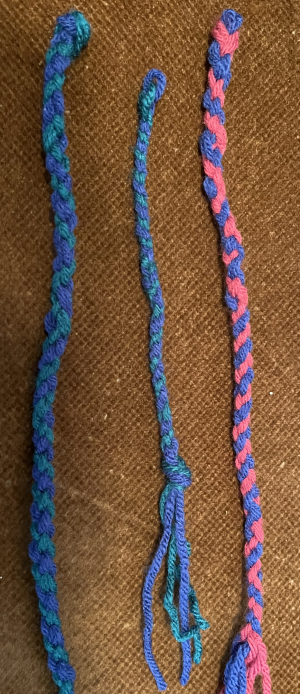
The rightmost braid is the one mentioned in the previous post. The leftmost braid is a repeat of the fingerlooping methods. Again, I tried both methods -- move the index finger to the middle finger vs move the ring finger to the middle finger.
They're pretty much identical from a braid structure standpoint -- the index and ring finger on one hand switch clockwise, and the index and ring finger on the other hand switch counterclockwise. With one, the index finger loop goes over the ring finger loop; with the other, the ring finger loop goes over the index finger loop.
Either one can spiral S or Z; it depends on the arrangement of the colors vs how the loops switch. Do I remember which is which? Umm, no. But it was obvious when I'd mess up by switching the twist directions by accident, and then switching back. I got both S and Z spirals with each of the methods.
Too bad the contrast on the left two braids is so low, because they were very informative. Both are in green and blue, with the fatter braid being fingerlooped and the thinner one single-strand freehand braided.
The middle one happened after I poked around on the 'net and my own books and stuff. It's a different method than the other freehand methods I wrote about earlier, though of course they're all kind of the same and it's mostly about the way my brain understands what is going on.
For the middle one -- think of these four elements being arranged in a circle instead of flat. Instead of 1 2 3 4, we have NW SW SE NE. As with fingerlooping and disk braiding, we're going to swap NW and SE in one direction, and then swap NE and SW in the other.
So... cross NW over SE, then cross NE over SW. Twist your wrists and move your fingers (and strands) as appropriate to make sure that the pairs of elements crossing each other don't interfere with the currently-passive elements or vice versa. As with the other braids, the spiral direction (and color pattern in general) depends on the arrangement of the colors vs the direction of the crossing twists. One can, of course, cross under rather than over, but for me, the cross-over twist of my fingers felt more natural than the cross-under.
Here's a paracord video that shows it, though with the color arrangement that leads to vertical stripes rather than a spiral: https://www.youtube.com/watch?v=UtWWA6MQXGE and it can also be seen fairly well on Sally Pointer's video (the second braid, starting about halfway through the video): https://www.youtube.com/watch?v=TwVXwH_w2ng
Am I done? Maybe. I'm probably not going to explore disk/stand braiding or whipcording because the how-to for those is pretty straightforward. I am going to try to pay attention to figure out which color arrangements lead to which spiral direction. It should be pretty obvious pretty quickly.
Whipcording (aka Viking whipcord or interlocking or slinging) -- as far as I know, there's no unambiguous evidence of this method being used before the 17th century. Honestly, though, whipcording just seems to be doing this braid with wooden bobbins to hold the excess length of unbraided yarn, plus hanging it from something high so it can be worked downwards vertically, plus adding a second person if so desired to make it a game (by tossing pairs of bobbins back and forth). It would be useful if making long lengths of cord. But for something that's roughly 8" long, like the Skjoldehamn hood ties? I'm thinking freehand or fingerloop since either can be done pretty spontaneously.
Dunno if and when I'll explore more 4-strand braiding stuff, such as other braid structures. I'm also not going to track the history of these braids, because they tend to be pretty universal over time and space, going way way back. People are clever.
So one possibility for a class is this braid, period. I could do the fingerloop method and only that. Or I could do fingerloop and freehand. Or even fingerloop, freehand, and disk. It would be in the context of the Skjoldehamn hood ties, with a general discussion of this braid throughout history.
If I did a second class, it would be the 6 strand pigtail-type braid used decoratively on the cuffs, necklines, etc., in the Skjoldehamn outfit, both freehand and fingerlooped.
So ends today's ramblings on this particular 4-strand braid structure. Maybe. There might well be an upcoming post on the 6 strand braid and maybe an example of the 4-strand braid showing which color placements lead to which patterns, so my poor little goldfish brain has something to return to later.
Saturday, December 21, 2024
A few easy braids from the Skjoldehamn outfit
I'm probably teaching a class next month. There are several in my rotation already, but maybe I feel like doing something new.
I've seen some interesting six-element braids in the past few months, shown to me by friends. One is from one of the Sion knitted relic purses. The purse my friend is knitting has what looks to be a six element square fingerlooped braid. (I tried making it a few months ago and it seems to look like the pics, so hey, probably a good first approximation.)
Another six-element braid was shown to me by a different friend who is using braids sewn down over seams as a decorative statement, very common in certain times and places. That friend was using ideas from the Skjoldehamn find and other similar-era finds.
I found a thesis that discussed the textiles of the Skjoldehamn find, including semi-decent pictures and also diagrams of the braids.
And off I go...
Braids are used in several places on this outfit. The Skjoldehamn hood has a couple of 4-element braided cords used as ties. Six-element braids are used decoratively around the cuffs and neckline. A twelve-element braid is used as a belt and something similar is used as a drawstring for the trousers. Plus ends of other bands are also braided, and possibly more I'm forgetting.
Most of the braids are made using doubled or tripled strands of yarn. Doubled strands always make me suspect fingerlooping, but there's no obvious evidence (such as braid tightness being different from one end to the other). So it's possible, but it's also possible the braids are all made in the hand, or by using disks or bobbins/whipcords or something else entirely.
I think the four element and six element braids would be reasonably easy to teach. So I found my acrylic stash and tried them out. I used one strand, not double stranded like I believe the originals were. Also, the originals are made from thin wool yarn and I'm using worsted-weight acrylic. Plus nevermind about natural dyes vs modern industrial dyes.
The bottom braid in this pic is from the hood. It's a four-element braid. I think it's either the same as or very similar to the ones one always sees around the world.
If the four elements are laid out as 1 2 3 4 -- element 1 goes under 2 and 3, then over 3 (to assume the new position 2); then element 4 goes under 3 and 2, and over 2 to become the new position 3.
It's a little awkward to do, so I might try going over-around-under instead of under-around-over to see if that flows better while still looking the same.
The photo of the hood tie in the thesis looks pretty much like my cords, with one end in an overhand knot and the other having loops (or maybe just ends) that are hid by a tassel cover. Was it fingerlooped? I'm not sure -- I'll have to see if the structure matches any of the four-element fingerloop braids I know, and then see what it looks like and how easy it is to braid compared to banging it out freehand.
The other two braids have the same structure. One is more tightly braided and monochrome than the other, but they're identical other than that. There are six elements. The right hand outermost element goes over two elements into the middle. The left hand outermost element goes over three elements (to cross the previous element) into the middle. Repeat. I think this type of braid is referred to as a plait, but honestly, I don't really know the current braiding terminology. I know this one can be done as a fingerloop, but it's plenty fast as a freehand braid.
I also looked at the Hedeby apron braid, mostly because it too is a 6 element braid of a similar time and place. That one is not fingerlooped, I don't think, since it consists of single stranded elements (of 2-ply wool), not double/triple. This one has the rightmost element go over 2, and then the left goes under 2 and over the just-moved strand. It has a more W like appearance (the 6 element plait above has a V like appearance). I could do the Hedeby 6 element plait in a different class. It's not much more complicated than the Skjoldehamn 6 element plait.
Here are the references I'm finding useful so far, more or less. I was given links to youtube videos from my friend using braids as decorative elements over seam lines. Videos are slow but they can help me confirm that I understand what's going on. Or at least the video person has the same understanding or misunderstanding that I do.
2009 master's thesis: https://web.archive.org/web/20220225172743/https://kaupafar.com/wp-content/uploads/2022/02/Nye-tanker-om-Skjoldehamnfunnet.pdf
also see https://www.yumpu.com/en/document/read/11552101/skjoldehamn-find-pennsic-expo-conv-svcscom and https://www.medieval-baltic.us/skjold.html (this second link is more for how to make the hood, since it seems a bit different from how most of my friends make it)
Hedeby: https://clothofstars.blogspot.com/2023/08/sca-6-strand-hedeby-braid.html and https://urd.priv.no/viking/smokkr.html#ev-haithabu and of course https://blog.eibeck.de/2014/plait-from-the-hedeby-apron-dress-fragment.html
The videos are from Wyrd Kindred https://www.youtube.com/@WyrdKindred
I think there are more links out there that I've found in the past, and also more links in general. But the above were of some use today.
Sion purse pic here: https://www.kornbluthphoto.com/SionPurse269.html The braid really looks like a square 6, which means a square 5 on one hand and a square 7 on the other. But I'll do more experiments later. My friend mostly cared about the knitted motifs, which are cute, but which are more well known and studied than the cords.
I hope the above kind of makes sense and helps me figure out what I was thinking about when I went exploring and experimenting today.
One more note to myself -- my friends and I should try making a Skjoldehamn hood according to the methods in the thesis to see how it works compared to the methods my friends currently use.
It's nice to be back creating -- I've been busy these last few months. What time and ambition I've had for creativity has mostly gone to playing in the kitchen, spinning, knitting, and gardening.
My braiding/weaving area is mostly off limits still, so I might not be able to start a new tablet woven band for another few weeks minimum.
Tuesday, July 16, 2024
Tubular Tablet Weaving Cord Fail
Thursday, July 4, 2024
Seal Tag 5 (another tablet woven tubular cord)
The original was described in Henshall, Audrey, 1964, Five tablet-woven seal tags, Archaeological Journal 121:154-162. But I haven't tracked down a copy of that yet. So I'm working from the description in Phiala's (aka Sarah Goslee's) email from this website/blog: https://research.fibergeek.com/2005/02/10/tubular-tablet-weaving/
It's described as a silk cord roughly 1.5mm in diameter, multi-colored and tablet-woven, with reversals throughout. It's the seal tag on a charter sealed by John (de Balliol), King of Scotland, to Nicholas de Haia, of the lands of Erroll, etc. Granted at Lindores, 1 August 1294. The colors in 1964 were described as white, dark blue, salmon-pink-faded-to-buff, and pale-yellow-green-faded-to-white. Dunno if the colors in 1294 were brighter; there are definitely dyes that would fade out over the centuries.
Well. I had been considering adding a pattern to spiral cords, and here was one already done and described, all historic and everything.
I didn't have the proper colors in my cotton stash, so I picked some likely-ish colors from the #10 big box store crochet cotton, namely substituting orange for the salmon pink. I charted up the pattern from the description and off I went.
It's not my favorite. I should have realized that the little box pattern is very similar to Candace Crockett's Sample Band A. With all the card orientations in the same direction and with the spirals, the box ends up very jagged rather than smooth. (We won't mention the early part of the band where apparently one of the cards rotated without me noticing so that it looks even messier.) It might have been better in a much finer thread. Also, the dark blue is too dark and the light green is too light. The orange is OK, though. But then the orange/blue/white combo ends up looking like something from the Denver Broncos Paraphernalia Store.
I used a lighter weight and a finer weft (doily-knitting cotton leftovers) to see if I could decrease the weft spacing in the final cord. I can't say that it made much difference.
The original has card 4 with a different orientation than the rest of the cards. I tried that for a while and again, there wasn't much difference. The spiral might be a little less tight in that area, but I don't think that was something the original weaver really could have cared about. So I'm gonna agree with those who said that this was unintentional rather than deliberate -- either the original weaver(s) didn't notice or he/she/they didn't care.
I sometimes flipped the cards (and continued turning forward though the weft was going from left to right) and sometimes rotated them backwards, as with the last band. Both are fine; I don't really have a preference. The little weft bloops are still there when the spiral is to the left, but they'll disappear when I wiggle the cord. I assume it's something about how the band is in tension while weaving and relaxes after, along with maybe pulling it less snug when the weft goes from left to right, or maybe there's some slight interaction between ply twist and cord twist. Eh. At least I had the sense to have white weft next to a card threaded with white.
The cord is roughly 6mm in diameter, and roughly 175cm long, before blocking and freshly done.
I learned a lot from this cord. Dunno if I'd do it again in different colors and/or different thread. But it had some good lessons for me. I'd definitely make more patterned cords, but will think more carefully about motifs and colors and how they interact with the spiraling, should I choose to spiral since I can also make cords that don't.
It's kind of frustrating looking at cords and braids and what-not in museum websites, for purses and for seal tags, etc. The sites talk about the seal. Or the purse and its embroideries. I want to see the braids and cords and tassels and stuff!
Also, I don't have a copy of this technical paper. I don't know if I need it or not. Several people have made re-creations of the 5 seal tags described within. Some of those are on my to-do list.
This blog post lists the techniques used in the seal tags: https://thewarpfactor.blogspot.com/2014/03/a-dead-end-on-durham-warp-transposition.html
One is an interesting double-face (with all tablets oriented the same) band with small geometric motifs.
Another one is also double-face in a checkerboard pattern, not sure if the tablets are oriented the same or alternating Z and S. (According to this, the7-tablet blocks alternate S and Z: https://aisling.biz/index.php/galerie/historisch/hochmittelalter/312-band-zwei-der-siegelbaender-aus-durham-gb for discussion and https://aisling.biz/images/brettchenweben/Anleitung/Durham_Seal_Tags.pdf for pattern)
One is a 3/1 twill (I think this is the one that one of the above blog posts calls a double-faced diagonal weave?).
One is brocaded.
One is this tubular cord. Collingwood claims that there's a seal tag which uses warp transposition, but I have no idea if that's correct or not; chances are that he's referring to a different seal tag in the Durham cathedral since he has an actual photo in his book that doesn't look like any of the above seal tags.
Hmm, someday I'll do some of the other easy tablet-woven seal tags that I can find (or chart) patterns for. Also, the cord I just finished is starting to grow on me. I'm not sure what I expected from it, but once I release my expectations, it's a perfectly nice cord.
I have no idea what project I'll do next.
Monday, July 1, 2024
Tubular Tablet Woven Cord
Saturday, June 29, 2024
Snartemo II and a 7-strand fingerloop braid sampler
Sunday, June 16, 2024
D-shaped 7-loop fingerloop braid (2 ways)
Tuesday, March 26, 2024
Another simple tablet-woven band (Double X Double O) and Bonus Fingerlooping (3-loop experiment)
I saw a photo of a band and wanted to re-create it. Attempt #1 is not quite right, but it's still reasonably attractive. I knew it wasn't quite right but forgot that I wanted to adjust my chart. I had already warped it up when I remembered, which seems very silly when I say that but that's more or less how it happened.
This is a very simple pattern. I call it Double X Double O. Maybe I'll do some variations on this in the future. I do like having the two-tone background color.
I've charted up attempt #2 and will probably try again. Not that I need to re-create what I saw, but it's an interesting exercise.
I'm still having issues with different motifs being different lengths. As far as I can tell, the width is the same and I'm beating the weft the same. But apparently not. Or the cotton is more stretched out in some areas than others. Or it's something about where the weight is, how close my weaving is to the cards, how twisted the edge cards are, how long the band sat under tension before weaving (though I tried to let it sit for a while each time). Or maybe it'll go away after blocking.
I kept the weight fairly low compared to what I usually do for this many cards, and I kept the weft fairly loose in order to widen the band (to reduce the apparent elongation of the motifs). The unblocked length is about 63" and the unblocked width is about 7/8" wide. It's destined for a gift.
---------------
Next up is a fingerloop braid. I decided it was time to try a new-to-me way to make longer braids. I've done the crochet-chain method before (I think I came up with it on the fly), but wanted to try other methods from Ingrid Crickmore's website.
I am doing 3 loops, all different colors, fairly short. I'm doing a flat braid (twist the left-hand loop, don't twist the right-hand loop) using the V-fell method. I did the method of making a slip knot, braiding one end, then undoing the slip knot and braiding the other end.
In terms of tension, it's pretty consistent. I can see the join, though, because I know where to look and because there is a slight color pattern disruption. The pattern is symmetric around the joining point.
But I don't have a flat braid. Huh? It looks like an unorthodox braid, even, with one side slightly domed with a V-type pattern and another side with a more interwoven look. It is almost but not quite triangular in cross-section. It has a gentle spiral along the length of the braid which is actually rather attractive. If it's unorthodox, that would also explain why the braid isn't flat. Is it even possible to make an unorthodox 3-loop braid?
So what did I do? My guess is that I wasn't paying attention and came up with yet another variation on a 3-loop braid. I thought I was using my middle finger on one hand, going through the middle-finger loop on the other hand, and picking up the index finger loop from that other hand. But what was I really doing? And what should I have been doing?
I should set this up again and actually watch what my hands are doing.
And I need to play around more with doing braids this way so that the center join is less obvious, and also to see what exactly happens to flat braids at the center (i.e., does it open up from the other side of the braid, in which case I'll reverse the crossed loop vs non-crossed hands?). Until then, though, I think I feel comfortable doing single-color square braids.
As always, attempt #1 just goes to show what a noob I am. I like the results but am rather mystified as to how I got there, and it wasn't quite what I was trying to do. On to attempt #2! (Check out the further exposition from Ingrid Crickmore, here. Apparently she has worked through these issues already. Except for the part where she was making a mystery braid, though she probably did that, too, at various points in her self-education.
---------------------
My list of things I want to do is SOOOO long. Dunno what I'll get to next.