Showing posts with label stripes. Show all posts

Sunday, September 6, 2026

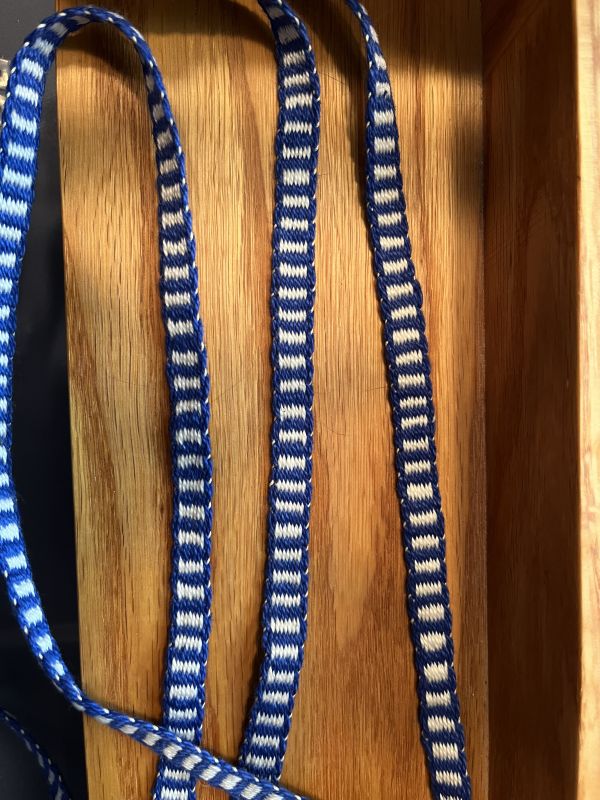
A narrow rainbow striped tablet woven band

This was done as a gift.  It's a simple pattern but of course very effective and fun to weave.  I did this on 14 tablets, all 4-threaded, all warped with just one color per tablet, 2 of each color (red, orange, yellow, green, blue, purple) and 1 tablet of white on each edge, to match the white weft.  Orientation is alternating / and \ and the turning is all forward.  It looks the same on both front and back.  The warp and weft are all big-box-store #10 crochet cotton.

The band ended up being about 1.5cm wide (9/16") and about 230cm long (about 89-90").  I hope the recipient likes it.

And I suppose it's a color wheel band as much as a rainbow band, depending on what one thinks about the blue/indigo/violet continuum and why the rainbow was defined as having 7 colors in the first place.

There's not much else going on.  I did teach two classes last weekend.  It was fun!

I'm not 100% sure about how I taught lucet.  I taught the no-turn method first and then the turn method.  I think I should have done the opposite, mostly concentrating on the turn method and then at the end showing how it can be done without needing to turn.  Well, I wanted to follow my friend's teaching plan since I was subbing.  And I haven't taught lucet in a class-like setting before.

Someone else at the event showed me something obvious yet very helpful when doing the no-turn method -- instead of wrapping both sides of the lucet and then pulling the old thread over the new, wrap one side, pull thread over, then wrap the other side, pull thread over, etc.  It makes conceptual sense, makes it easier to control tension, and in my opinion, shows more clearly how both the no-turn and the turn methods are really the same.

People learned how to work a lucet and they all seemed to go away happy, so hopefully I was sufficiently effective as a teacher.

The other class on disk braiding (8-strand Z-spiral kongo gumi) went well, too.

What next?  Quite possibly sprang or braiding, though I never really know for sure what will catch  my fancy.  I have such a long list of things I want to do, across so many techniques.

My 200th post on this blog went by last month.  Clearly I didn't notice so didn't do any kind of summary of the past or plans for the future or anything else.

I've learned a lot over the years.  I hope to keep learning.  And of course, having fun in my narrow minded way.

Dunno what I'll do if Google gets too weird with blogspot, but I guess I'll worry about that if and when things start getting weirder.


Thursday, March 12, 2026

Space! and a bit of Time!

It's been a busy few months.  My little weaving area has been in storage for way longer than planned.

But finally, I've managed to find some time and the weaving area was available, and now I'm set up again for a bit of weaving.

I'm doing a very simple pattern, Flash, by Catherine Weaver, from her blog: https://www.tabletweavingintheoryandpractice.co.uk/2024/06/flash.html

I expanded it by another 10 tablets (another set of alternating light/dark pattern motifs) because I wanted a wider band.  I'm not sure who will end up with it, but it could be a strap for a musical instrument or a case/bag/purse, or a belt, etc., as well as just being used for trim.  So I wanted something that was at least an inch or so wide since that seemed like a more useful width for its eventual purpose.  Having it be reversible was important, and I also wanted something that would be quick to weave.  Usually I set up something like stripes, but this pattern caught my eye.  It's only slightly more complicated than stripes and still has a stripe-like feel.

The colors in the original are red and yellow.  I'm using teal and sage, in my usual big-box-store #10 crochet cotton.  Why teal and sage?  They have good color contrast, I have a fair amount of each color, and I don't use these colors as often, especially for historic patterns, so this is a good opportunity to use them for something cute.  Plus the two colors look good together.

It's going well.  I do like the rhythm of tablet weaving, even something as simple as this.  I'd make this pattern again because it's very striking, lots of bang for the buck.

I took a photo of the band-in-progress but the light is wrong so it's hard to see the pattern motifs.  Eh, not so important.  I'd rather get a post out on this blog (the first in MONTHS!!!) rather than spend a lot of time on my nearly non-existent photo skills.  Therefore, this post is text only, no pics.

Hopefully I'll be able to keep doing stuff after this band is finished.


Thursday, December 11, 2025

Andean-style braiding progress since the last post

There's not much progress, honestly, but I am doing things at spare moments.

I finished the zigzag braid.  I like it and feel like I'm slowly getting better at the physical movements and am understanding more of the theory behind it.


Then I started a new braid.  This braid has one side twisting clockwise and the other side twisting counterclockwise, to make a braid that is a straight square instead of a spiral.  This is a pretty common braid that can be made in several ways.

I wanted to try this braid to see if I could match the braiding pattern on a photo of a sling from the Silk Road area (in Asia) that I saw in an online museum archive.  I'm not quite there yet but I am getting to practice a couple of new things.

It's an intentional pattern design so I have to keep track of which strand goes where and when.  Also, the colors are aligned vertically rather than spiraling, which means alternating the twisting directions on the N/S versus the E/W sides.  And one side is all the same color, so I have to keep track of which thread is the lower vs the upper, the left set of threads vs the right, and so on.  One additional thing is that this is in a fairly thick cotton yarn; dunno if that adds anything to the complexity but it is different from doing it in a fairly thick acrylic yarn.


As with other braids I've tried, I started in the middle, braiding the square braid with 4 strands (3 white and 1 green).  Then I joined the ends together into a loop, and continued downwards with 8 strands.

My braid isn't perfect but it's getting better as I make various mistakes, realize what's going on, and then try to improve.

In addition to looking through Adele Cahlender's book on Andean Sling Braiding, and through Roderick Owen's books, I also used Jean Leader's explanations from this page on her website: https://www.fascinatingbraids.com/sling.html and in particular, her instructions on Sling Braids with Spirals and Stripes.

I'm not sure what's next.  I do want to make a few hemp slings and share them with my friends.

Everything else is on the to-do list, too.  But life is busy, and other things often take priority.  Although I do fun things when I have a chance, I don't always end up with something interesting to photograph or write about.

Tuesday, June 24, 2025

Gift Band #7 -- Rainbow Stripes

Next up will be something I choose for my own reasons, hopefully.

This was a fun band, though.


It's exactly what it looks like -- rainbow stripes.  The rainbow consists of 4 tablets each of red, orange, yellow, green, blue, purple.  There are 2 tablets of white on each side, for 28 tablets total.  All are 4-threaded.  The orientations are alternating / and \.  The weft is also white.  All of these are big-box-store #10 cotton crochet thread, as usual.

I started with 3 yards and ended up with about 89.5" unblocked.  The width is a bit more than 1", maybe 1-1/8".

It went pretty quickly except for the parts where the cats tried to help.

Sunday, June 8, 2025

Sprang project #4 -- two-color acrylic bag

The learning continues.


I used acrylic this time.  And two colors.  I was actually trying for a different color pattern but got myself too confused, so I kept it simple.

There are 16 loops (32 ends total), with 8 of each color, alternating.  I used the frame with 20" PVC sides, and when the tension got too tight, I moved the loops to skewers and taped them to the loom.

I did a basic 1/1 interlinking pattern.

Diagonals!  I'm so pleased!

The acrylic is a little sticky, especially when I'm undoing mistakes.  But on the whole, it behaved reasonably well.


The above is after sewing up.  I did the same figure-8 loop around the threads at the bottom that I've done for most of my projects so far.  Then I sewed up the sides and ran a twisted cord through the loops at the top to use as a drawstring.


The above photo isn't a great angle, but it shows how the diagonals open up into amazingly cute stripes when the bag is stretched over something.

This size is about right for a cell phone or something of similar size.

Things I learned:

I am still quite terrible at sewing up.  Keep working on that...

I should have wriggled the piece to even out the gauge before sewing up.  It might also be a good thing to move the piece to skewers immediately after warping.  Or figure out something else to keep the top from being so loose.  Maybe these things were always attached to something firm, like a band or a purse handle or something?

When sewing up, secure the drawstring so it doesn't fall out of the loops I so carefully set up before sewing.  Also, make sure the drawstring goes in the correct direction.  Perhaps I should have a safety string through the loops that doesn't get untied and removed until after the piece is done?

When hiding ends, don't pull things too tight, and make sure you can loosen the ends to the correct tension before it's impossible to find them again.

Think about matching colors for sewing up the sides.  Should the edges be the same color?  Should I use different colors to sew them?

This is a fun and attractive pattern.  I like the color pattern and how it interacts with the interlinking pattern.  These could also be interesting hand/wrist warmers.  Or a hat.

On the whole, I'm pleased with the lessons I learned from this project.

Monday, February 3, 2025

An Akhmim tablet-woven band (and some ignorant braid ruminations)


This is a dead simple tablet-woven band.  It has 15 tablets, 4-threaded, alternating \ and / orientation.  All turns are forward, though one can turn backwards when the twist builds up if desired.  (I kept it all forwards.)  It's a simple pattern of stripes and Vs and it looks the same on both sides.  (The photo above shows both sides.)

It's meant for a gift/donation, where I like to do things that aren't too fiddly but still look nice.

The pattern is from Tablet Woven Bands from Egypt by Silvia "Aisling" Ungerrechts, p.20-21.  It's one of two Akhmim bands in this section of her book.  She says that the two bands from Akhmim are from hand-drawn images in the book Ueber Brettchenweberei by Margaret Lehmann-Filhes in 1901, with this one being in Figure 29 on p.20.  (The drawing is included in Aisling's book with the original caption of "Schnurband  aus Grabfunden in Akhmim".)

The original does not list the colors nor the width of the band nor the content of the yarns.  I have no idea if the band is in a museum somewhere or even if it still exists.  I don't see any information about how old it is, either, though I guess I could figure out some of these things if I went internet-searching or looked at Aisling's book more closely.  I'm glad that it was documented and that Aisling has shared it with everyone.

Aisling chose wool in red, white, and blue.  (A lot of these bands seem to use linen for the white/natural, but whatever.)  I am weaving with cotton, as usual.  It's better for gifts anyway since it's easier for people to care for than something which might shrink/felt unexpectedly.

I'm starting to get a bit low on colors in the Aunt Lydia's cotton stash (yay!), so I used my small, old stash of cotton rug warp, in dark purple, light purple, and olive green.  I'm getting low on this batch of cotton rug warp, too, which is fine by me.  I'm not crazy about its matte texture or how well it wears.

It turned out well.  I'm very pleased with it and am happy to pass it along.  It's a pattern I should keep in my general rotation for when I need to crank out something quick to use as a gift.

The band is around 15/16" wide (24mm) and around 65.6" long (169cm) before blocking.  It should work well as a belt, a strap, trim, etc.

-----------------

A friend has been chatting me with about the Sion knitted purse 269, which I think I mentioned before.  Photos can be found here: https://www.kornbluthphoto.com/SionPurse269.html with more of the Sion knitted purses (and other purses) here: https://www.kornbluthphoto.com/Purses.html

We had fun talking about knitting, dyeing, and spinning techniques.  Next up is the braid!  It's not completely shown in the photos.  In particular, I would love to see all the ends to see if there are any loops.  I'd also like a better look at the split braids compared to the main strap braid.  And the knots, of course.

So...  The purse is knitted in silk and it's pretty clear that the braid is made from the same yarn, in the same colors.  It's a six strand braid, with each braiding element looking like it consists of 2 strands of yarn.  For those who care, the yarn is Z spun and S plied, and dyed in blue, purple, yellow-green, orange-red, buff/tan (though this might have been darker or more distinct in the past), and natural/undyed.

It sure looks like fingerlooping at first glance, and indeed, I can easily crank out a 6-loop fingerlooped braid that looks right to the casual eye.  I need to do a 6-strand pigtail braid to see if I can get it to look right, and also do a 6-strand loop-exchange braid, though I'm not quite sure the way the loops cross matches, and also whether the color progression would match without a lot of careful set-up.  Oh, and a loop-exchange braid would have to be a 2-person braid, I believe, something I don't know much about yet.  Or maybe it could be done with bicolor loops.  Hmm.

Would the people making these purses known about 6-strand square fingerloop braids?  As far as I can tell, the simple square/round fingerloop braids that show up in the braiding manuals tend to call for an odd number of loops.  (Loop exchange braids tend to have an even number of loops.)  But it's not too hard to independently re-invent an even-number square/round fingerloop braid.  Another possibility is a fat fingerlooped braid that then separates the loops into two thinner pigtail braids (and/or is done with loops unreversed to split the fat braid into two thinner braids) as part of the pull-through closing strap.   The photos aren't quite clear enough, and I'm too much of a braiding noob, to quite understand what I'm seeing.  So I guess I'll get some yarn out and start to play.  I should also see if I can find the article I've seen reference to, probably by Joy Boutrup, on the braids of these purses.  If indeed it was these purses and not some other medieval-ish purses with fingerloop braids.

The fat knots and tassels on this and other Sion purses are entirely adorable, too.


Friday, August 30, 2024

More monochrome tablet weaving

This is the start of a belt/band/strap for a friend.  I've done this pattern before -- it's used in the Band from Cigarralejo and also the Museum of London Braid 449.  It's very simple yet effective -- use a multiple of three tablets, 4-threaded, and alternate three Z-oriented tablets with three S-oriented tablets.


I'm using the same teal cotton I've been using for the last few bands, and it will be a gift to go along with the other teal and teal/gold bands.  This is fairly fine thread -- even with 30 4-threaded tablets, the band is barely an inch wide (give or take a few mm).  I did a fairly long warp, too, about 3 yards (9 feet).  The final band will probably be at least 7' (2m) long.  The weft is the same thread as the warp.

I'm using my big tablets (from Robin & Russ Handweavers) since I wasn't sure how many tablets I'd need and I have more of these than any other tablets.  It confirms that I really do strongly prefer smaller tablets.  These big ones are harder for my small hands to hold and turn.  There will also be a little bit more waste at the end, not that it really matters given how long the band is gonna be anyway.

It's kind of a hassle keeping all of the threads from tangling, and also a bit of a hassle keeping the shed clear and open.  Although I like the band, I'm not exactly enjoying Life when the threads tangle or get caught on the tablets.  It should get easier as I keep weaving, I hope.  Luckily I am patient and by now have adequate skill on weaving back mistakes even when a tablet goes wild and needs some individual assistance.  Also, one warp thread seems to be a whole lot shorter than it should be.  Dunno how that happened, but it'll have to be dealt with once I get there.  It's not a big deal, just something to be aware of.

The band has a really nice feel to it.  I like how it drapes.  It's not too stiff while still feeling very sturdy.  I hope the recipient likes it and I hope it ends up being both durable and useful.

I seem to recall someone on the 'net did this texture pattern based on a medieval portrait (i.e. an interpretation of a painting rather than figuring it out from an actual artifact), and that weaver called it a "seat belt pattern" because presumably it reminded the weaver of a car seat belt.  But I can't find that post again to see whose portrait it was.  Not that it matters.

I'm not sure what I'll do next.  The double-face seal tags (from the article everyone references, that also has the tablet-woven cord in it) are calling to me.  They'd probably look better in finer threads, sigh, though they'll probably be sufficiently attractive in thicker thread if that's what I choose to do.  I don't know if I want to move on to silk sewing thread just yet but I do have some finer cottons.  Plus I don't care if I match the size of the historic sample since that's not my goal.  I'm just here to have fun.  But maybe some other technique or pattern will catch my eye and I'll do that instead. I did agree to teach some braiding sometime in September, so I'd better do a quick review to figure out what I want to teach.


Monday, August 5, 2024

Another teal and gold tablet woven band (17th century Falun silk ribbon pattern)

It is done, yay.  All 2.7 meters of it (108-ish inches).  It's roughly 9mm wide, not quite 3/8".  The broken warp threads are properly darned in, and now it awaits a quick wet-block.


I like how it turned out.  It's nothing dramatic, but it should be a pleasant and hopefully useful piece of trim for the person I'm giving it to.

I'm not sure what I want to do next.  Another teal plus or minus gold band or braid?  Or something else entirely?


Saturday, August 3, 2024

Achievements unlocked (a tablet weaving post)

Dunno if it's a real achievement, but I broke a warp thread in my current tablet-weaving project.  I knew in theory what to do, and I did it, and yay, it worked!  I'll darn in and hide the loose ends when the band is finished.

The second achievement, such as it is, is that this is a longer tablet-weaving project than I usually do.  It'll probably close in on 3 meters by the time it's done.  I'm getting tired of it so am taking this break and typing for a while instead.  My fingers and wrists are a bit sore and I don't want to give myself an overuse injury.  I'll probably keep weaving off and on, though.  It's hard to resist doing just a few more inches, and then a few more, etc.  Plus once I get it done, I can set up another band.

Why 3 meters?  Because I'm using some small skeins of Anchor pearl cotton #3.  I folded it in half and half again, and it was longer than 3 yards (when folded in fourths) but not by much.  I wanted to make at least 2 meters of woven trim, meaning that I needed at least 3 yards of warp, so I shrugged and went with whatever length it was when folded in fourths.  (Yeah, I mix my units.  I can live with it, and all my readers are imaginary so their opinions don't matter.)

The other yarn is a much finer 2-ply cotton, probably around #20 or so, give or take a bit.  I'm using it for the weft, too.  I used it as weft in my previous teal and gold project, too.  I suppose that's a third achievement -- although I do weave with finer threads, I haven't done so for a while.  This is a weaving cotton, all limp and 2-ply, rather than the crisp multi-ply and/or cabled cottons I use for knitting doilies.

So, with two thicknesses of yarn, and one of them shinier than the other, the Falun band seemed like a good fit.

It's also a way of honoring Amica Sundström, one of the authors of the Historical Textiles blog, who passed away recently.  I saw this band and the pattern for it on their blog.  I've made it before, but it's a fun and easy pattern and I am fine with keeping it as a semi-regular pattern in my everyday repertoire.

This pattern has ten tablets and alternating / and \ tablet orientation (the original pattern specified \ and /, but I did it as / and \ this time, just for kicks).  Two four-threaded thin-yard tablets alternate with two two-threaded thick-yarn tablets, for 3 stripes of thin yarn and 2 stripes of thick yarn.  It's simple but cute.

I rigged up a warping path to make the thin yarn the same length as the thicker pearl cotton, got the tablets threaded, and off I went.  Well, I had to move around some cards at first since apparently I wasn't paying attention as I warped and got some of the tablet orientations wrong.  Luckily that's a very easy fix.  I blame the cats for distracting me.  Cats are terrible weaving assistants.

The thread tangled quite happily given half a chance, and even when I made strenuous attempts to keep it from tangling.  (The cats made strenuous attempts to tangle it further, of course.)  Some threads also had a bit of animal fur on them, which would felt a bit as I tried to untangle things and then further contribute to the tangling.  It's gotten a lot easier as the remaining warp length shortened, but the first few times untwisting and advancing the warp weren't a lot of fun.

The thin thread is dark teal and the thick thread is old gold.  Yes, they're meant for the friend who requested gold and teal and provided these threads for my use.

The band is going well.  There's enough contrast between the two threads to make it all look good.  It'll be excellent as trim or as a thin belt or strap.  I have maybe a meter of warp left to go.

The warp thread broke about 4" in -- my fault, the thread got caught on something sharp and I tugged rather than trying to work it loose.  I was worried that it might be the first of many warp breakages, but luckily it's all holding together so far.

The thicker yellow thread accumulates twist tension more rapidly than the thinner blue thread even though the yellow thread is two-holed and the blue thread is four-holed.  I suppose it's because the yellow thread is thicker.

There are no photos yet, not even of the pin that's holding the thread ends from the broken warp.  And yeah, I had thought I'd be doing the monochrome band next, but I'm doing this two-color band anyway.

---------------------

A friend recently told me that I seem to do a lot of production tablet-weaving (as opposed to only time-intensive intricate pieces, which is my friend's strong preference).  There's a certain amount of truth to that claim.  I do complicated stuff, but I also like to crank out yardage, where the fun of the band is in setting it up and then watching it grow, being able to weave in a meditative way without needing a ton of concentration for each turn of the tablets.

I do a lot of simple bands for other reasons, too.  I suspect a lot of tablet-weaving throughout history was utilitarian, not designed for a wealthy person's cuffs but rather for everyday belts and straps and cords and warp-weighted loom selvedges.  Speed and efficiency were probably important, whether for everyday bands or special bands.  The best way to get faster is to get a lot of practice in weaving, so that a lot of it becomes second-nature.  That way, when I do a more complex band, there's a lot of the basic weaving stuff that happens without me having to pay attention to every single detail, so I can concentrate on the fiddly stuff.  Plus I can make lots of general-use tablet-weaving and freely distribute it among my friends, and not just make a limited number of performance pieces.

Also, the best way to get good at something like this is to do a lot of it.  A fair amount of this skill is a physical thing, with my fingers knowing what to do -- how much tension for the weft, how hard to beat it down, how to turn the cards so it's easier to get a clean shed, etc.  So, by doing a lot of bands, I automatically improve my weaving consistency.  These quick bands give me more yardage than a slower band would and thus more weaving for my brain and hands to absorb.  Again, that helps improve the overall quality of my weaving when I do the fiddly bands.

The same is true for fingerloop braiding.  It gets better, more consistent, etc., the more I do.  And ditto for just about everything else.  It takes time and repetition, not just the top-level understanding of how it all works.

Which we all know, of course.  But sometimes it's good to write it all out.  Not that I'm hugely experienced with tablet-weaving (or fingerloop braiding, or some of the other things I do).  Not yet.  But I'm getting there.


Monday, February 5, 2024

Rainbow stripes (an easy tablet-woven band) and a couple of 3-loop fingerloop braids

This wove up quite quickly.  Well, no reason why it shouldn't have -- just keep turning the cards, no counting or thinking to do.


I like how it looks.  This is the same on both sides and would make a good strap or belt.  It's about 67" long and not quite 1.25" wide.  There are 33 tablets, 4 threads per tablet, alternating / and \ tablet orientation, with all 4 threads in each tablet being the same color.  The colors are rainbow -- red, orange, yellow, green, blue, violet, 2 tablets of each, with 3 tablets of black between and around each color stripe.  I used my usual stash of big-box-store crochet cotton #10 with the slightly finer black #10 cotton as weft.

I'm not sure why the lines aren't crisp for some of the colors.  Differences in tension?  Funky weaving?  Uneven cotton thread?  \ and / instead of / and \ for the tablet orientations?  It'll probably mostly even out with blocking and/or wearing.  It's still a cute band.  I still like stripes.

--------------------

Next up are two 3-loop fingerloop braids.  I wanted to really see the difference between two slightly different braiding patterns.  I used loops of 3 different colors to have some sense of what was going on.  (Six colors would have been even more clear, but eh, maybe a future experiment.)


Yup, definitely different.

The first braid is the one from Ingrid Crickmore's instructions at https://loopbraider.com/2012/08/02/easy-3-loop-braids/.  (It was originally a tutorial/class on the Braids and Bands mailing list.)  I did what she calls the square braid, which indeed is more triangular than square.

The other braid is based on a different loop-braiding tutorial/class on the Braids and Bands mailing list, by Jean Leader.  It is a lot rounder that the first one, and for me at this point, it's looser and stretchier than the first one.  It's still pretty cute and would be perfectly respectable with better color and yarn/thread choices.

For both of these braids, I was using my middle finger to get the loop from the other hand.  Leader's instructions (now that I look at them) suggests using the index finger.  Actually, Leader's instructions are definitely different from what I did.  Hmmm...  Clearly I need to follow her actual instructions instead of the ones in my imagination.  Or maybe I really did see what I did somewhere and have just forgotten where.  Or maybe I am mixing the instructions for the double-braid (aka divided braid) and the square braid.

Let's see if I can describe what I did without a good graphic...

For both braids, there are 2 loops on one hand and 1 on the other.

For the square/triangular braid -- I used my middle finger as the picker.  It went under the loop on my index finger, through the loop on the middle finger of the other hand, then around the top of the loop of the index finger on the other hand, pulling that loop through.  The loop on the middle finger moves to the empty index finger, leaving the middle finger ready to take a loop from the other hand.  Then the moves repeat using the other hand.

My second braid is done just like the first Crickmore braid, except that the empty middle finger goes through the loop on the index finger as well as through the middle finger of the other hand before picking up the loop from the index finger of the other hand (through the top, so it reverses).

Jean Leader's version is a bit different from that -- she uses the index finger as the picker and hooks the loop through the bottom and doesn't go through the same loops as the other versions, I don't think.  I will do this one and see how it compares!  It might just be the A-fell vs V-fell version of the same braid, though I'll better after I do it.

I am not including the double-braid (i.e. no reversed loops) or the flat braid (alternating reversed and non-reversed loops) in my playing around.

Once I get bored with simple 3-loop braids, maybe I'll move on to the 5-, 6-, and 7-loop braids.  There are lots of possibilities with those!  I'll also post pics of my 2- and 4-loop loop-exchange braids and maybe do the 6-loop version or beyond, as well.  The 4-loop one looks very much like some of the 8-strand square braids I've done on the marudai.

------------------

I'm not sure what tablet-weaving project will happen next.  I'm also feeling a vague urge to warp up my inkle loom (now that the big one has returned to its owner) and make a few inkle bands.  And so on.


Friday, February 24, 2023

Explorations in monochrome tablet weaving

I have been continuing to work with the wool yarn this week, exploring some new patterns.

First, I decided to play with structural stuff, where the tablet orientation makes the pattern.  I considered the plain part of the belt of Philip of Swabia -- it's a monochrome checkerboard pattern, more or less.  Here is one version of that texture pattern.  Here is another.

I finally decided that the wool is too heathery to really show the details of the checkerboard.  However, this textural pattern, consisting of vertical stripes rather than checkboards, seemed like it might fit my yarn better.


I used 15 tablets, alternating threaded S and Z (or \ and /), 3 per orientation before switching to the other orientation.  All turns were forward, as I usually do, with no reversals.

Interestingly, and not surprisingly, the yarn was a bit stickier than with the two-hole patterns.  Nothing was felting or anything.  But the threads weren't always thrilled to slide smoothly past each other when opening the shed.  I had to help it along a little bit.

The pattern is subtle in this yarn but I still like it a lot.  This band is quite wide, 1.25-1.5", compared to the two-hole bands I've been doing.  It's also a bit shorter -- there was a bit more take-up, quite possibly because there are four threads per tablet.  I think this pattern would look really nice in a flat, non-heathery color, in a shinier yarn, maybe more tightly twisted.  So it was good for me to play with it and add this pattern concept to my idea bank for when I just want to crank out something simple.

Next up, I wanted to play around more with the idea of two adjacent empty holes per tablet, in the manner of Candace Crockett's Draft 14.  Peter Collingwood discusses this concept briefly in The Techniques of Tablet Weaving, on p.93-94 in my edition.  I charted up a simple chevron.

I was worried that the pattern wouldn't show up well in the heathery gray, so I tried it in some red vintage-store crochet cotton.  I like how it turned out, but I decided it was a bit too subtle for the heathery gray.  Also, the two sides are slightly different, in a more noticeable way than I wanted for the gray yarn.  I used the same red for weft as for warp, and I wonder what it would have looked like with a contrast color for the weft.  Another variation that mildly interests me is doing diagonal lines instead of chevrons -- doing a strip/stripe of the line going one way, alternating with strips/stripes of the line going the other way, with maybe a couple of tablets with 4 threads in between the stripes.  Hmm, someday.

Another interesting comment I found online about these patterns with two empty holes adjacent rather than diagonally opposite, from Phiala's venerable Stringpage site, in the section on two-hole tablet-weaving: "If the tablet is threaded through two adjacent holes, all possible sheds can be produced (both up, both down, one up and one down), making it possible to weave any structure possible with a four-harness loom!"

I'm going to have to think about that for a bit.  In addition, of course, there is Andean Pebble weaving done with tablets.  That uses two colors, but they are adjacent rather than diagonally opposite.  Linda Hendrickson has published some English-language stuff on this, Claudia Wollny discusses it in her book Tablets at Work, and I know there are other resources, in English and other languages, even though I'm not gonna list them all here right now.

Anyway!

Back to the monochrome brick patterns of Karisto and Pasanen!  This time I returned to Tablet Woven Treasures and chose the charming pattern on p.109.  I added a tablet to the left edge to make it symmetric.  Thus it uses 10 tablets.  The two tablets on each edge are threaded with four threads, and the six pattern tablets have two threads each.  The tablet slants alternate \ and /.  For the pattern tablets, the \ tablets are threaded in AC and the / tablets in BD.  The weft is the same as the warp.

I really like this one a lot!  The band turned out to be about 3/4" wide and about 62" long unblocked.  I will definitely make this one again.  As with the other brick patterns I've done, it could be expanded with more two-hole brick-pattern tablets, or by adding stripes and what-not (possibly in different colors) for the edges.

What did I learn?

Uhh....  I still like weaving with wool and no longer fear tablet-weaving with it.  I liked all of these new-to-me patterns and should do them again.  I'd like to explore more of the two-adjacent-hole patterns.  Doesn't the true pebble-weave structure done with tablet weaving use this technique, though of course that concentrates on the color patterns rather than subtle monochromatic structures.  Hmmm.

Cats are not particularly useful weaving assistants.  As always.  But they do like to keep an eye on what I'm doing even when they're not actively helping. I hope that the recipients (a few of these will be gifts) don't mind a bit of cat fur mixed into their bands.

It was slightly difficult to maintain even tension for a few of the bands.  I need to think about that for a bit.  Is it because I didn't put even weight on each card?  Is it because of the slight effort needed in making a shed?  Is it because some cards were \ and some /, some two-hole and some four-hole, and thus there was different take-up when combined with the ply of the yarn?  If so, would weighting individual tablets rather than the entire bundle make that better, worse, or no change?  Will most of it go away with blocking/steaming/ironing/weighting/using?

What's next?  I'm not sure!  I might re-do the wool bands using cotton.  Or I might resume multi-color tablet-weaving or even knock out a few inkle bands.  I'm still enamored with two-hole patterns, so that seems most likely.  But you never know.  Some braids are still calling my name -- that Whitehorse Hill cist burial braid (which seems to be a 13-strand plait which can be done freehand or using fingerlooping) and a 6-strand braid from the Hedeby apron, which has an online site showing it done freehand, but I suspect fingerlooping might have been involved in the original.


Tuesday, January 10, 2023

A Few More Inkles

 Here are the rest of the bands I made with that last bit of leftover perl cotton.  There was only enough left to make one more band with horizontal stripes -- blue with white bars.  Then the rest of the thread stash made two narrower bands with vertical stripes.


One of the vertical-stripe bands has 4 ends of red, 3 of orange, 1 of dark gray, 3 of yellow, and 6 of pink.  Yes, asymmetric, but it looks good anyway.  I particularly like the 1 dark gray, which of course makes speckles rather than a vertical stripe.  The band is very cheerful.


The other vertical-stripe band has 2 ends of blue, 4 of white, and 6 of green.  Simple, narrow, asymmetric, yet also attractive.


The last remnants of the various colors are all less than 3 yards long.  I suppose they'll go into the braiding stash.  Or whatever I end up using short bits of yarn/thread for.

The bands in the photos are unblocked.  I did block them later -- soaked them in warm water, then either ironed them or hung them up to dry.  They look better, of course, but not so much that I'm going to add new photos to this blog.  Not yet, at least.

Now what?  More inkle weaving?  I can move on to another thread stash.  I can put heddles onto the Dundas inkle loom (a thrift store find) and use that for a few bands.

Or maybe it's time to do more tablet weaving.  I've been circling around various 2-thread patterns and double-face patterns.  Which shall I try first?


Tuesday, December 27, 2022

A Few Inkles

I have been wanting to (a) use up my dwindling stash of perl weaving cotton, and (b) play around with stripes, and (c) do some quick things.

This meant that it was time to pull out my inkle loom.  I wanted to do simple horizontal stripes (i.e. bars), preferably in low-contrast colors.

Some of these are low contrast, I suppose!


I like them a lot.

It's been a long time since I've done any inkle bands.  As such, I'm not too surprised that my edges are uneven and my picks aren't necessarily consistent.

What I've learned -- I like these simple stripes!  I will continue to do them as long as I have enough thread for horizontal bars, which is probably around 2-3 more, and then I'll switch to vertical stripes for the last band.  Or I'll switch to some other thread completely, or even start doing wider and more complex inkle patterns.  We'll see!

I seem to like using #20 crochet cotton for the weft.  #30 is too fine, and #10 is OK but I still like #20 better.  So that's useful to have learned.  I feel like Goldilocks now.

It would have been fun to have done stripes with the opposite color for the edges, but I don't have enough thread to do that.  Oh, well.  That's what happens with stash-busting -- there's not enough left for new experiments.  Maybe I'll do that for some future projects, especially if I'm still enamored of these narrow bands with horizontal stripes.

Cats are not particularly useful weaving assistants, but they seem less able to cause mischief when I use an inkle loom than when I've been tablet weaving.

Inkle-loom bands are quick to warp up and quick to weave.  They are great for a little bit of near-instant gratification and low-attention-span weaving.

How I did these:  The color that I had the most of was used for the border, which consisted of 3 or 5 warps.  Then I alternated color 2 and color 1 until it looked like I was either out of color 2 or had just enough of color 1 left to do the other border.  For all of them, I think I ended up with 7 warps of color 2.

The above photos are straight off the loom.  I'm going to wet-finish them and will take new photos to share.  For wet finishing, I'll soak them in hot water, then get rid of most of the water by wrapping them in a towel, then ironing them and then letting them finish drying.

In the past year or two, a couple of other inkle looms serendipitously have come my way.  I'll need to play around with those, too.  The one I used for the above bands is my own home-made one that I've had for many years.  The person who made it used dimensions/instructions from Inkle Weaving by Helene Bress combined with images of a Schacht inkle loom.  It holds roughly 3 yards.  Of the others, one is a small 2-sided inkle loom, also home-made, given to me as a gift.  The other is a Dundas that I found for dirt-cheap in a thrift store.

I still want to do more tablet weaving soon, once I have space to set it up again.  A friend told me about a sale on ceramic fence insulators, so I might try using those as weights, one per card or so, the next time I warp up.  I'll load them up like kumihimo bobbins (described in Braids by Rodrick Owen) and see if it helps me with my warp control issues.

I also recently had some fun with disk braiding, and in particular, the Fill the Gap braid.  I ran a quick little course for beginning braiders back in November and we all had a lot of fun.  I'll do a new post about that soon-ish.