Friday, August 29, 2025
Some idle thoughts
Thursday, July 24, 2025
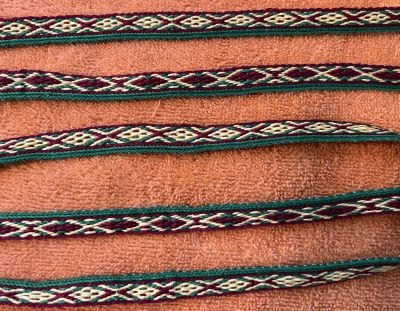
Rib weave tablet woven band from Maksu, Humikkala (a 2-hole pattern from Tablet-Woven Treasures)
This one has appealed to me for a while. I'm not sure why I decided to do it now, but that's fine. It was a pretty straightforward project.
The band is in Tablet Woven Treasures by Maikki Karisto and Mervi Pasanen. It's on p.131, 15. Maksu, Humikkala (KM 8656:H30:1). They call it a rib-weave pattern. It's a two-threaded pattern with all the threads in holes A and C, not offset like a lot of other 2-hole patterns. There are 7 pattern tablets. Each side has 3 four-threaded edge tablets which are tubular-woven. (In other words, both sides have tubular edges and all 3 edge cards on each side are part of the tubular edge.) That makes 13 tablets total, 6 edge and 7 pattern tablets.
It's pretty adorable! Unblocked, it's about 7/16" wide and about 65" long.
A warp thread snapped in the middle, yikes! I have no idea whether to blame the cats, the thread quality, or happenstance. I'm glad I already have experience with this, and indeed, it was not an issue to attach a new warp thread and keep going. There's one spot where apparently I forgot to do the tubular edge on one of the sides. I tried to fix that, too, a bit less successfully. It looks fine on the top but is slightly visible on the bottom if one knows it's there and looks at the right spot. Or if one runs fingers along the band -- the repair spot feels a bit different, but that's also true of the unrepaired area before I tried to fix it.
The width varies slightly. I really wanted the red on the edge tablet to show. But I had to balance that against pulling the weft tight enough for the pattern to look right. I'm a trifle disappointed that the red edge is not too visible most of the time. Oh, well, it can be a secret, I guess. Or I can use this as a strap since both sides of the band are very cute. Or attach it at the very edge of something and/or attach it loosely so the red can be glimpsed.
I'm glad I did this band, but I think I'm tired of tubular edges for a while.
I have no idea what I'll do next. Something, I'm sure!
Tuesday, July 1, 2025
Brocade planning and other useless ruminations
Next up is brocade. It's time! And my tablet-weaving area is open, no other commitments, no need to pack things away for a while, etc., for the first time in months. OK, the cute band I just finished was a bit of a spontaneous distraction, but that doesn't count. I seem to have been writing about brocade for most of 2025; time to actually do something about it.
First up will be a sampler.
I think I'll use the usual big-box-store #10 crochet cotton for the warp, as usual. Weft will be one of the leftover doily cotton threads, with no real attempt made to match the weft color.
Supplementary/brocade weft will be something thicker, of course. I think I'll mostly use the dull-gold cotton perle #3 that I used for the Falun-pattern gift band a while back. But I might also use some of the oddball/synthetic knitting stash threads, too. Or whatever else I find.
I think I'll warp up 13 tablets in alternating S Z orientation. That should give me enough tablets for some of the early Saxon bands, a few Birka bands, some of the Coptic bands (in Aisling's book), motifs from Wollny's Roslein und Wecklein transcription, plus a few others, depending on how much space I have and what I feel like trying. I might try the motifs in both positive and negative versions to see what they look like. I might try a few isolated motifs or a bit of soumak. I might try a few different colors and/or different brocade-weft materials. Or I might not. I'll see if there's a difference for me between carrying the brocade weft to the same place on the band vs only where the motif is. Etc.
There's a lot to learn. The basics seem very straightforward. But there will be lessons in tension and also in brocade vs background and base-weft thread thicknesses. I expect the first sampler band to be very sampler-ish.
And as always, there's a chance I'll get distracted by something else and brocade will end up getting delayed yet again.
----------------------------------
Because I'm dithering and blithering, I decided to list most of the major tablet-weaving techniques I know about, whether I've tried them, what I think, what future plans are, or whatever else I felt like writing about them.
I'll start with the techniques in Claudia Wollny's Tablets at Work (though I might miss a few minor ones she discusses within other chapters).
Threaded in patterns -- check! These are popular with modern tablet-weaving designers. There are a lot of fun things that can be done with threaded-in patterns and all-pack forward/reverse turning. I still do a lot of bands that fall under this category.
Double face -- check, though I want to explore more soon. In particular, I haven't done much yet with the blocky/repp version where the tablets are all in the same orientation as opposed to alternating orientation. Also, I'm pretty sure Wollny does 2F2B double-face for both SZ and all-Z double-face, and I'm curious about the "rotate 180 to change colors" version that's in Shelagh's pdf on double-face repp effect.
Double cloth -- this is on my to-do list. It's high up there, but I keep doing other things instead. Maybe this will be after brocade. It looks pretty straightforward but I'm sure there are nuances that will be learning opportunities when I get there.
3/1 twill -- check, though I'm only at the beginning of exploring this method. I haven't explored all of the variations that Wollny discusses in Tablets at Work and her Twill 1+1 book. I really like this technique and want to do a lot more than I've done so far. I want to learn better how to chart my own patterns (I can do some, but maintaining the twill line and avoiding long floats are still things I'm working on.) I also like the Collingwood method for doing one-color twill as a two-pack method (as opposed to handling each tablet) and need to explore color changes and other motif developments with this style of card manipulation.
Diagonals -- check! This is such a big category of modern patterns. Also, there are a couple of variations I've tried though not everyone makes a distinction between them. The Egyptian-diagonals modern method usually changes cards in groups of two tablets and two turns. Finnish diagonals are more carefree.
Kivrim -- check! These are fun and also popular with modern tablet-weaving designers.
Sulawesi -- check! I really like doing Sulawesi. I definitely want to make more bands, both with traditional and modern and self-designed motifs. I need to learn the tubular strap method that often accompanies bands that are woven by the original/traditional weavers.
Floatwork -- check! I've done very little so far, though.
3-hole -- check! I want to do more of this. I like how one can combine the textures of 3-hole with a bit of floatwork. I also like how there are historic bands that apparently combine this with brocade -- that too is on my eventual to-do list.
2-hole -- check! I love doing 2-hole designs. This might be my current favorite technique. I've also done 2-hole where the holes are next to each other and those are interesting, too.
Pebble weave -- this is on my to-do list, but I haven't done it yet.
Cablework -- check, though only a teeny bit to make sure I understood. Heck, I do cable knitting; this is pretty much the same thing. I did see some nice-looking cablework bands not too long ago, which has piqued my interest a bit.
Structure weave -- check! I don't think Wollny talks about the Gotland bands, which might be made through flipping tablets around a horizontal instead of a vertical axis. I've tried the Gotland method as well as regular monochromatic textural weaving.
Relief structure -- I haven't tried this yet.
Brocade -- as I wrote at the top of this post, this is almost certainly up next.
There are plenty of other techniques that aren't covered by Tablets at Work.
Pack-idling -- check! I like this method. Collingwood talks about a lot of variations, but even just the style used for Cambridge Diamonds and Felixstowe is perfectly nice.
Cordage/tubular bands -- check! I've only really done 4-threaded cordage so far. The 2-hole methods are on my to-do list.
Tubular edges -- check! (these are in the Finnish bands discussed in Tablet Woven Treasures)
Double-turns -- check! (also from the Finnish bands)
Tie-downs -- check! (from several places, but probably best known from Tablet Woven Treasures)
Laceby -- I haven't done this yet. Shelagh discusses the method on her website.
Soumak -- I haven't done this yet. Since this sort of overlaps with brocade, maybe I'll do a little bit in my brocade sampler.
Tablet weaving around a core thread -- I haven't done this yet.
Tablets with a different number of holes (3, 6, etc.) -- I haven't done this yet.
Adding or removing tablets during weaving -- I haven't done this yet (though I understand the basics)
Turning or bending the band during weaving -- ditto.
Adding extra or ornamental warp or weft threads (such as making fringe or attaching to a loom-warp) -- I haven't done this yet.
I'm sure there are more things casually mentioned in Collingwood that are entirely new categories of techniques, but which at my current knowledge completely zip over my head.
I'm also pretty sure there are things I've either done or that I'm aware of that aren't on this list.
So far, I've liked all the techniques I've tried.
Saturday, June 28, 2025
Not a Gift Band -- simple stripes and dashes tablet woven band
Tuesday, February 11, 2025
Finished: Band 41 from Tablet Woven Treasures
You can see the waviness in this pic (given the way the light was, it highlighted this particular aspect of the band) -- that's pretty typical for patterns made using the diagonals technique. It'll block out, especially if I iron the band. I kind of like the three-dimensionality, actually. Most of the time it's not that noticeable unless the light hits it just right.
Thursday, February 6, 2025
Band 41 from Tablet Woven Treasures (from Kaukola, Kekomäki (KM 2489: parts 67-68, 107 (H1))
It's been a while since I've done a Karisto/Pasanen band. I was flipping through Tablet Woven Treasures for inspiration and decided to do Band 41, which was the top edge of a skirt from Kaukola, Kekomäki (p.190-191). This is a cute little 4-threaded band that uses the diagonals technique with half-turns (along with a little bit of 3/1 twill and double-face sensibilities) and has tubular edges. I like the motif.
The book shows the band in blue, yellow, and red. My cheap cotton stash is starting to get low, so I ended up choosing different colors that I had a bigger supply of. Mine is aqua/teal, sage green, and burgundy red. It's pretty reasonable, I think. (The pic's colors are not quite right, but close enough.) The weft is random leftovers, as usual. Since this isn't necessarily going to be a gift, and since both sides have tubular edges, I'm not going to worry about possibly needing to change my weft thread partway through the band.
There are 11 tablets, 7 for the pattern and 2 on each side for the tubular edges. One thing I'm noticing is that one side curls under a lot more than the other. Hmmm. Dunno if it's my technique and tension, or if it's something about how the tablet orientation interacts with the yarn twist and the path of the weft. I'll try to loosen up a bit to see if it helps. If it is tension, I'm not sure which direction is tighter than it should be.
It's going pretty quickly. There's nothing very difficult about it, but I do have to pay attention. I like it so far.
Mostly unrelated: There's a book that's been around for a while on Anatolian tablet weaving (Tablet Weaving from Anatolia and the Ottoman Court). Sarah Goslee's review (https://www.archaeologicaltextiles.net/pages/anatoliaTW.html) mentions kivrim aka ram's horn style motifs on some of the bands, and that these motifs weren't found on bands (in the book's photo section) that were pre-17th century. So there's an approximate date for when kivrim patterns were known to exist. They go back to at least the 17th century in that part of the world. So there.
Sunday, October 20, 2024
The newest tablet-weaving project (Fajum graveyard fragment)
Tuesday, July 30, 2024
The latest two-color two-hole brick-patterned band
I do like this pattern. Obviously, since I make it a lot. This time it's teal on a gold background. The person wanted two matching bands of a particular length. So I did X repeats, put in a spacer, then did another X repeats. There was a bit of warp left over, so after the second spacer, I wove another few inches until I reached a reasonable stopping point.
I am not sure yet, but it kind of looks like my weaving was not absolutely consistent. The bands might be slightly different lengths. Rats. I'll see how it is after blocking. I can probably re-block it by pinning the two bands together in hopes that the slightly shorter one will stretch out just enough.
The smaller piece will end up being a bookmark or a keychain fob or something similar.
Why is my weaving not consistent? I need to get that figured out.
I'm making this as a gift, for someone who wants gold and teal. I might make a few more gold and teal doo-dads, and maybe even a band that is all teal. All are likely to be simple patterns I've made before.
I do want to dive back into trying new things and doing more complicated patterns. But for now, it's kind of fun to crank out these quick pieces. (But why is my weaving not consistent?)
Monday, July 22, 2024
Simple tablet woven belt(s) -- #3 in a series
In this version, the pattern tablets that are in the / orientation are threaded in AC while the ones in the \ orientation are threaded in BD. Everything else is the same as the previous two bands -- 16 tablets (2 4-threaded edge tablets per side plus 12 2-threaded pattern tablets in the middle), alternating / and \ tablet orientations, same medium brown carpet warp and caramel brown doily leftovers cotton.
I like this one, too.
All three are pretty much the same dimensions -- 5/8" wide (roughly 17mm) and close to 65" long, give or take a bit, depending on how ambitious I felt about squishing in that last half-inch or so of weaving.
I like the different textures from such a seemingly minor variation in how the 2-threaded tablets were arranged. My least favorite is the ribbed weave but even that one is nice and would make a good background for further embellishment.
I'm wondering about some of the pack-idling monochrome belt patterns that Grace Crowfoot described. Could some of them have been brick-patterned 2-hole patterns instead? (I suppose that's easy to determine by counting the number of threads dangling from the ends.)
I think I'm temporarily tapped out on medium brown brick-patterned belts/bands. The next one will be a different color, at least. Chances are I'll start playing with some of the 4-threaded monochrome belt pattern variations. Those will end up wider and thicker, too. Or maybe I'll flip back to fun color patterns, whether from historic or modern bands.
Sunday, July 21, 2024
Simple tablet-woven belt(s) -- #2 in a series
Thursday, July 18, 2024
Simple tablet woven belt(s)
Belts. Brick-patterned, double-face, pack-idled, simple turned.... I'm in the mood.
First up is this one in brown carpet warp. It's one of my favorite two-hole simple-minded patterns -- all the tablets are set / and \. There are two edge tablets per side (4 total) which are 4-threaded. The 12 pattern tablets in the middle are 2-threaded. I'm doing the one where one alternates two tablets threaded in AC vs two in BD. The weft is some leftover doily knitting cotton in a lighter caramel brown color. All turns are forward.
It was fun, quick, easy, etc., and looks great even unblocked. It ended up about 5/8" wide (17mm), about 65.5" long (166cm). The photo color is not accurate -- the warp thread is brown, not gray nor blue.
I like the version where all the pattern tablets are threaded in AC (i.e. all the same instead of alternating) and also the version where the / tablets are AC and the \ tablets are BD.
Double-face looks good in monochrome as does simple 4-threaded all-forward turning, both with alternating / and \ tablet orientation. Pack-idling is also fun and effective and of course there's 3/1 twill and other amusements. I'm sure I'll get bored with monochrome and start adding color patterns again soon enough. Or switch back to doing cords or more of those historic seal tags or fingerloop braiding or something.
Sunday, June 30, 2024
Snartemo II band
Saturday, June 29, 2024
Snartemo II and a 7-strand fingerloop braid sampler
Tuesday, June 25, 2024
Hallstatt 3/HallTex 152 tablet-woven band (2-thread technique)
Saturday, June 22, 2024
A mid-summer band (Halllstatt 3/HallTex 152)
Sunday, March 17, 2024
Back to basics -- another two-hole two-color brick-patterned tablet-woven band
Monday, January 29, 2024
Not quite done with easy zigzag tablet woven bands...
And another. This one is taken from the Lautanauhat Facebook page, obviously a continuing source of inspiration for me. I saw the photo, which, in translation, was described as "ancient Karelian ribbon the old way". This is a bit ambiguous, since the purpose of the post was to show the author's progress as a weaver, often re-interpreting the structure of an archaeologic band in a more complex way as well as currently weaving the same patterns with finer materials, more tightly woven. So, is this a genuine Karelian pattern? Another riff on the Ladoga fragments? Who cares? It was fun, quick, etc., a nice band to knock off after being able to re-assemble my weaving corner.
I re-charted the band based on the Facebook photo. It's as simple as it looks. There are 10 tablets total (6 pattern tablets and 2 edge tablets per side), 4 holes per tablet. The edge tablets are aqua for the outermost (1 and 10) and white for the inner (2 and 9), with alternating tablet orientation. The pattern tablets start with AB in aqua and CD in white, staggering them across the 6 pattern tablets to make diagonal lines, all with the same tablet orientation. Then it's a nice simple 17F 17B rotation sequence, with the edges always turning forward.
Am I done with zigzags? I'm not sure yet...
I'm not sure what band I'll do next. I'm dithering as usual. Double face? Two hole? 3/1 twill? Another fast-and-easy band? (I told someone I might make them a band that would be suitable to make into an instrument strap.) If I make the instrument strap, then ideally it should look good on both sides.
----------------
I also taught a couple of classes on making simple cords this month and will teach another one next month. I did a class on twisted cords (two different methods) and another on the two-loop fingerlooped braid (with a quick demo of the basic 3-loop braid). Next month I'll do one on fingercrochet (aka two-strand chain sinnet). I should probably do a class someday on making cordage using the reverse twist/warp method since it's yet another classic/simple technique.
So I guess that's 4 cord-making techniques so far. I still want to teach a class on pigtail braids, particularly the 5-strand pigtail. Then I can tell myself I've done the "Five Easy Pieces" series. Each one uses a different technique -- twisted cord, finger-loop braid, fill-the-gap disk braid, finger-crochet,, and free-end pigtail braid.
For the finger-looping class, I used the instructions from Ingrid Crickmore on her loopbraider.com website. She initially wrote the instructions and created the videos for a class she taught on the Braids and Bands mailing list, giving permission to pass them along if she was credited, which of course I did. (And of course I didn't charge anything; this was a completely free thing.)
For the twisted cord class, I wrote my own instructions. However, I found a video and a non-video instruction site for each of the methods I taught or mentioned (simple twisting of one strand or bundle of strands, folded back on itself; twisting or two or more strands separately, then tying them together; the inch-at-a-time twist and fold/wrap method). I also linked a couple of fun things -- a technical article on finding ancient cordage on a worked piece of stone that dates to Neanderthal times, a short video on building Inca-style bridges in Peru, and a website showing photos of archaeologic/historic twisted cords used on clothing as ties, drawstrings, and for decorative purposes.
Today just for funsies I decided to crank out a 4-loop fingerloop braid that builds on the principles of the 2-loop one. That's another fun and quick braid.
I need to warp up a borrowed inkle loom to weave a long band. The loom needs to go back to its owner soon. It does 5 yards of warp, whereas my own inkle loom tops out at 3 yards of warp. It will be plain inkle-weaving (i.e. a warp-faced band/tape), no pick-up or anything fancy.
Twined baskets and bags in the Columbia Plateau style are also consuming my time and brainspace. Happy sigh. Plus knitting and spinning and sewing and all the usual non-narrow-wares stuff.
Wednesday, September 6, 2023
Broken stripes easy tablet woven band
A friend supplied yarn for me in return for me using the yarn to weave them a sturdy strap.
Here it is. The yarn is DK to worsted-weight cotton. I used sport-weight cotton as the weft. The band is roughly 5' long and between 1-1/4" and 1-3/8" wide. As suspected, the thicker yarn meant that I had a higher take-up and a bit more waste at the end, and thus the band ended up a few inches shorter than usual.
The pattern is based on a chart from Lautanahuat by Maikki Karisto, p.105. I simplified it, of course.
It was quick and easy to weave and I like how it looks. I might have to make more bands in this style.
I could have dropped down to 14 tablets instead of 16. Or expanded the band to have another set of stripes. Or lots of other options.
I do like the design and color sense of the patterns in this book.
If I weighted each tablet separately, I might have been able to lengthen this by a few inches. But it would probably have been offset by all the other hassles. There are always trade-offs, sigh.
Tuesday, August 15, 2023
Time for Twill
The weaving area is set up again, and it's time to weave!
I did a continuous warp of 17 tablets (plus 3 edge tablets per side for 23 tablets total) with two light and two dark threads. This is a great set-up for diagonals or double-face or twill.
My initial plan was to do the latest diagonals pattern posted on the Lautanauhat Facebook page. It's Merisalo 147. There's a version in Applesies and Fox Noses (21. Applesies in a grand sieve, p.66-67) that I've been eyeing for a while. And now these two new versions!
I warped up with dark blue and sage green cotton and got ready to party.
And I didn't like it.
First I tried the version with half-turns. Then the version without. They're both lovely patterns. But the weaving was just not fun.
Sigh. I didn't even bother with the version in Applesies.
Now what? I wanted to weave something!
Well, for a while, I've been thinking about something I read on Aisling's website. She wrote that after she first learned how to do 3/1 broken twill from a class with Ottfried Staudigel, she did bands that were simple and plain, no color patterning at all. I thought they were very handsome bands and wanted to make a few of my own.
So that's what I'm doing. I re-arranged the tablet orientations and thread positions and got started. Fun! This is clearly the right thing to be doing, since I keep returning to do "just one more" set of turns, over and over again. In general, for this type of weaving, I do a set of four turns at a time (i.e. one pattern repeat) and then consider if I am still able to focus or if I need to step away for a minute or two. If I lose focus, then I tend to spend the next little while unweaving.
I'm using Claudia Wollny's charting and weaving instructions since I might want to add motifs at some point. She has a bunch of motif charts in Tablets at Work and also in the two Lily Grove books. There's also the Arlon book, but those are all very wide motifs and I have a mere 17 pattern tablets to play with! The charts are all modular and work with her general charting scheme, very convenient.
I was reading back through Sarah Goslee's website and noticed her description of the two-pack method for doing twill. I've been doing the one-pack method so far. Maybe I'll try the two-pack method for a future band. Though that one would almost certainly be plain since I don't really like flipping or rotating cards around their axis; I usually prefer to switch the turning direction. This means I also need to read up on Peter Collingwood's discussion of twill.
It's been quite a few lovely inches of weaving, and I really am starting to think about adding motifs. The finished band will be around 1" wide 5 to 5.5 feet long, good dimensions for a belt. A few motifs would look quite nice, wouldn't they? Hmm, maybe do some color-switching, too, so that I have green motifs on a blue background as well as blue motifs on a green background. I'm sure I will keep things VERY simple and abstract-ish rather than doing animals. Twill is slow enough by itself (straightforward, but a trifle fiddly and thus slow) and I'm sure it'll only get slower if I am adding designs on top of the structure.
----------
I found some Lacis tablets at a local-ish spot. They have good reviews so I decided to try them. I think I like them. They are small (2.5") and white and plastic and come in packs of 25 cards. I've enjoyed working with smaller cards, so that was a plus. I wasn't sure if these were laminated cardboard or actual plastic. They are actual plastic, thin and somewhat flexible. I expect that they will eventually chip or crack.
The cards are labeled ABCD in a clockwise way, not that it matters. There's also a hole in the middle of the cards in addition to the ABCD holes. There aren't any colors or notches or anything else on the edges. If anyone cares.
My Robin & Russ tablets are getting kind of ratty-looking. They're cardboard and have woven many bands. It's kind of fun to see the wear. I have a lot more of them but I tend to use the ones I've already used, partly to watch this slow deterioration. I don't do a lot of really wide bands but I have plenty of these cards for when I do!
I must admit that I prefer smaller cards in general. My hands are relatively small, and also the smaller cards allow me to work in a smaller space since there's not as much room needed to turn the cards. That's especially true for eking out the last inch or two of weaving when the warp is almost done. The shed seems to be perfectly reasonably sized for the smaller tablets I've used, so I don't necessarily need a card that is over 3".
I hope someday to return to the Merisalo 147 band because it's gorgeous and because I usually do like doing diagonals patterns. But for now, it's gonna be twill! And then maybe some double-face if I don't return to my two-hole/two-thread obsession. Or maybe Saxon (i.e. pack-idling). Or Sulawesi. So many wonderful things; I am glad that modern tablet-weavers have done so much to resurrect these old techniques and old (and new!) patterns for today's weavers.
Monday, June 19, 2023
Zigzags with a Red Stripe
I guess I'm into zigzags this month....
My weaving area is available again. I wanted something quick. Some of the easy four-threaded forward-and-back patterns in Tablet Woven Treasures have been calling to me.
So that's what I made.
This is the 27. Kaukola, Kekomäki band. I liked the red, yellow, and blue of the pattern in the book, so that's what I chose to use, too. Well, my colors are the nearest equivalent in my cotton stash, not natural-dyed wool, but other than that...
It was easy and I like the results. I think this would look good in other color combinations, too. Maybe green instead of red? And with purple diagonals on a white background? Also, I'm not sure the tubular selvedges add that much to the design. Maybe next time I'll drop the edge tablets to two each and skip the tubular part.
I warped up about 3 yards, and ended up with about 85" (207cm) plus fringes and what-not before blocking. The width is roughly 12mm (with a few spots being closer to 11 or 13 mm). The weft was some fine crochet cotton that happened to be on my shuttle. It ran out about 2-3 repeats before the end of the band and then I finished with something comparable though not exactly identical. I'm glad it's all used up now since it likes to kink up and twist back on itself, sometimes on the edges or underside of the band without me noticing, sigh.
I'm not sure what's next. I'm thinking about doing another even simpler threaded-in pattern that is based on another archaeologic find. Also, someone asked me if I'd done any of the Hallstatt patterns. No, not yet. Everyone weaves them, and although they're adorable, there are other patterns that I find more alluring. I hadn't remembered that one of them is now thought to be a two-hole pattern. Well. It's a lot cuter as a two-hole design! Maybe I need to weave that one, quite possibly in the same colors as I used for this pattern. The original has a greenish and a brownish section. The green could be replaced by blue, and the brown by red. The light-colored motifs could be white or, more probably, yellow. Maikki Karisto and Mervi Pasanen have a good chart I can work from, and so does Sylvia. I think Elewys does, too. Or I could re-chart it myself.
And of course it's always fun to continue making two-hole brick-patterned designs. So I can't say for sure what the next few bands will be.