Showing posts with label multi-pack. Show all posts

Tuesday, October 22, 2024

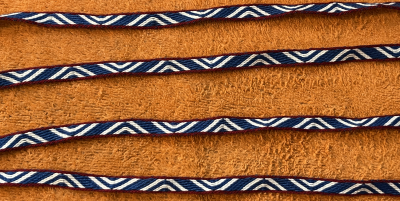
Fajum graveyard sleeve fragment tablet-woven trim

'Tis done.


I really like it!

After my last post, I thought about things for a while.  I looked at the photo in the book, and decided that I wanted the band to be symmetric.  So I eliminated the rows that required me to push down on the white.  It's now a 34-row pattern.  And symmetric.

The weaving went fairly smoothly, except when it didn't.  Did I mention that cats are terrible weaving assistants?  Also, if I stopped paying attention, I'd turn something forward when it needed to go backwards, or vice versa, or I'd lose my place and have to figure out where I was.

But it's done and it looks lovely.  There's one teeny little error that no one will notice.  The pattern repeats at the beginning of the band are only subtly different from the rest of the band, so that too won't be a problem.

The band ended up almost 1cm wide.  I had thought it might be 8-9mm but it's in the 9-10mm range, so it is pretty close in size to the original.  It's about 170cm long (66-67" long, 3/8" wide) before blocking.  I did 30 pattern repeats.

I hope the red is stable and nothing leaks onto the white when it gets blocked and washed.  I might get some of that dye-catcher stuff to try to ensure it.  I'll also iron this since it's a little twisty, not surprising given the design. 

I'll probably keep this in my repertoire.  I think it offers a lot of bang for the buck, a very striking design that isn't super-simple but is still straightforward and fairly quick to weave.


Sunday, October 20, 2024

The newest tablet-weaving project (Fajum graveyard fragment)

I've been busy with other things these past few weeks.  However, today I started a new band.  As often happens, it wasn't the band I had thought I was going to do next.  It is another one of the Coptic bands in Aisling's book Tablet Woven Bands from Egypt (by Silvia "Aisling" Ungerechts).  It's in the 3/1 Twill section on p.100-101.  The book says that this was a small tablet-woven band on the wrist of a sleeve fragment.  The origin was described as "from the graveyard of Fajum".  She estimates it to be 5th to 7th century and typically Coptic.  The band is currently in the archives of the Skulpturensammlung und Museum fur Byzantinische Kunst, Berlin, Inv. no. 11429.


The band has only 8 tablets, 2 of which are edge tablets.  The design is white zigzags on a blue background with red edges.  Although that sounds simple, 3/1 broken twill and tie-downs (or whatever the opposite of a float is called) are used to create crisp lines.

I recharted the pattern to make sure I understood it.  Aisling warns that she's not always perfect at noting thread orientation vs tablet orientation for her charts, but since she likes to chart top-down and I like to chart bottom-up it ended up being kind of moot.  She does have a row 37 in the chart that seems to be unnecessary.  Also, as charted, there ends up being a white blip on rows 1 and 36 which doesn't seem to be in the woven band that's in the photograph on page 100.  For those two rows, I push down the white thread before passing the shuttle through the shed.  I could have turned back and forward instead but that would have left a float, I believe, and the photo doesn't seem to show a float.

As suggested, I'm using white and blue for the zigzags and red for the edge, and a similar shade of blue for the weft.  I'm using a darker red since the brighter one was not as colorfast as it should have been when I last used it, yikes!  I've only done a few pattern repeats but I like it a lot so far.  It weaves up pretty quickly and seems very rhythmic.  So far it's fun rather than frustrating.

The original is wool and linen, but as usual, I'm doing cotton.  The original is about 1cm wide.  Mine is likely to be a bit thinner than that.

This band is somewhat similar to a band in Tablet Woven Treasures by Maikki Karisto and Mervi Pasanen.  It too is a narrow band with zigzags of different widths.  In their book, it's number 36. Kaukola, Kekomaki (KM 2489:5 H1), p. 176-177.  The graveyard in which this particular fragment was found is thought to have been used during the Crusader Era, 1100-1300.  So that's interesting.

Onward!


Monday, August 12, 2024

Cambridge Diamonds

This is a famous historic band from England.  It uses pack-idling, as does the also-from-England Felixstowe band.  There's some question about whether it's Saxon or Medieval, but I don't care.

Cambridge Diamonds has been on my to-do list for a while.  So finally I did it.  There must be something in the air, since I think I've seen mention of at least 3-4 other people either doing the same band or recently finishing it.  It's one of those patterns that most people eventually weave.

I chose blue, white, and green for my colors, and I think it's a good color combination for this pattern.


For whatever reason, this band gave me more trouble than it should have.  It would go along well for a while, then suddenly start giving me uneven color lines and missing bloops and color peek-throughs and what-not.  I believe that the threads were catching on tablet edges even though I tried very carefully to make sure that the shed was doing what it should be doing before I put the weft through there, and this both messed up the tension and caused various threads to end up in the wrong shed.  I had to unweave several times, once because a couple of tablets actually had caught badly enough for the two tablets to switch places.  I knew something was quite wrong but it took a little while to figure it out.  I was also using less weight than I often do for a pattern with this many threads, and maybe that too contributed to the threads catching on various tablet corners.

I hope some of the uneven spots settle down a bit with my usual wet blocking.

I used Shelagh Lewins' chart, both the one in the pdf in her website here: https://www.shelaghlewins.com/tablet_weaving/Cambridge_diamonds/Cambridge_diamonds.pdf and the twisted threads chart here: https://twistedthreads.org/pattern/nQZCXTQdxTaZZgbzd

The unblocked band is 63" long (162cm) and about 1/2" wide (1.25cm).

I'm not sure what I'll do next.  Do I need more practice in multi-pack patterns to improve my shed-clearing abilities?  Or do I want to do something different because this band was kind of annoying at times?  I don't want to swear off of pack-idling patterns because I think they're all kinds of cool, but I don't think my next project is gonna involve pack-idling.


Wednesday, December 6, 2023

3/1 Broken Twill tablet-woven band, two-pack method

 It worked!


It looks like I occasionally got a thread caught on a tablet corner so that it didn't end up getting tacked down by the weft.  In other words, there are a few spots where I have floats.  Like I often do when weaving with multiple packs.  Still.  Even though I try to watch out for it.

But I do have to say that using two packs for the basic 3/1 structure is faster than manipulating each card (or pair of cards) individually.

I had less thread-catching with the FFBB cards ahead of the FBBF cards.

The belt is a little poofier than I like.  Hmmm.  I guess I'll need to play around with warp tension and how tight I pull the weft.  On the whole, though, I am pleased.  This would make a good belt.  It's about 62" long, about 7/8" wide.  Maybe I'll get some hardware (a buckle or a couple of D rings, plus or minus plaques) and turn it into an actual belt.

The front side is green (with a one-card brown stripe along the edge) and S-twill, while the back side is brown (with a one-card green stripe along the edge) and Z twill.  Obviously this can be worn either side out.

Next time I am in the mood, I'll play around with tablet-flipping/twisting in order to change the twill direction and/or to change the colors.

My next band will be a two-hole band, yay!  It's Yet Another Version of the Staraja Ladoga zigzag pattern I've already woven twice.  This version uses the chart and pics from Aisling's website .  Her version has 3 pattern tablets instead of 4, making for 11 tablets total (4 edge cards per side).  I charted it up with the Twisted Threads charting software to see how to get those zigzags with spots.  It looks like 7F7B should do it.  We'll see.  That seems a bit unusual for two-hole weaving (which usually does things in sets of two-cards-and-two-turns) but we'll see how it goes.  If it doesn't work out like I'd like, I can change around the turning pattern.  Or I can unweave those few pattern repeats and add another card and make another one using the previous two-hole pattern.

The red/white/purple zigzag band I'm about to do will probably be the last one from these particular vintage cottons.  There's not much left of any of the colors, so they'll go into the leftovers I've been using as warp.  Maybe there's enough to use for another spot band if I use a different vintage cotton for the main color.  We'll see.

I'm also wanting to do more bands from the rug warp, to use as belts or straps.  The Museum of London bands (here and in the Crowfoot article) that I did in that sampler a while back would make good belts, as would various brick-style two-hole patterns.  Things that look good on both sides are my preference for straps and belts where both sides of the band might be visible.


Thursday, November 30, 2023

Noobish two-pack twill thoughts

 I'm mulling over Peter Collingwood's directions for weaving 3/1 twill using the two-pack method.  It's in his book The Techniques of Tablet Weaving, starting on about p.216.

For warping, he talks about position I and II as well as Pack A and Pack B.  Later he starts mentioning position III and IV, so apparently positions refer to which colors are in which hole positions.  Then we go on to tablet slant, turning directions, what to change to get various effects, and so on.  We're on our way!

In general, changes are done through tablet twisting rather than changing the turning direction.  I think the tablet-twisting or flipping is done around the vertical axis pretty much exclusively.

I don't know if any of the tablet-weaving programs out there account for tablet-twisting.  But I can do some playing around.  (My memory says that there is a program that does do tablet-twisting but I can't remember which one off the top of my head, sigh.)

And cool -- I found that by flipping every other tablet (when one is at the start of the 4-row turning sequence), one can automatically switch from S twill to Z twill or vice versa.  I suspect it can also be done before the 3rd turn, too.  It's kind of fun to play with the initial tablet orientation and see how it carries over into the weaving.  I could make Vs or Ws if I wanted to.  Or diamonds and Xs if I change in the middle of the weaving. 

Actually.....  Collingwoods says that when you're in the middle of the band, you change the direction of the pack that is in position II or IV.  In other words, twist the pack where the same color is along the AD or BC line, as opposed to the AB or CD line, so that you don't mess up the colors.

I looked at Claudia Wollny's twill charts to play around with changing colors on a horizontal line (zig-zag, of course).  So...  I can turn two more turns and then resume the twill turning sequence.  Or, I can use Collingwood's method of tablet-twisting one pack, doing a turn, then tablet-twisting the next pack.  He also mentions the same method Wollny uses -- turning the packs two more times (i.e. doing either row 1 or row 3 three times) to put all the cards in the opposite color orientation.

I wonder if I can do something like tablet-twist one pack around the vertical axis and the other around the horizontal axis to get it done in one move, or if that will look wrong in some way?  I guess that's something to test.

If I don't see a program that does tablet-twisting, I'll have to experiment with Collingwood's other methods as I weave.  I'm sure more of it will make sense when I do it.

My vague plan is to warp up something and keep it mostly monochrome on each side.  I might switch Z and S.  I might switch half of the cards so that the twill lines meet in the middle, as chevrons.  Or I can play with Collingwood's method of making diagonal color changes (i.e. in a diagonal line across the band, parallel to the direction of the twill) and make a two-toned band.  Or maybe these will all be different bands.

Collingwood's two-pack method looks like it'll be faster than the one-pack method.  It alternates two cards in S orientation with two cards in Z orientation (or vice-versa -- I don't think it matters).  One half of the cards (the odds) is threaded with the the first color in AB and the other color in CD.  The other half of the cards (the evens) is threaded with the first color in AD and the other color in BC.

Then one turns the odd cards in FFBB sequence, with the even cards turned in FBBF sequence.  This leads to a monochrome band with the first color on top and the second on the bottom.

If the first two cards are the same orientation (either // or \\) you get an S-twill, going diagonally up to the left.  If they are in a different orientation (so that the 2nd and 3rd are in the same orientation), you get a Z-twill, going diagonally up to the right.

After that, one flips/twists cards at various spots to get changes in direction and/or color, making motifs and what-not.  That's more advanced than I currently wish to play with, but no doubt I'll get curious enough about it to try doing that later.

I am not fond of tablet-twisting.  Hopefully the results will be worth it and/or will help me to like it better.  It'll be interesting to see under what conditions a two-pack method makes more sense and where a one-pack method will make more sense.

Dunno yet whether this will be a sampler or if it'll be a useful and reasonably aesthetically pleasing band.

I've ordered Claudia Wollny's new book on 3/1 twill.  I'm looking forward to seeing what's in it.  The patterned band I did used her charting and methods -- I wonder if she'll continue with that charting style and motif modularity, or if she'll change it up a bit?  I wonder if all of her methods can be done using the two-pack method or if some are best done with a one-pack method?

No doubt I'll roll my eyes at myself after I gain a bit more experience.  I fully acknowledge my noobiehood.


Tuesday, October 31, 2023

A Halloween Post

 It's been busy, but I did get a little bit of tablet-weaving in.  It was a reward I promised myself that I could do after the busy-ness subsided.


It was a fun band to weave.  It looks like little spirals, and it's reversible, too. I've seen it on pinterest (as a gtt chart) and elsewhere.  I used this Twisted Threads chart, obviously changing around the colors and edges.  I used 20 tablets, 14 pattern tablets and 3 edge tablets (always turning forward) on each side.  The pattern tablets alternate threading of AC dark and BD light with the opposite (AC light and BD dark).

I did speed-warping aka continuous warping for the pattern tablets and it went fairly smoothly.  The trick, as I had suspected, is to make sure the thread sources do not tangle, especially the part between the tablets and the source.  In other words, keep the bobbins or skeins or whatever in a fairly fixed spot so they can't roll around and otherwise be unruly.  I'd tried a few other things that also helped a bit (such as running the thread around the warping path and then dropping a tablet instead of running all the tablets around the warping board along with the thread, changing the orientation of the warping board and thread and me, etc.), but it was still somewhat aggravating to untangle everything.  So that was good to confirm, that I indeed understand the concept of how to do it and mostly need to streamline the process.  Transferring the warp from the warping set-up to my warp-weighted loom set-up without getting everything tangled again took a bit of time but on the whole wasn't too aggravating.  I'll continue to refine the details in hopes of making this quick and easy and hassle-free.

In spite of its apparently complexity, this pattern is dead simple.  Several tablets go 3F3B while others go 3B3F.  After the 3 turns (either the forward or the backward), the entire pack either goes all forward or all back.  If that makes sense.  It's twist-neutral except for the edge tablets, and of course even the edge tablets can be occasionally reversed to keep them neutral.  Anyway, this was a very straightforward thing to weave.

I don't much like my version, though.

I used 8/2 cotton rug warp (I think).  It has a matte rather than a shiny luster.  And, well, it's OK.  Just OK.  My craftsmanship also had issues -- floats on the backside where apparently I didn't catch certain threads in the correct sheds.  The spirals are sometimes elongated to varying degrees, though some of that has to do with how long the cotton was under tension (and stretched out) when I was weaving.  Sometimes the spirals look more like feathers than spirals.  I was beating pretty hard while not pulling the weft too tight but maybe I was inconsistent or something.

Maybe I'll like it better after blocking evens things out.

I'd make it again, simply because it was fun, but I'd use some other material.

I'm still dithering about the next band.  Two-pack 3/1 broken twill?  Something double-face?  A two-thread/two-hole band?  Or something else completely?   Hmmmm....

I have been knitting, spinning, and weaving baskets while I dither.  I'll be doing some leatherwork and dyeing this week, too.  Plus various other things.  But none of those are narrow wares, so they don't get recorded on this blog.


Wednesday, March 22, 2023

A monochromatic sampler band (plus a few comments and speculations)


I was poking around the internet, re-visiting some of my favorite tablet-weaving sites.  One of them is this old (but still wonderful) page from Thora (Carolyn Priest-Dorman): https://www.cs.vassar.edu/~capriest/3recipes.html.  These are 14th-15th century tablet-woven braids found in London that were described by Grace Crowfoot.  The middle one (Braid 450) I recognized as the one Mervi Pasanen (I think it was Mervi) was weaving in a Facebook post (with video!) in the Lautaunat/Tablet Weaving page on Facebook on December 30, 2018.  She even credits it as a "medieval silk belt, 14th century London," so I'm pretty sure she's using the same instructions.  It's here: https://www.facebook.com/Lautanauhat/videos/2241382072561960

Hmm.  The belt is described by Grace Crowfoot in this reference: Crowfoot, Elisabeth; Pritchard, Frances; and Staniland, Kay. Textiles and Clothing c. 1150-c. 1450. Medieval Finds from Excavations in London, 4. London: HMSO, 1992.   Which, thanks to the miracle that is the Internet, I was able to find.

Crowfoot describes the braid thus (I'm including the photo that is Fig 100B, too):


In the text near the braids photographed as Fig. 100, she describes the braid as a "lozenge pattern," that was "possibly monochrome."  The braid next to it, Fig 100A, is also described as a lozenge pattern "with at least two colors."  That braid, Braid 143, is later described as a "double-faced weave with lozenge pattern" in the paragraph above Braid 450's description.

Staniland 1975, 167 is in the bibliography as this:


Which, amazingly enough, I also found online.  Here is the entirety of references to tablet weaving on p. 167 in the "excavated textiles" section:


I have not yet figured out if there are further references, nor how the numbers (e.g. 594) compare to the number Grace Crowfoot uses.  I haven't yet found the braid online in some Museum of London database, though I might still go deep-diving for more info.

Anyway.

The double-face surface appearance of braid 450 can be achieved much more easily than Crowfoot specifies.  If one just sets the tablets with alternating S and Z orientations, it is regular double-face -- FFBB.

Also, it looks similar to some of the two-hole brick-patterned bands I've been making.

So, I have questions.  Is this genuinely a four-hole pattern?  I suppose one can count the fringe ends and be fairly certain of it --16 vs 32 ends.   And, how did Crowfoot decide that it was made by alternating FFBB tablets with BBFF tablets instead of being straight double-face?  Elsewhere in the same section of the reference, as I quoted above, she actually calls out some double-face tablets, so she knows what double-face is, for sure.

I charted up both possibilities.   For Crowfoot's band, the FFBB threads are twisting around the weft in an ABCD order, while the BBFF ones are twisting in a DCBA order.  In a monochrome band where all the threads are the same, it makes no difference.  For a colorful band (or one with threads that have different textures), you can get the exact same order of threads by how you thread the tablets.  It would be rather a pain, but it's not hard.  Maybe doing it this way leads to subtle differences in the band's appearance?  Or is a way of balancing out irregularities in the threads while keeping the warping simple?

Obviously some real-world experimentation was called for.

I haven't really played around with double-face yet, so this was a good opportunity to do so.  Also, while I was being all monochromatic, I might as well see what the other two bands on Carolyn Priest-Dorman's page are like.  One of them (braid 449) has the same structure of the El Cigarralejo band I recently did, and I thought it would be fun to see what it looked like in a flat-colored smooth yarn instead of the heathery and slightly fuzzy wool.  The other one (braid 423) uses two staggered packs that alternate being turned and being idled.  Well, that's a new trick to play with, so sure, why not?  After that, I'd see what I felt like doing.

As far as I can tell, there is little or no difference in the appearance of these two methods of making a band with a double-face surface.  Setting the tablets in alternating SZ and doing FFBB looks identical or nearly identical to setting them all as Z (or S) and turning the odd tablets as FFBB and the evens as BBFF.  Any slight difference could be due to the hassle of either dealing with multiple packs of tablets, or, as I did in another experiment, manipulating each tablet individually, as opposed to turning everything as a single pack.  I really do not see a "diagonal twill effect" that is any different in any version I tried.

So that's interesting.  Why did Crowfoot determine that the band was made with this very laborious method vs the much easier method of turning the entire pack of cards the exact same way?  I will see if I can find out any more info online, and then maybe ask some of the more experienced tablet-weavers out there.

One more question -- Was the band all warped up at the same time, with all the tablets in the same orientation, and then half the tablets were flipped (and then rotated as necessary) to give alternating orientation before weaving?  It's not quite the same if the four threads are different colors, I don't think, but it is for two colors.  Maybe it is for four colors as well, but I'm not wrapping my brain around it properly and I'm not going to warp it up right now to double-check.  I will keep this possibility in mind as I look online, too.

While I was playing around with these two forms of creating a double-face type of appearance, I also experimenting with the effect of weft tension and a bit with warp tension.  As I expected, a looser tension enabled me to keep the weft threads closer together.  That made things a little closer to square, though consequently the weft bleps were a little more obvious.  So...  for future projects when I want to do double-face, I can control some of the technique's characteristic motif elongation to some extent, though I'll also want to consider how contrast-y the weft color is.

So that's braid 450, plus some exploration of double-face with alternating SZ tablets.  I forgot to do some regular FFBB double-face when I had the cards all in the same orientation, oops, but that's a fairly minor thing.

Then it was playtime.  Braid 423, with two packs, half of which idle per turn, was kind of fun.  It's a bit slow and fiddly, but not at all difficult.  So now I can confidently tackle the Cambridge Diamonds pattern if I ever want to do so, which I might very well because it's kind of cute.  Again, the appearance of this band is not dissimilar to the appearance of some of the two-hole brick patterns described by Karisto and Pasanen.  I did not mess around with weft tension, which could prove interesting.

While I was perusing Collingwood Chapter 10, on the subject of some tablets idling or getting extra turns, I tried out some of the ideas he presented about idling tablets.  That was OK.  I would have needed to do larger areas to bring out the textural differences and/or use a thread that was shinier and more tightly twisted to make the contrast more obvious.  It can also be a bit fiddly to do.  It's a fairly intriguing idea, though.  I do want to explore it again someday -- chapter 10 is full of crazy-complex stuff.

I later did a few sections where I'd change the directions of different tablets to make shapes that were defined by S or Z tablets.  That works, for sure.  A lot of people (such as Claudia Wollny) seem to use the term "structure weave" for this latter technique, which is mostly a diagonals-type technique in one color.

I also wove a bit of Braid 449 (monochromatic rather than two colors) just to complete the trifecta of braids on Priest-Dorman's website.  Yup, I like making this braid, and perhaps I should make it in two colors someday.

I had some space left, so it was time to do a bit of 3/1 twill since I haven't done that before, either.  To my delight, it's very straightforward whether the twill lines climb to the left or the right.  It, umm, works better if all the tablets are oriented the same rather than alternating SZ, at least for the charts and explanations I was using.  But to learn that was also educational.

I can't remember if I did much else.  The band itself is not particularly attractive, but that wasn't its purpose.  I learned a lot from doing it.  I now feel confident about doing double-face or 3/1 twill patterns whenever I want to, knowing that the underlying structure is something I have already done.  I'm ready to do the Cambridge diamonds pattern whenever I want, and also to play around with other ideas involving idling tablets.  And I have some questions about Braid 450 and thus some research to do.  Even so, I know I can make something that looks like that band whenever I want, whether or not my method is the one Crowfoot claims it is.

A couple of other cool things for the future:  There are several other cords in the Crowfoot article, with tubular tablet weaving, finger-looping, and plaiting.  Fun times!  She also describes tabby-woven narrow wares, an interesting decorative trim for garters, and of course other tablet-weaving techniques for the narrow wares (such as brocade).

The article from the Staniland reference shows some knots a few pages earlier!  They're all in leather, from the section on Medieval Leather by Jennifer Jones.

I'm not sure what I will be doing next.  More two-hole?  More samplers?  Something besides tablet-weaving?  We'll see...  The tablet-weaving area has been disassembled for the next week or so, requiring some improvisation if I want to do tablet-weaving.