Monday, July 1, 2024

Tubular Tablet Woven Cord

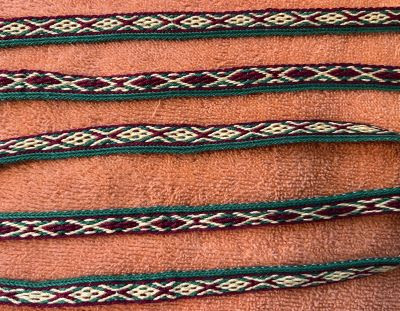
I saw one of those tablet-woven tubular cords on someone's website and suddenly decided I need to make one.  Today.  Right now.


So I did.

This pattern is seen on a purse strap of a 14th century German purse in the V&A Museum.  Apparently the chart/description is from an article in the Spring 2008 issue of TWIST, but I found it on an archive.org copy of a silkewerk.com page.

This one is 9 cards, all 4-threaded, all with the same orientation.  There are 3 cards each with red, yellow, and white.  (I picked the same colors as the original seems to be, more or less.)  The original is silk, while mine is the usual cotton.  I used #10 cotton for both warp and weft.

This is a cool pattern because you can get it to bias and thus make spirals.  When the cards are oriented \ (Z-threaded) and turned forward and the shuttle thread goes from right to left, it spirals to the right.  When the cards are oriented / (S-threaded) and the shuttle thread goes from left to right, it spirals to the left.  I assume that mixed directions don't spiral, or don't spiral as well.  One can also flip cards or turn them backwards to change the direction that the warp is twining -- warp twining direction and spiral-weft-thread direction go the same way, if I understand it correctly.

The basic concept is like I-cord in knitting -- the weft always goes in the same direction, and one tightens it to bring the edges together.  This makes a tube instead of a flat band.

The original zigzagged at random intervals, so that's what I did, too.

The cord is roughly 1/4" in diameter and roughly 63" long.

When weaving, the band is all stretched out and straight, though it wants to rotate.  As soon as the tension is off, the threads relax into spirals.  It's fun to watch.

I found that the weft tension was looser one way than the other.  I'm not sure why.  Maybe the thread ply direction also affects things?  Or it's because I turned cards backwards rather than flipping them?  The loose bits go away pretty easily if I wiggle the cord.  I was silly and used a white weft thread to connect the red and yellow.  I should have had white on one side instead of both being colorful, to minimize the little white weft blips.

This is really cute.  I will play around with colors and different numbers of tablets when I make more.

There's also an article in ATN 21 that shows a tubular cord, monochrome, on 16 tablets, but with half-turns between the weft spirals instead of quarter-turns.  I might try that someday to see what it looks like.  Assuming that it's a correct description -- sometimes the explanations evolve.

The photo of the purse is not particularly high resolution, but those sure look like fingerlooped braids coming off of the tassel.  They might even be the ends of the purse strap; I can't quite discern what's going on.  The drawstring looks like it could be a twisted cord.  I'm not sure if the braid on the sides is embroidery or a braid that's sewn on.

The museum's description is of course quite perfunctory where narrow wares are concerned.  Oh, well!

This is my first tablet-woven tubular cord.  It won't be the last.  I can now officially add this technique to my mental repertoire of cord-making methods.

Sunday, June 30, 2024

Snartemo II band

It is finished!  Well, except for the blocking.


I like it.  It was quick to weave and it's a charmingly effective pattern.  My band is roughly 12mm (a bit less than 1/2") wide and a bit more the 150cm (roughly 60") long.  There wasn't quite enough room to fit in one more 52-row pattern repeat so I stopped where I was.

I'm not sure what I'll do with it, but it might end up being a gift.

I don't know if I'll bother with the tubular edging if/when I do it again.  It is cute, though.  And it's not like it really took much extra time to do.  This band was fun enough that I'd be willing to make it again.

I'm not sure what's next.  Several bands are whispering to me.

Saturday, June 29, 2024

Snartemo II and a 7-strand fingerloop braid sampler

Here's a little one-color 7-strand braid I was playing around with.  I tried different things along the length (with a few repeats).  Although the photo is pretty crappy, I will list the variations I tried.  Most were unorthodox braids.  I was working V-fell, where the pinky finger is the operator finger and the index finger of the other hand holds the traveling loop.  I mostly picked up the traveling loop from above, which reversed the loop (and not from below, which reverses it with the opposite twist).


I did the square/round braid when I wanted to separate braids that I thought would be too similar.  I also did a bit of the braid where you don't go through any loops at all, kind of a pigtail braid.  Then there were the unorthodox skip-a-loop-or-two braids.  Skip the loop next to the index finger.  Only go through the loop next to the index finger.  Go through the two loops next to the index finger.  Go through the pinky and middle finger but skip the ring finger.  Etc.

It was interesting seeing the slight differences.  In general, the more loops one goes through, the wider/looser/flatter the braid.  Sometimes there's a small groove down the center of the braid, while other times the middle stands high.  The depth of the groove on the backside was sometimes a bit deeper/shallower, too.

None are bad braids.  The two Crickmore variations (triangular and D-shaped) are distinctive from each other and from the other ones I tried.  Ditto for the Guajiro braids, though i don't think I did the version where you skip the pinky and middle finger but go through the ring finger loop.


I also warped up a new tablet-woven band.  This is Snartemo II, though of course I'm working in cotton (the usual #10 crochet thread for the warp and finer crochet thread for the weft) rather than wool, as the original probably was.  I also decided to weave it in blue and white rather than red and yellow.

I'm using the chart/description from Maikki Karisto and Mervi Pasanen, because of course I am.  Their version has 17 tablets.  The center 12 tablets are the pattern tablets, and they are 2-threaded.  There are 3 edge tablets on the left and 2 on the right, all 4-threaded.  The 3 tablets of the left edge are woven with a tubular selvedge.  The pattern is pretty simple -- 26F/26B, not counting the edges which are always turned forward.

Here is a description of how they determined that this was the probable technique used for the band.  They worked through some other possibilities and showed that the other ones probably weren't the techniques used and that this version, in their opinion, most closely matched the archaeological specimen.

Anyway, it's fun, easy, fast, etc.  I'm enjoying it so far.  The pic is of one of the first repeats.

Tuesday, June 25, 2024

Hallstatt 3/HallTex 152 tablet-woven band (2-thread technique)

It is finished!  Well, not blocked yet.  But it's off the tablets.  It ended up being roughly 1cm wide, roughly 160cm long.  Each 3-diamond repeat is roughly 6cm long.


I used the chart from Maikki Karisto and Mervi Pasanen, from the Swan River Crafts blog.  They wrote that the original was made from wool (mine is from #10 crochet cotton) and was 1.4 cm wide.

I like it a lot.  Well, 2-hole, of course I like it!  It was fun to weave.  The backside looks nice, too.  Interestingly, it has a slight spiral twist, probably because the edge tablets are asymmetric (3 on one side, 1 on the other).  Hopefully it'll block out, and ditto for any other irregularities.

I have no idea what I'll do with this band.  Maybe it'll be a gift.   I like the color combo and will use that in future bands.

It is interesting to me that I keep getting pattern/motif elongation.  The weft is packed pretty tightly (it's quite wedged in when I have to unweave).  It's not pulled too tightly across the band, I don't think (if I loosen it up much more, the edge tablets start look strange and I still can't beat it much harder).  I don't think I have the tension too tight, and I don't want it to be much looser because then it's hard to beat and the threads start getting wonky and inconsistent  (too tight is also hard to beat and of course stretches the weft out more).  The weft thread is a lot finer than the warp thread so that's not the issue.  Maybe it's something about cotton.  Or about a warp-weighted loom.  Or just some variable I haven't recognized yet, or some technique I need to improve/modify.  Hmmm.

Dunno what I'll do next.  Maybe I'll warp up another quick tablet-weaving project and also crank out a few fingerloop braids.  Or cast on for a sweater or afghan or something.  Or spin up a few things so I can justify going to a fiber festival and buying something.  Or all of the above.


Saturday, June 22, 2024

A mid-summer band (Halllstatt 3/HallTex 152)

I finally stopped dithering and warped up a new tablet-weaving project.  The winner is Hallstatt 3 aka HallTex 152, the 2-hole version charted by Maikki Karisto and woven by Mervi Pasanen here (and no doubt in a few other places but this is the chart I'm using right now): https://swanrivercrafts.com/2016/09/30/new-research-on-hallstatt-3-tablet-woven-band-halltex152/

I had initially thought about using different colors, but decided that I liked the ones that are usually shown.  So I'm using #10 big-box-store crochet cotton, in yellow, green, and dark red.  The weft is, as usual, leftover doily-knitting cotton thread, probably #20 or #30, in a medium-light green (it was already on the shuttle from the last project).

I've done a few repeats and really like how it looks.  I'm fiddling around with weft tension as I often do near the beginning of a band, trying to see how loose/tight I want things.  I don't want the diamonds to be too elongated if I can help it.

I always forget how happy it makes me to see a nice tablet-weaving pattern grow under my hands, knowing that I did that.

I still want to play around with bi-color loops and patterns for 7-strand braids, both orthodox and different kinds of unorthodox.  I also think it's time to learn the Spanish braid.  The instructions make sense when I look at the description and/or watch the video, but I was having trouble making it work since I didn't have a good working angle with where I had attached my loops.  Oh, well.  Deep breath -- many of the braids I've been doing this year have been a bit mystifying when I first tried them.  I'm patient and will try again, and I'm quite sure I'll get the hang of it soon enough.  Plus my "mistakes" will also make useful braids so I should try to record what I did in case I want to do it again.

I'm also in the mood to do some inkle bands.  And lots more tablet-weaving.  And knitting/spinning/etc.

So, this band is kind of interesting in its asymmetry.  It features yellow checkerboard diamond motifs on a green/red (or green/brown, I'm not sure) background.

The checkerboards are all alike.  Even those are a bit weird for two-hole.  Typically, from what I've seen in later patterns, two-hole patterns tend to work in blocks of two tablets and two turns.  This one also has some blocks of three tablets (though still two turns).

The edge cards are asymmetric -- one card on one side, and three cards on the other.  This is not atypical since it's meant to be sewn to the edge of clothing or something.  There are no tubular edges, but this isn't too surprising since the Hallstatt bands are significantly older than the Finnish Iron Age bands that often include tubular edges, and they are also from a different culture.

The distance between the checkerboards varies.  Sometimes there are 4 F/4B turns between them, sometimes 5F/5B turns.  It has 2 checkerboards with 4/4 between them and then 1 checkerboard with 5/5.  This number -- 13 -- is the same as the number of red and green threads.  Dunno if that's meaningful or just a coincidence.  Dunno if the different gaps between the checkerboards is deliberate or not.

The sections of red and green background colors that the checkerboards are on is asymmetric -- there are 2 greens and 3 reds on one half, 2 reds and 3 greens on the other.   This one I do kind of understand, since this means that one uses the same number of threads of each background color (13 of each, as mentioned above).

I'm doing it as charted.  It looks lovely.  (I'm not going to write about other candidates on my to-do list since there are so many...)

I'm getting low on some of the colors of this crochet cotton.  Once I'm almost out, I'll switch to the next batch of thread I have and will use the rest for simple bands, inkle bands, braids, weft, and/or crocheted snowflakes.  But really, the thread is OK even though it's not uber-high quality.  Most of my bands end up pretty similar in width to the archaeologic examples.  The thread is reasonably consistent and not too full of knots or anything.  I do want to use wool, silk, and linen eventually.  I have some, but not in any kind of color range.  Though I'm fine with monochrome bands, of course!

Cats are not particularly good weaving assistants, but it all worked out, at least so far.

No photos, but I'm sure there will be some soon enough.  This is going pretty quickly and smoothly so far, as long as I pay attention and don't get distracted.

Sunday, June 16, 2024

D-shaped 7-loop fingerloop braid (2 ways)

It's been a while since I've posted!  I've been busy.  I've been doing some fingerloop braiding and other narrow wares, but nothing all that exotic, so I haven't posted.  I've also taught more people how to do various types of fingerloop braiding.

Today I decided to watch Ingrid Crickmore's video to see the braid she calls a D-shaped 7-loop braid (https://loopbraider.com/2015/04/21/uo-dshaped-7tut/)  I can't remember if I've done this braid already, but if not, then I definitely played with it today!

If I haven't done the braid before, it's because she doesn't give instructions on her website for how to do it.  One has to watch the video here: https://www.youtube.com/watch?v=vOFL5qigiU0&ab_channel=IngridCrickmore.  I mean, it's a fine video, but a few sentences or a diagram would have been MUCH faster.

But now the video has been watched, and the braid has been braided.  It's very cute.  Of course.  And it will be entirely easy to play around with all kinds of color/texture variations.


I've tried to fold the braid in the pic so one can see both sides of the braid, and also see where I switched back and forth between unreversed and reversed loops.  Those are the "2 ways" referred to in the blog post title and also in the video.  I used acrylic worsted weight yarn, though the white yarn is a little thinner than the blue and the green.

Ingrid Crickmore on her video said that reversing was best done by coming over the top of the braid rather than the bottom -- she seemed to think that the first twist direction made a more pleasing braid.  That is interesting since twist direction was one of the things I thought might be a variable for fingerloop braiding variations.  Yup.  It might be a very minor variable, but I guess it can make at least a subtle difference.

This is an unorthodox braid, meaning that the operator finger doesn't go through all the loops before picking up the traveling loop.  With the V-fell method that Crickmore uses, the pinky finger goes through the pinky and ring finger loops of the other hand, then over the middle finger loop, before picking up the index finger loop.  Loops can be picked up either unreversed or reversed without changing the overall appearance of the braid all that much (not counting colors, of course).

I used bi-color loops, obviously, in the same arrangement that the video uses.  There are a lot of fun color variations on the website.  I'm looking forward to playing with them.  I'll also play around with other 7-loop unorthodox braids, of course.  I've already done some -- there are a lot of different things to play around with.

One of the things I've been teaching lately is a 5-loop unorthodox braid, the braid that so many people worldwide seem to do.  I was looking at instructions for a brode lace of v bowes (https://fingerloop.org/patterns.html#n01) and realized that it was a different unorthodox braid that I had initially assumed.  For the brode lace of v bowes, which in the Medieval manuscripts is done with the A-fell technique, one skips the loop next to the traveling loop.  But it's also easy to skip the loop next to the operator finger and go through the loop next to the traveling loop instead.  Both look perfectly respectable, though I think I might slightly prefer the appearance of the first one (where you skip the loop next to the traveling loop).

Just as an aside, for the unorthodox braids where you skip the loop closest to the operator finger and go through the loop closest to the traveling loop, Ingrid Crickmore refers to them as triangle braids.  The braids she refers to as D-shaped braids skip the loop closest to the traveling loop.  Or so I currently understand.  I think.

I'll have to take pics of my little 5-loop samplers and add them to the blog, either revising this post or making a new one.  I did give most of them away, though.  Maybe I'll make a new one.  I usually do several braids to show people -- pigtail (i.e. don't go through any loops), brode lace of v bowes, divided, square/round, flat, the unorthodox braid where I go through the loop next to the traveling loop instead of next to the operator finger, and so on.  People like the divided braid to use as a hanging loop or buttonhole, etc.

---------------

Aisling's tablet weaving book finally arrived.  Yay!  Tablet -Woven Bands from Egypt of the early Byzantine era (395-641) and later, by Silvia "Aisling" Ungerechts.  This is the color version, purchased from a European vendor.  The USA version was in black and white (which I don't think was known before the publisher delivered copies to USA vendors) and the charts had zero contrast and thus were unusable.  The color one is fine.  I've done a few of these bands already (ones that are on her website or were in her TWIST articles about a few of these bands).  I'm looking forward to exploring more!


Tuesday, March 26, 2024

Another simple tablet-woven band (Double X Double O) and Bonus Fingerlooping (3-loop experiment)

I saw a photo of a band and wanted to re-create it.  Attempt #1 is not quite right, but it's still reasonably attractive.  I knew it wasn't quite right but forgot that I wanted to adjust my chart.  I had already warped it up when I remembered, which seems very silly when I say that but that's more or less how it happened.


This is a very simple pattern.  I call it Double X Double O.  Maybe I'll do some variations on this in the future.   I do like having the two-tone background color.

I've charted up attempt #2 and will probably try again.  Not that I need to re-create what I saw, but it's an interesting exercise.

I'm still having issues with different motifs being different lengths.  As far as I can tell, the width is the same and I'm beating the weft the same.  But apparently not.  Or the cotton is more stretched out in some areas than others.  Or it's something about where the weight is, how close my weaving is to the cards, how twisted the edge cards are, how long the band sat under tension before weaving (though I tried to let it sit for a while each time).  Or maybe it'll go away after blocking.

I kept the weight fairly low compared to what I usually do for this many cards, and I kept the weft fairly loose in order to widen the band (to reduce the apparent elongation of the motifs).  The unblocked length is about 63" and the unblocked width is about 7/8" wide.  It's destined for a gift.

---------------

Next up is a fingerloop braid.  I decided it was time to try a new-to-me way to make longer braids.  I've done the crochet-chain method before (I think I came up with it on the fly), but wanted to try other methods from Ingrid Crickmore's website.

I am doing 3 loops, all different colors, fairly short.  I'm doing a flat braid (twist the left-hand loop, don't twist the right-hand loop) using the V-fell method.  I did the method of making a slip knot, braiding one end, then undoing the slip knot and braiding the other end.

In terms of tension, it's pretty consistent.  I can see the join, though, because I know where to look and because there is a slight color pattern disruption.  The pattern is symmetric around the joining point.

But I don't have a flat braid.  Huh?  It looks like an unorthodox braid, even, with one side slightly domed with a V-type pattern and another side with a more interwoven look.  It is almost but not quite triangular in cross-section.  It has a gentle spiral along the length of the braid which is actually rather attractive.  If it's unorthodox, that would also explain why the braid isn't flat.  Is it even possible to make an unorthodox 3-loop braid?

So what did I do?  My guess is that I wasn't paying attention and came up with yet another variation on a 3-loop braid.  I thought I was using my middle finger on one hand, going through the middle-finger loop on the other hand, and picking up the index finger loop from that other hand.  But what was I really doing?  And what should I have been doing?

I should set this up again and actually watch what my hands are doing.

And I need to play around more with doing braids this way so that the center join is less obvious, and also to see what exactly happens to flat braids at the center (i.e., does it open up from the other side of the braid, in which case I'll reverse the crossed loop vs non-crossed hands?).  Until then, though, I think I feel comfortable doing single-color square braids.

As always, attempt #1 just goes to show what a noob I am.  I like the results but am rather mystified as to how I got there, and it wasn't quite what I was trying to do.  On to attempt #2!  (Check out the further exposition from Ingrid Crickmore, here.  Apparently she has worked through these issues already.  Except for the part where she was making a mystery braid, though she probably did that, too, at various points in her self-education.

---------------------

My list of things I want to do is SOOOO long.  Dunno what I'll get to next.